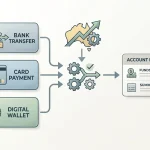
PayID identifies a bank account for a transfer; the NPP carries funds between participating banks, while casino terms set conditions for deposits and withdrawals.

PayID is a way to identify the destination of a bank payment without entering a conventional account number and BSB. You use a unique identifier, such as a mobile phone number or email address, that is registered with a bank account. The identifier points the payment towards that account; it is not a separate balance or a casino wallet.
In Australia, PayID transfers run through the New Payments Platform (NPP), the infrastructure that enables quick transfers between banks. In practical terms, PayID supplies the payment address and the NPP carries the transfer between participating banks. The money moves from one bank account to another rather than being stored in PayID itself.
That distinction matters when you see PayID described as a payment option for online pokies. It is a bank-transfer method, not a payment card, cash service or independent account. A payment interface may ask you to select PayID and provide or confirm an identifier, but the actual transfer still depends on the bank accounts involved and the NPP transfer process.
If you’re looking for online pokies in Australia with PayID in mind, check each casino’s current cashier options before depositing: the details here do not confirm PayID availability. Use the notes below to see what is known about each operator.
Lucky Dreams
You can note its A$20 minimum deposit via POLi. The available details do not confirm PayID support.
DragonSlots Casino
You can identify DragonSlots Casino by its Curacao Gaming Authority licensing and operation by Jumpman Gaming Ltd.
Wild Tokyo
You have a stated minimum deposit of A$10, with crypto payouts listed at 30–60 minutes and fiat payouts at 1–5 days.
MrPacho
You can expect the listed minimum deposit to be A$30. Its stated payout times are 30–120 minutes for crypto and 24–72 hours for fiat.
LevelUp Casino
You can identify LevelUp Casino by its Curacao eGaming licence, OGL/2023/174/0082, held by Dama N.V., and its A$15 minimum deposit.
Playfina Casino
You can note its Curacao eGaming licence through Hollycorn N.V., held since 2017. The stated A$20–30 minimum deposit depends on the offer.
Roby Casino
You can identify Roby Casino by its Curacao eGaming licence, held by Roby Games Ltd.
GoldenCrown
You can identify GoldenCrown by its Curacao Gaming Control Board licence, OGL/2023/176/0095, held by Hollycorn N.V.
7Bit Casino
You can note that 7Bit Casino is licensed in Curacao and operated by Dama N.V.
Kingmaker
You have a stated minimum deposit of A$30. Listed payout times are about 90 minutes for crypto and 1–5 days for fiat.
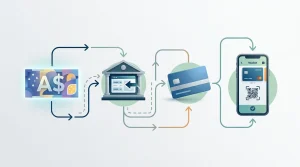
A useful way to picture the route is:
The steps shown to you can differ between banking apps and payment interfaces. The underlying function is the same: PayID identifies where the transfer should go, while the NPP provides the interbank payment route. A phone number or email address is therefore not, by itself, proof that money has been sent. The transfer must still be initiated through the relevant payment process.
PayID is designed for fast transactions, and transfers between banks through the NPP can happen quickly. That describes the payment rail, not every step a casino may place before or after it. A casino’s own system may have separate procedures for handling a payment. Those procedures do not change what PayID is: a bank-linked identifier used to address a transfer.
The distinction also explains why PayID should not be confused with a casino’s account system. A casino account records activity on the operator’s platform; your bank account holds the funds used in a bank transfer. PayID connects the payment instruction to a bank account, but does not establish what the recipient does with funds after receiving them. Nor does the presence of a PayID option demonstrate that a service is lawful, fair or willing to pay out.
For people physically located in Australia, that legal distinction is essential. The Interactive Gambling Act 2001 prohibits operators from providing real-money online casino services, including pokies, to customers in Australia. A payment method does not alter that rule or make a prohibited service permissible. This explanation describes how the payment system functions; it is not an offer to use an online casino.
When reading about PayID pokies, separate three things that are often blurred together: the identifier used to address a bank payment, the NPP that carries transfers between banks, and the recipient’s own service and procedures. Only the first two describe PayID’s role in moving money. The casino does not become part of the NPP merely because it accepts a bank transfer, and PayID does not decide whether the recipient should be trusted.
A PayID deposit is a bank transfer initiated with a registered identifier rather than by entering a conventional account number and BSB. For a payment to an online gambling service, the practical sequence is that you authorise the transfer through your bank, the bank processes it, and the receiving service credits the amount to an account there. The bank transfer and the casino’s account balance are separate stages: money can leave your bank before the receiving account displays a matching credit.
Attention: A confirmed PayID transaction cannot be reversed. Once you authorise the payment, it should not be treated like a card purchase that can be cancelled through your bank.
PayID deposits at online casinos are typically completed within seconds. That describes the transfer, not every part of the account process. A quick bank confirmation does not, by itself, explain how the receiving service records the payment or whether its displayed balance has updated. Keep the transaction confirmation and note the amount and recipient shown by your bank. If the bank shows a completed transfer but the other account does not reflect it, the confirmation gives you information to use when seeking an explanation; it does not undo the payment.
The important property is that a confirmed PayID transaction cannot be reversed. Once you authorise the payment and it is confirmed, you should not treat it like a card purchase that can simply be cancelled through your bank. A later change of mind does not reverse the transfer. A mistaken recipient or amount can therefore have consequences even if you notice the error quickly. Before confirming any transfer, read the recipient and amount displayed by your bank and make sure they match what you intended to send.
This final confirmation matters because the payment instruction is not merely a request to reserve funds. It authorises money to move from your bank account. If you have not yet confirmed the transaction, you can stop and reconsider. After confirmation, the transfer is treated as complete and the irreversible-payment condition applies. Do not assume that contacting a recipient will guarantee that money can be returned; PayID’s confirmed-transfer property does not provide that guarantee.
The amount accepted for a deposit is a separate condition from how fast PayID transfers it. Most operators accept deposits starting from AU$10 to AU$20, but the amount available at a particular service depends on its own terms. A bank transfer can therefore be technically successful while failing to meet a receiving service’s stated deposit condition. The key distinction is between the amount sent and the amount that the receiving account will recognise under its rules. A fast transfer does not make those conditions interchangeable.
A further distinction is between payment mechanics and the legality of the service receiving the money. Under Australia’s Interactive Gambling Act 2001, it is illegal for operators to provide real-money online casino games, including pokies, to people physically located in Australia. PayID is a bank payment method; its availability does not make an otherwise prohibited gambling service lawful. Searching for online pokies with PayID for real money does not change the legal status of the service or the nature of a confirmed transfer.
This also means that a phrase such as “instant PayID pokies” can be misleading if it suggests that every part of a deposit is instant or that payment access is a safeguard. The bank transfer may complete within seconds, but that timing says only something about movement of the payment. It does not establish that the receiving account has credited it, that the service is permitted to operate in Australia, or that funds can be recovered if a problem occurs.
Treat the bank’s confirmation as evidence of the transfer instruction being completed, not as proof of what happens next inside a recipient’s system. If the details shown before confirmation are not the details you intended, do not proceed. If the transaction has already been confirmed, remember that PayID does not offer a simple reversal. The practical consequence is straightforward: the moment before authorisation is the point at which you can still prevent an unintended transfer.
Legal Status
Under Australia’s Interactive Gambling Act 2001, it is illegal for operators to provide real-money online casino games, including pokies, to people physically located in Australia.
A PayID option answers a narrow question: whether a payment route is displayed or available for a particular transaction. It does not establish that an operator may lawfully provide real-money casino services to people in Australia, that its games are fair, or that it will release a balance when requested. Treat those as separate issues; evidence for one does not prove the others.
That distinction matters in Australia because the Interactive Gambling Act 2001 prohibits operators from providing real-money online casino services, including casino-style games, to people physically located in the country. An overseas licence does not make such a service lawful to provide to Australian customers. PayID availability should therefore not be read as a sign that a service is approved for Australian use or that it is suitable to use.
A payment method is infrastructure, not a regulatory endorsement. If a cashier displays PayID, that indicates only that the operator presents it as a way to move funds. It does not show that a regulator has assessed the operator or authorised its casino services for Australians.
Be precise about what any licence claim means. A foreign licence, where one is claimed, is not the same as permission to provide prohibited services in Australia. Nor does a payment option establish that a licence is genuine, current or relevant to the service being offered. The presence of a familiar Australian payment method cannot fill those gaps.
This is why a list of PayID options is not, by itself, a list of suitable or lawful services. Ranking providers by whether they display PayID would confuse a technical capability with a legal and consumer-protection assessment. It could also give a misleading impression that a provider has been checked simply because its payment method is recognisable.
PayID does not tell you how a game’s outcomes are generated or whether its stated rules are applied accurately. The payment method is separate from the software and controls that determine game results. Seeing PayID in a cashier therefore provides no evidence about fairness, game integrity or the accuracy of any return information.
Those questions require evidence about the games and the operator’s oversight, not assumptions based on how deposits are made. Even such evidence would not change the legal position on providing real-money online casino services to people in Australia. Keep the two questions distinct: a claim about game quality is not proof of lawful availability.
The ability to send money into a service does not prove that a withdrawal will be approved or completed. A displayed payment route cannot establish how an operator handles account checks, disputes or payout requests. It is not a guarantee that funds will be returned, and it should not be treated as evidence of an operator’s willingness to pay.
The same caution applies to fee claims. PayID itself does not impose a transfer fee, and reputable venues do not add a separate charge for PayID deposits or withdrawals. But that fact does not verify a particular operator’s reputation or establish what its other terms say. A claim of “no PayID fee” is only a statement about one possible charge; it says nothing about legality, game fairness or payout reliability.
When assessing any claim, identify its subject and limits. A cashier entry can indicate a stated payment option. A published term can describe a stated condition. Neither alone verifies licensing, fairness or actual payout conduct. Avoid combining these into a broad conclusion such as “PayID accepted, therefore safe” or “PayID accepted, therefore legitimate”: neither follows from the payment information.
For people in Australia, the central distinction is not which PayID pokies appear easiest to fund. Real-money online casino services are prohibited from being provided to customers located here, and a payment method does not alter that rule. Accordingly, PayID access should not be used to select, endorse or promote a casino service. It is a limited payment detail, not proof of permission or protection.
PayID uses a bank account as the source of funds, so a transfer depends on more than the payment method shown on a payment screen. The bank has a role in deciding whether it will process a particular payment. A transfer can therefore be affected by the bank’s policies even when PayID itself is functioning and the account has been entered correctly.
A specialist review has reported that some Australian banks, including members of the Big Four, occasionally block PayID transfers to gambling merchants they recognise. This describes a possible bank response, not a rule that applies to every bank, account or payment. Whether a transfer is affected can depend on the bank’s policy and how it treats the recipient. The mere fact that a payment is initiated through PayID does not override those controls.
It helps to separate the payment method from the bank’s decision. PayID provides a way to address a transfer using an identifier associated with a bank account. The New Payments Platform carries the transfer between participating banks, but the presence of that payment infrastructure does not require a bank to approve every transaction. A bank may prevent a transfer from proceeding under its own acceptable use policy, including where it identifies the recipient as a gambling merchant.
That distinction explains why a payment route can appear available in general but fail for a particular recipient. The bank may apply a restriction at the point it assesses the payment, rather than PayID being unavailable for all uses. A rejected or blocked payment is therefore not, by itself, evidence that the player entered a PayID incorrectly or that the whole payment network is down. It may reflect a bank-level restriction.
The practical point is that bank controls are separate from the recipient’s payment arrangements. A merchant may display PayID as an option, but that does not guarantee that your bank will permit a transfer to it. Conversely, a bank’s ability to process ordinary PayID payments does not establish that it will process a payment it treats as gambling-related. Payment access is conditional on the institutions and policies involved.
Some Australian banks may block PayID transfers to recognized gambling merchants based on their own acceptable use policies.
If a bank declines a payment, do not assume that changing small details will resolve the issue. First check the message or status shown by your bank and contact the bank through its official channel if you need to understand the decision. The bank can explain whether the payment was stopped by a policy restriction or whether there is another account-specific issue. Avoid trying to disguise the recipient or route a payment around a bank control; that does not change the underlying nature of the transaction and may create further account problems.
There is also a legal context that matters when considering gambling-related transfers. Under the Interactive Gambling Act 2001, it is illegal for operators to provide real-money online casino games, including pokies, to people physically located in Australia. A bank restriction is not a determination of an operator’s legal status, and a successful transfer is not evidence that the service is lawful. Likewise, the availability of PayID does not show that a gambling service is fair or that it will pay winnings.
For someone physically in Australia, the bank’s payment decision should not be treated as a signal to seek another route to real-money online casino play. Australian law prohibits operators from providing those services to people in the country. The relevant distinction is between a payment system’s technical capacity to move money and the policies that govern whether a bank allows a particular payment. Neither one turns a prohibited service into a permitted one.
When you encounter a payment failure, keep the question narrow: did the bank process or decline this transaction, and what reason does the bank give? That is different from asking whether PayID works in Australia generally, or whether a particular gambling service is legitimate. Keeping those questions separate prevents a bank’s decision from being mistaken for an endorsement, a technical verdict on PayID, or proof about the recipient.
Do not infer that a site accepts PayID from its name, an old review, or a payment logo shown outside the operator’s own pages. Payment options can differ between operators and may change. Before creating an account, look for the operator’s cashier or payments page and check whether PayID is explicitly listed for deposits. A general statement that bank transfers are accepted does not establish that PayID is available.
Read the conditions attached to the listing. Check whether it applies to Australian users, whether it is listed for deposits rather than another transaction type, and whether any restrictions are stated. A payment method appearing on a page does not by itself confirm that it will be available to every visitor or account. If the page is unclear, ask the operator to confirm the current availability before registering; keep the response with the date, since payment information can become outdated.
Treat third-party lists of PayID pokies sites as leads to verify, not as confirmation. A directory may be stale, may describe a different country, or may refer to an operator’s previous payment arrangements. The same applies to references to partnerships: a claimed relationship does not prove that PayID can be used on the site now. Look for the payment method in the operator’s own current information rather than relying on a copied logo or a social-media post.
A stated minimum deposit can be a useful cross-check, but it is not proof that PayID is supported. One specialist review describes minimums in the $10–$30 AUD range at sites it assessed; that range is not a universal rule and should not be treated as the terms of any particular operator. Confirm the amount and payment method together in the operator’s current cashier information.
Most importantly, payment availability is not evidence that an online casino is lawful for Australian customers. The Interactive Gambling Act 2001 prohibits operators from providing real-money online casino games, including pokies, to people in Australia. A page listing PayID does not change that legal position. This check can establish only what payment option an operator says it offers; it cannot make the service lawful or establish that it is suitable.
Two separate thresholds can affect a PayID deposit: the minimum accepted by the operator and the daily transfer limit applied by your bank. The operator’s minimum is the smallest amount its cashier will accept for a deposit. Your bank’s limit constrains how much you can send through PayID. A payment can therefore meet one threshold but fail the other.
A specialist review reports that the daily PayID transfer limit is set by the player’s bank. Treat that as a bank-specific condition, not a universal amount: check your own banking app or ask your bank what limit applies to your account. If you have already made transfers that day, the amount still available may be lower than the full daily limit. Do not assume that a payment will be accepted simply because it is within the casino’s deposit range.
The operator’s minimum is a separate figure. Check the cashier’s PayID terms for the smallest deposit it will accept before deciding how much to send. A specialist review reports that some operators set a starting deposit at AU$5, but that figure should not be taken as a general offer or as a promise that a particular cashier will accept it. The terms shown by the operator are the relevant ones for that account and payment option.
Compare the two amounts before initiating a transfer. The planned deposit must meet the cashier’s minimum and remain within the amount your bank allows you to send. If your remaining bank limit is below the operator’s minimum, changing the deposit amount will not resolve the mismatch; you would need to check whether the bank’s limit can be adjusted or wait until the applicable limit permits a transfer. Any change to a bank limit is controlled by the bank, not the casino.
Check Deposit Limits
Identify Bank Limit
Check your banking app or contact your bank to determine your remaining daily PayID transfer limit.
Identify Operator Minimum
Check the casino's cashier terms for the smallest deposit amount they will accept.
Compare Thresholds
Ensure your planned deposit meets the operator's minimum while remaining within your bank's daily limit.
Record the minimum and the bank limit you have confirmed before entering payment details. If either figure is unclear, pause and check with the party that sets it: the cashier for its deposit threshold, and your bank for its PayID transfer limit. That avoids sending an amount the recipient will not accept or attempting a transfer your bank will not authorise.
A PayID withdrawal has two distinct stages: the casino’s review and the transfer to your bank account. The payment method affects the second stage; it does not determine when the casino approves the request.
After you submit a withdrawal, the casino reviews it internally. The review may depend on your account verification status, often described as KYC, as well as the operator’s own checks. If the review is not complete, the request can remain pending and the money has not yet left the casino’s system. Once approved, the casino initiates the PayID transfer to the bank account associated with your PayID.
A specialist review reports that PayID transfers can take 12–24 hours after approval, while the casino’s pending period can extend the time from request to receipt to 2–4 days. Treat those figures as reported timings, not a promise: the review, verification status and operator processing can change how long an individual withdrawal takes. The key distinction is that a quick bank transfer cannot remove time spent waiting for internal approval.
The reported minimum withdrawal range for PayID is AUD 20–50. The amount that applies is set by the operator, so check the withdrawal rules before submitting a request. If your balance is below the stated minimum, you may need to wait until it reaches that threshold; a deposit minimum does not tell you what the withdrawal minimum will be.
For a clear timeline, note when you submitted the request, whether the account has passed the operator’s checks, and when the status changes to approved. If the request remains pending, the delay is still at the casino-review stage rather than evidence that the bank transfer is underway. After approval, the transfer stage begins, but the reported range does not guarantee an arrival time for your particular bank account.
There is also an important legal context for readers in Australia: the Interactive Gambling Act 2001 prohibits operators from providing real-money online casino games to people physically located in the country. Payment availability does not change that restriction.
A “free credit” label does not mean the balance is cash you can withdraw. A bonus may be added to an account for play, while any winnings remain subject to the offer’s conditions. One condition to inspect is the wagering requirement: a specialist review reports requirements of 30x–45x the bonus amount. The multiplier indicates how much qualifying wagering must be completed before the bonus-related winnings become eligible for withdrawal.
Read the full terms before accepting an offer, including which balance the requirement applies to and what actions can invalidate it. Pay particular attention to the maximum permitted bet during bonus wagering. Exceeding that limit can void both the bonus and associated winnings, so a bonus balance should not be treated as available funds until the conditions are satisfied.
Attention: Exceeding the maximum permitted bet during bonus wagering can void both the bonus and any associated winnings.
Searches for free PayID pokies or free credit offers do not establish that an offer exists, that PayID is involved in claiming it, or that its terms are suitable. The payment method and the bonus conditions are separate: PayID describes a way to move money, while the bonus rules determine whether promotional funds and related winnings can be withdrawn.
There is also a legal boundary in Australia. Under the Interactive Gambling Act 2001, operators cannot provide real-money online casino games to people located in Australia. A promotional label does not change that restriction or make an offer permissible. Avoid treating a free-credit claim as evidence that a service is lawful or that its terms will be honoured.
Before entering payment details, check that the PayID you intend to use is the one registered with your bank. A PayID can be linked to an identifier such as a mobile number or email address, so an old or incorrectly entered detail may not point to the bank registration you expect. The account holder should confirm the registered identifier through their bank rather than relying on memory.
Also compare the name on the bank account with the name on the casino profile. They should match. A difference in spelling, a former name, or another person’s account can create an identity mismatch when the operator checks a payment or withdrawal. Do not assume that a transfer will be accepted simply because the PayID itself is active.
Treat these as separate checks: the PayID must correspond to your bank registration, and the bank account name must match your profile. Confirm both before submitting any payment details. If either detail is wrong, correct the relevant bank or profile information first; do not try to work around the mismatch by using another person’s PayID or account.
These checks concern who the payment details identify. They do not establish that an operator is authorised, that a game is fair, or that winnings will be paid. In Australia, real-money online casino services are prohibited under the Interactive Gambling Act 2001. PayID availability does not change that legal position.
If a payment has already been submitted with inconsistent details, contact your bank and the operator through their official support channels before making another attempt. Keep the transaction information available so the parties can identify the payment.
A Facebook post mentioning PayID and pokies does not establish that an offer is genuine, that a payment option is available, or that the service is suitable for you. A post may describe a promotion, but its wording alone cannot confirm who operates the service or whether the stated terms apply.
Treat the post and the service it refers to as separate things. Check whether the operator and offer can be identified through information the operator itself provides, and whether the details are consistent across its own channels. A social-media page, comment thread or shared link is not independent proof. Do not send money or personal information simply because a post displays PayID details or claims that an offer is available.
PayID is a way to transfer money between bank accounts; its appearance in a post does not show that a casino is fair, will pay winnings, or is authorised to serve Australian customers. In Australia, the Interactive Gambling Act 2001 prohibits operators from providing real-money online casino games, including pokies, to people in the country. Advertising those services is also prohibited. A Facebook listing does not change that legal position.
If you encounter an offer described as Facebook PayID pokies, the information you can verify is limited to what is independently supported—not what the post promises. Avoid treating likes, testimonials or payment instructions as confirmation. If the operator, offer, or terms cannot be established clearly, do not rely on the post to make a payment decision.
You authorise a bank transfer using the recipient’s registered PayID, then the receiving service credits the payment to your account. Before confirming, check the recipient and amount shown by your bank; confirmed PayID transfers cannot be reversed.
PayID supports withdrawals as well as deposits, but whether a particular service offers PayID withdrawals depends on that service’s payment options.
The bank transfer is typically completed within seconds. The receiving service’s account balance may update separately, so keep your bank confirmation if the credit does not appear.
PayID can be used for deposits and withdrawals where a service offers it, but it does not make that service lawful. Australian law prohibits operators from providing real-money online casino services, including pokies, to customers in Australia.
After approval, a PayID withdrawal typically takes 12–24 hours, and the transfer usually arrives the same day. Casino review and pending periods can make the total time from request to receipt usually 2–4 days.
PayID uses an identifier, such as your mobile number or email address, registered with your bank to direct a transfer. However, Australian law prohibits operators from providing real-money online pokies to customers in Australia.