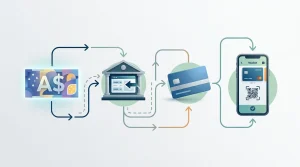
The guide separates everyday wallet use from casino cashier support and explains why a deposit option does not confirm a withdrawal route.

In Australia, paying by tapping a contactless credit or debit card is part of ordinary commerce. Mobile wallets, including Google Pay and Apple Pay, are also accepted almost everywhere. These habits show that many people can choose between a physical card and a phone-based wallet when paying in everyday settings. They do not show that every kind of merchant, or any particular online service, accepts the same options.
That distinction matters when you see Google Pay described as a familiar payment method. Familiarity tells you that the wallet is widely used and accepted across Australia; it does not establish where it can be used in a specific transaction. A payment option can be common in shops and still be unavailable for a particular online service. Broad acceptance is a pattern across everyday commerce, not a guarantee that a particular merchant has enabled the method.
Australian consumers also move between payment types. Alongside cards and mobile wallets, they use services connected to bank accounts, such as PayPal. That flexibility describes how people manage payments in general: the method can change depending on what is available and suitable for a given purchase. It does not mean that all those routes are interchangeable or that a service accepting one will accept the others.
If you’re looking for casinos that accept Google Pay in Australia in 2026, use this list as a starting point for checking the details that matter to you. Review each casino’s available payment options and terms before depositing.
Lucky Dreams
Lucky Dreams lists a Curacao license and a minimum deposit of A$20 via POLi. Check whether Google Pay is available for your account before depositing.
DragonSlots Casino
DragonSlots Casino is listed under the Curacao Gaming Authority, with Jumpman Gaming Ltd identified as the operator. Check its current payment options to see whether Google Pay is available to you.
Wild Tokyo
Wild Tokyo lists a Curacao license and a minimum deposit of A$10. Its stated payout times are 30–60 minutes for crypto and 1–5 days for fiat; confirm payment options before choosing it.
MrPacho
MrPacho lists crypto payouts in 30–120 minutes and fiat payouts in 24–72 hours, with a minimum deposit of A$30. Check whether Google Pay is currently offered to you.
LevelUp Casino
LevelUp Casino lists a Curacao eGaming licence, OGL/2023/174/0082, held by Dama N.V., and a minimum deposit of A$15. Check the casino’s current cashier for Google Pay availability.
Playfina Casino
Playfina Casino lists a Curacao eGaming licence held by Hollycorn N.V. since 2017. Its minimum deposit is A$20–30 depending on the offer, so check the terms and available payment methods before depositing.
Roby Casino
Roby Casino lists a Curacao eGaming licence, with Roby Games Ltd identified as the operator. Check its current payment options to confirm whether Google Pay is available to you.
GoldenCrown
GoldenCrown lists a Curacao Gaming Control Board licence, OGL/2023/176/0095, held by Hollycorn N.V. Check the cashier for current Google Pay availability.
7Bit Casino
7Bit Casino is listed as a Curacao casino operated by Dama N.V. Confirm which payment methods are available to you before depositing.
Kingmaker
Kingmaker lists crypto payouts at about 90 minutes and fiat payouts in 1–5 days, with a minimum deposit of A$30. Check its current payment options to confirm Google Pay availability.
For someone asking whether an Australian online casino accepts Google Pay, therefore, the country’s high use of mobile wallets is only background. It cannot answer the operator-specific question. Nor does the fact that a person can use Google Pay in many ordinary settings show that it is offered for online gambling transactions. The answer depends on the particular service and transaction, not on how widely the wallet is used elsewhere.
The same separation applies to phrases such as “Google Pay mobile casino” or “online pokies with Google Pay.” They combine a payment method with a type of online service, but the combination itself is not evidence of availability. A familiar payment logo, a general description of Australian payment habits, or a statement about mobile-wallet acceptance in shops cannot establish that a particular online service supports that method.
It helps to keep three ideas separate. First is the payment method’s general reach in Australia: mobile wallets are accepted almost everywhere. Second is a person’s habit of switching among cards, wallets and bank-linked services. Third is whether a named online service makes a particular method available for a particular purpose. The first two describe the local payment environment. They do not settle the third.
This also explains why general statements can sound more conclusive than they are. “Google Pay is widely accepted in Australia” is a statement about broad usage. “This online service accepts Google Pay” is a specific claim about one service. The second cannot be inferred from the first. Changing the wording to “Australian casino,” “online pokies,” or “mobile casino” does not close that gap; those labels do not make everyday acceptance evidence of online payment support.
A useful way to read claims about payment habits is to ask what setting they describe. If the claim concerns Australian consumers paying in ordinary commerce, it can help explain why mobile wallets are familiar. If it concerns a particular online transaction, general familiarity is not enough to verify it. The setting determines what the claim can actually establish.
So, Australia’s payment habits provide context, not a shortcut to identifying online services that accept Google Pay. Cards, mobile wallets and bank-linked services all form part of the local payment mix, and consumers are comfortable moving among them. That broad pattern should not be treated as proof that Google Pay is available for any particular online casino transaction.
A payment route has several separate parts: the cashier must offer it, the wallet must be usable for that transaction, the payment must be authorised, and the account must receive the resulting credit. Seeing Google Pay mentioned in general payment information does not, by itself, confirm that every part of this path is available for a particular online service.
Deposit Route
Check the Cashier
Verify that Google Pay is explicitly presented as an active option for your account and transaction.
Review the Hand-off
Observe the next screen to see if you are redirected to a wallet confirmation or asked to choose a payment credential.
Verify Details
Read the amount, currency, recipient, and any displayed charges before authorizing the payment.
Confirm Status
Compare the wallet's confirmation with the transaction record in the casino account to ensure the balance is updated.
Complete Account Checks
Ensure any required Know Your Customer (KYC) identity assessments are completed so the account is ready to transact.
Start with the cashier, not the wallet app. A payment method is usable for a deposit only if it is actually presented as an option for that account and transaction. A logo elsewhere on a page is not the same as an active cashier choice. The cashier’s instructions should identify Google Pay clearly and state any conditions that apply before you begin. If the option is absent or the instructions are unclear, do not treat another wallet or card option as an equivalent route.
If a cashier does present Google Pay, check what happens after you select it. The next screen should make clear whether you are being redirected to a wallet confirmation, asked to choose a payment credential, or returned to the cashier to complete the request. The wording matters: a wallet may be involved in authenticating a payment without being the method that the service ultimately accepts. Do not assume that a familiar wallet interface means the deposit has been submitted or credited.
Before confirming, read the amount, currency, recipient and any displayed charge together. A deposit amount entered in the cashier is not necessarily the same as the amount that will appear in the account if a fee or conversion is involved. If the checkout does not show enough information to understand what you are authorising, pause rather than relying on an estimate. Do not infer a permitted minimum from a search phrase such as “$10 deposit”; only the cashier’s current terms can establish whether a particular amount is accepted.
The payment status also has distinct stages. A wallet confirmation may show that you approved a request, while the cashier may still show it as pending or not yet credited. Keep the confirmation details and compare them with the transaction record in the account. If the wallet reports a completed payment but the cashier does not reflect it, avoid submitting the same deposit again until the discrepancy is resolved. Repeating a request can create a second transaction rather than repair the first one.
Account checks are another part of the route. Before processing financial activity, an online casino may require you to establish your identity through a Know Your Customer assessment. That means a payment method appearing in a cashier does not necessarily mean an account is ready to transact: identity checks may still be outstanding. Read the account’s instructions and provide information only through its stated process. A payment confirmation does not replace those checks.
Processing time should be treated as a separate question from payment authorisation. The wallet’s confirmation screen, a cashier status, and the time at which an account balance changes can refer to different events. Without an explicit, applicable estimate from the cashier, there is no sound basis for promising that the balance will update instantly or within a particular period. If timing matters, check the terms before initiating anything and retain the transaction reference for any later enquiry.
A useful assessment therefore follows the route in order: confirm that Google Pay is offered in the cashier; read how the cashier describes the hand-off; check the amount, currency and any charge before approval; note the wallet’s response; then verify the transaction status in the account. Each point answers a different question. A wallet logo cannot establish the cashier’s current availability, a successful authorisation cannot establish that the account has been credited, and neither one determines a minimum deposit or processing time.
This method avoids confusing a payment brand with a complete deposit procedure. The exact screens and requirements depend on what the cashier displays for the account at the time of the transaction. Treat each displayed instruction as specific to that route, and do not fill gaps with assumptions drawn from how Google Pay works at shops or in other services.
A “best” label implies that the options have been identified and assessed against the same criteria. For Google Pay, that requires more than a general statement that a site supports digital payments: acceptance must be confirmed for the particular operator and for customers in Australia. Without reliable operator-specific confirmation, there is no sound basis for naming or ranking casinos as Google Pay options.
This distinction matters because a payment method’s popularity does not establish where it can be used. Google Pay is widely accepted by Australian merchants, but that says nothing definite about an online casino’s payment arrangements. Nor does the presence of a wallet logo, a broad “mobile payments” label or a general list of payment methods necessarily establish that Google Pay is available to every customer.
A useful assessment therefore starts with the exact claim being made. Does it refer to Google Pay itself, or does it group several mobile wallets together? Does it describe Australian customers, or a different market? Is the claim about a specific operator, or merely about online payments in general? If those distinctions are unclear, the statement cannot support a confident recommendation.
The word “best” also needs a defined comparison. A ranking could refer to confirmed availability, transaction costs, deposit conditions, withdrawal options, or some combination. These are separate characteristics. Evidence of one does not establish the others, and a list that treats them as interchangeable can give you a stronger impression of certainty than the information warrants. A site described as accepting a wallet, for instance, has not thereby been shown to offer a particular payout route or processing speed.
The same standard applies to descriptions such as “instant” or “recommended.” Such wording is useful only when it is tied to a clearly stated, operator-specific condition. Otherwise it is a promotional description, not a basis for comparing payment options. A review may describe what it found at the time it was written, but payment arrangements can change; a claim should not be treated as permanent merely because it appears in a review or directory.
You can use a simple test when reading any purported recommendation: look for a direct, current statement that identifies the operator, the relevant customer market and Google Pay specifically. Then check whether the claim is limited to one part of the payment process or makes a broader promise. If the wording only says “mobile wallet,” it does not answer whether Google Pay is included. If it names no operator or gives no market context, it cannot establish Australian availability.
This standard does not produce a shortlist. It explains why a shortlist cannot be responsibly presented without confirmed, comparable information. Naming sites based on a broad category, a wallet’s general popularity or an unqualified recommendation would turn an assumption into advice. The accurate answer to requests for the best Australian casino site taking Google Pay is therefore not a ranking: no operator can be responsibly identified as meeting that description on the basis of a general payment-method claim alone.
That limit is also useful when a page combines different topics. A casino’s game catalogue, its payment methods and the quality of its services are distinct matters. A site’s name beside Google Pay in a broad list does not, by itself, establish the particular acceptance claim or justify calling it the best. Keep the claim narrow: only operator-specific evidence can establish operator-specific acceptance, and a comparison requires evidence on the same terms for each option.
A payment method working in one direction does not prove that it works in the other. A deposit sends funds from a payment source towards an account; a withdrawal sends funds away from that account through a route the operator makes available for payouts. Those are separate functions, so seeing Google Pay offered for a deposit would not, by itself, establish that it can receive a withdrawal.
The word “instant” also needs a clear reference point. It could describe how quickly a payment is authorised, how quickly an operator approves a payout, or how long the receiving payment route takes to make funds available. These are different stages. A fast result at one stage does not determine the timing of the others.
Even where an operator supports a payment method for deposits, payout arrangements may be defined separately. The cashier’s deposit options and its withdrawal options answer different questions. A method appearing in one part of a cashier should not be assumed to appear in the other, and a general statement about wallet payments does not establish the rules of a particular service.
Before a withdrawal can be assessed, the operator may also need to review the account. Online casinos commonly require customers to pass identity and customer checks before carrying out financial transactions. That review is distinct from the payment route itself: completing it does not establish that Google Pay is available for payouts or determine how quickly a payment would arrive.
Attention: A payment method working for deposits does not prove it is available for withdrawals, as these are separate functions with different operator rules.
For a useful comparison, separate three points: whether Google Pay is accepted for deposits, whether it is listed as a withdrawal option, and what timing applies to an approved withdrawal through that option. A claim about one point does not answer the other two. In particular, the phrase “instant withdrawal” should not be read as a promise that every stage—from account review to receipt of funds—happens immediately.
This distinction matters when a payment description combines Google Pay, real-money play and a fast payout. The wording may sound like a single feature, but it joins separate questions about deposit acceptance, payout availability and processing. A claim about a new service or a no-deposit offer would not resolve those questions either; promotional wording is not proof of a supported withdrawal route or its speed.
If payout timing is important, the relevant details would need to identify the withdrawal method and explain what event starts the stated processing period. A deposit receipt, wallet logo or statement that a deposit is quick cannot substitute for those details. Treating them as equivalent risks building an expectation about a payout from information that only concerns money going in.
A claim that a casino accepts Google Pay needs to refer to that operator’s own payment options, not simply to Google Pay’s general availability in Australia. Mobile wallets are widely accepted by Australian businesses, but that does not establish that a particular online casino supports the wallet.
The distinction is between a payment method being familiar to consumers and a particular merchant accepting it for a particular transaction. A casino might mention digital payments generally, or display payment information that applies to another country or service. Neither establishes that Google Pay is available to Australian customers at that operator. Even a general statement about wallet acceptance needs to be specific enough to identify the service and the market it covers.
The same limit applies when comparing operators. Naming an operator without operator-specific confirmation would turn a general fact about Australian payment habits into an unsupported claim about that operator. A ranking would add another unsupported claim: that the named sites had been compared on a reliable, relevant basis.
For a reader, this means that a casino’s name appearing alongside Google Pay in a general description is not enough to establish acceptance. The wording needs to apply to that operator and to Australian customers. Payment options can also differ across markets and transaction types, so a statement that does not identify those boundaries may not answer whether the wallet is accepted for the transaction in question.
The careful answer to whether a named casino accepts Google Pay is therefore not a recommendation or a guessed shortlist: the claim needs direct, current confirmation from that operator before it can be relied on.
There is also a separate limit for Australian readers. Australian consumer law does not protect people who use offshore casinos. That matters when assessing claims about a payment option: a familiar wallet name does not itself verify the operator, the applicable terms, or the protections available to you. Keep the payment-method question distinct from assumptions about the status or reliability of a casino.
Legal Risk
Australian consumer law does not protect individuals using offshore casinos, regardless of the payment method used.
A payment method and a game catalogue describe different parts of an online service. Google Pay concerns how a payment may be authorised; the catalogue concerns which games an operator makes available. One does not establish the other. Seeing Google Pay as a payment option would not, by itself, tell you which games are offered or whether a particular game can be funded through that route.
The distinction matters because payment acceptance is generally handled at account or cashier level, while game access is controlled separately. A cashier may display payment choices without linking each choice to individual games. Conversely, a game appearing in a catalogue says nothing about whether Google Pay is offered for payments. Treating these as one feature can make a broad payment claim sound more specific than it is.
Mobile wallets, including Google Pay and Apple Pay, are accepted widely across Australia in everyday transactions. That describes general payment habits, not the systems used by online casino operators. A wallet working at shops or other services does not establish that an online casino supports it, and it does not show that support varies by game.
When you see a claim connecting Google Pay with casino games, separate its parts. Is it about the wallet being accepted as a payment method, or about a particular game being available? Those are distinct claims and require distinct confirmation. A general reference to Google Pay does not answer the game question; a game description does not answer the payment question.
The same distinction applies whether you are considering access by phone or another device. A mobile casino describes how a service is accessed; Google Pay describes a possible payment route. The device, payment method and game catalogue are separate elements, so a statement about one should not be taken as proof about the others.
Keeping these categories separate makes payment descriptions easier to interpret. Look for clear wording about the payment method itself, rather than inferring support from a game name, a mobile-friendly interface or the broad popularity of digital wallets. Likewise, do not infer anything about the catalogue from a wallet being familiar or widely used in Australia. A payment label identifies a route for handling a transaction; it does not define what the service offers.
A reference to Google Pay alongside casino slots combines separate claims: that an operator accepts the wallet, that a particular game category is available, and that a bonus is linked to the payment method. One claim does not establish the others. In particular, a general statement about mobile-wallet use in Australia cannot confirm Google Pay support for a specific game category or any associated offer.
The same distinction applies when a payment method appears in bonus wording. A phrase suggesting a Google Pay casino bonus is not evidence that a promotion exists, that it applies to a deposit made with that wallet, or that its terms are available. No specific Google Pay-linked bonus or slot-related payment arrangement can be confirmed. Treating a search result’s wording as proof could therefore give you a false impression of what an operator accepts or offers.
A useful way to assess such claims is to separate them into questions. Does the operator identify Google Pay as an accepted payment method? Does it specify that the method applies to the relevant transaction? Are any promotional terms explicitly stated? Without clear answers, the combined wording should not be read as confirmation. This is a method for interpreting claims, not a recommendation to use an online casino or an assurance that a payment route is available.
The distinction also matters for lists. A list labelled as casinos accepting Google Pay for slot-related activity would require confirmed operator-level details. A broad description of mobile wallets does not supply those details, and an offer label does not fill the gap. Naming operators or promotions without confirmation would turn an unverified association into an apparent fact.
Accordingly, slot- and bonus-related Google Pay wording should be treated as a set of claims to verify, not as evidence of availability. Google Pay’s general use as a mobile wallet does not establish game-specific acceptance, a qualifying deposit, or a bonus.
Before a casino processes a financial transaction, it typically requires you to complete a Know Your Customer (KYC) assessment. This is an identity check, not a payment-method feature. The cashier and account process may therefore involve separate stages: the payment route concerns how funds move, while KYC concerns whether the operator has assessed your identity.
That distinction matters when considering a Google Pay withdrawal. A wallet appearing as a possible payment option does not, by itself, establish that it can receive withdrawals. Nor does completing KYC confirm which route an operator will use to pay out. Identity assessment and withdrawal availability answer different questions.
You should treat any claim that an online casino supports Google Pay withdrawals as something that needs direct, current confirmation from the operator. Check the cashier’s withdrawal options and the relevant payment terms, rather than inferring support from a deposit option or from general use of mobile wallets. If the route is not shown clearly, ask the operator whether Google Pay can receive withdrawals for your account and what conditions apply.
KYC may also affect when a transaction can be processed: the operator’s identity assessment is a distinct requirement that must be considered alongside the payment route. Do not assume that an account is ready for a withdrawal simply because a deposit was accepted or the wallet was available at the cashier.
For a Google Pay withdrawal, the practical checks are therefore separate: whether the operator offers that route for payouts, whether your account has completed the required identity assessment, and whether the operator’s terms explain any conditions. Without confirmation of those points, the presence of Google Pay elsewhere in a payment flow is not enough to establish a working withdrawal method.
Google Pay does not change the legal status of an online casino service. The relevant distinction is not which payment method appears in a cashier, but whether an operator provides prohibited gambling services to people in Australia.
Under the Interactive Gambling Act 2001, operators must not offer real-money online casino games to people physically located in Australia. The restriction covers casino-style services, regardless of whether a customer considers the site Australian or accesses it from an Australian device. A payment option such as Google Pay cannot make an otherwise prohibited service lawful.
The Act places the relevant prohibition on operators. It does not explicitly make an individual’s use of an offshore casino a criminal offence. That distinction should not be mistaken for approval or protection: the legal restriction on providing the service remains, while Australian consumer law does not protect people who use offshore casinos. If a dispute arises with an offshore operator, you should not assume that Australian consumer protections will provide a remedy.
Enforcement of the Interactive Gambling Act sits with the Australian Communications and Media Authority (ACMA). Its role concerns compliance with the Act; it does not turn a payment method or a casino’s claims about its location into evidence that the service may lawfully be offered in Australia.
This context matters when assessing any claim about an Australian casino using Google Pay. A site’s ability to display a wallet option, accept a payment, or describe itself as available to Australians does not resolve the legal question. Payment acceptance and permission to provide online casino games are separate issues. For people in Australia, the Act’s focus is on the operator’s provision of the service, while the availability of a particular payment route does not override that restriction.
In Australia, contactless credit and debit cards are accepted in almost all everyday settings, and mobile wallets such as Google Pay and Apple Pay are similarly widespread. That describes the country’s general payment environment. It does not establish that a particular online casino accepts either a card or a wallet.
The distinction is about where acceptance is measured. A shop’s contactless terminal and an online merchant’s payment arrangements are separate contexts. The fact that you can tap a card or phone at many Australian retailers cannot confirm that an online casino’s cashier offers Google Pay. Nor does widespread retail use show that a Google Pay transaction to a casino would be approved.
Cards and wallets are also different ways to present or route a payment, not proof of a merchant’s available options. A consumer may be accustomed to switching between them, but the relevant question is still whether a specific merchant supports that method for the transaction in question. General familiarity with Google Pay does not answer that.
So, if you are trying to determine whether Google Pay is accepted at a casino, do not treat Australia’s broad contactless acceptance as evidence of casino support. It supports a narrower conclusion: contactless cards and mobile wallets are common across the country. It does not verify that Google Pay is an available casino payment method, or establish that a card would be accepted there.
This distinction prevents a familiar payment experience in one setting from being mistaken for confirmation in another. A phone payment working at a local retailer tells you about that retailer’s setup; it says nothing definitive about an online casino’s cashier. Likewise, general card acceptance in Australia cannot be used to infer the payment choices offered by an individual online service.
Check the casino’s cashier for American Express as an available deposit option. Select it only if it is offered for your account and transaction.
Jackpot City Casino, Spin Palace, Ruby Fortune, Ignition Casino, Joe Fortune and PlayAmo are listed as accepting Amex deposits for Australian players.
Amex deposits are processed instantly. Withdrawals can take up to five days to clear.
Look for American Express in the casino’s cashier and check the instructions for your account. Some online casinos do not accept Amex.
Each casino sets its own Amex deposit and withdrawal limits, so check the limits shown in that casino’s cashier or terms.
Some casinos allow Amex withdrawals, but not all do; you generally need to have deposited with Amex first. A withdrawal fee may apply.
Amex may block payments to a particular website, and Australian banks may also block gambling-related Amex transactions. Acceptance can therefore differ between casinos and card issuers.
Online casinos typically require you to complete a Know Your Customer assessment before financial transactions. This is an account verification requirement, not necessarily a separate Amex card verification.