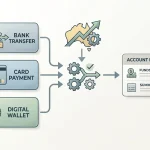
PayID identifies a bank account, while the New Payments Platform facilitates transfers between banks.

PayID is a digital payment system used in Australia. It lets a person send a payment using an identifier, such as a mobile phone number or email address, rather than entering conventional bank account details. The transfer itself moves between banks through the New Payments Platform (NPP). PayID provides the addressing method; the NPP provides the infrastructure for transferring funds.
That distinction helps explain what happens when a payment page presents PayID as an option. The payment does not travel through a separate casino payment network simply because the destination is an online service. The payer’s bank processes the transfer, and the NPP facilitates the movement between banks. The site’s payment interface is where the transaction is requested; it is not the system that carries the money between financial institutions.
A PayID is an identifier associated with a bank account. It can be a mobile number or email address, for example. Its purpose is to make the recipient addressable without requiring the payer to use a traditional account number. The identifier is not itself a bank account, a balance, or a payment card. It points to the destination used for the transfer.
If you’re looking for new PayID pokies in Australia for 2026, use this list as a starting point to check each casino’s available payment options and terms before signing up. The details below highlight only the information available for each operator.
Lucky Dreams
You can note the Curacao license and a A$20 minimum deposit via POLi. The supplied details do not confirm PayID availability.
DragonSlots Casino
You can identify DragonSlots Casino by its Curacao Gaming Authority license and its operator, Jumpman Gaming Ltd. No payment or deposit details are provided.
Wild Tokyo
You can consider the A$10 minimum deposit and the stated payout estimates: 30–60 minutes for crypto and 1–5 days for fiat. The supplied details do not confirm PayID availability.
MrPacho
You can note the A$30 minimum deposit and stated payout estimates of 30–120 minutes for crypto and 24–72 hours for fiat. No license or PayID details are provided.
LevelUp Casino
You can identify LevelUp Casino by its Curacao eGaming license, OGL/2023/174/0082, held by Dama N.V., and its A$15 minimum deposit. The supplied details do not confirm PayID availability.
Playfina Casino
You can note that Playfina Casino is licensed by Curacao eGaming through Hollycorn N.V. and has been since 2017. Its stated minimum deposit is A$20–30, depending on the offer.
Roby Casino
You can identify Roby Casino by its Curacao eGaming license and operator, Roby Games Ltd. No payment or deposit details are provided.
GoldenCrown
You can identify GoldenCrown by its Curacao Gaming Control Board license, OGL/2023/176/0095, held by Hollycorn N.V. No payment or deposit details are provided.
7Bit Casino
You can note that 7Bit Casino is licensed in Curacao and operated by Dama N.V. No payment or deposit details are provided.
Kingmaker
You can note Kingmaker’s A$30 minimum deposit and stated payout estimates of about 90 minutes for crypto and 1–5 days for fiat. The supplied details do not confirm PayID availability.
The NPP is the payment infrastructure through which the participating banks facilitate the transfer. In practical terms, a payment involves two linked operations: identifying the intended destination and moving the funds from the sending bank to the receiving bank. PayID addresses the first part; the NPP supports the second.
This is why “PayID payment” and “instant transfer” are related but not interchangeable descriptions. PayID is the system for addressing a payment with a familiar identifier. The NPP is what enables quick transfers between banks. A payment can be described as using PayID because of the identifier, while the interbank movement relies on the platform behind it.
When you choose PayID in a payment interface, the transaction starts with a request to send funds to an identified destination. The interface may show instructions for making that payment, but it does not replace your bank as the institution that sends the money. The bank is the point from which the transfer is initiated, and the NPP facilitates movement to the receiving bank.
Once the payment is submitted and processed, the receiving bank can make the funds available to the destination account. PayID deposits at online casinos are typically completed within seconds. The bank-to-bank movement and the service’s own handling of a payment are separate processes.
The distinction matters because a payment interface may make the flow look like a single action. Technically, however, the identifier, the sending bank, the NPP and the receiving bank each have a different role. PayID supplies a readable way to address the payment. Your bank sends it. The NPP facilitates the transfer between banks. The receiving bank handles the funds on the other side.
Without the NPP, a transfer between banks would depend on other arrangements for moving the payment. PayID operates through the NPP, which is designed to facilitate quick transfers between banks. The NPP is therefore not an extra identifier that you enter; it is part of the underlying payment infrastructure.
This also explains why the speed of a PayID transfer should not be attributed to the identifier alone. An email address or mobile number makes the destination easier to specify, but that alone does not move money. The transfer speed comes from the payment system working through the NPP and the banks involved. PayID and the NPP are complementary parts of the process, not two names for the same thing.
The same basic separation applies when a payment is directed to an online service. The site may provide a destination and instructions, but the bank transfer still uses the banking system. Calling a payment method “PayID” does not mean the website itself operates PayID or the NPP. It means the payment is addressed using PayID and transferred through the relevant banking infrastructure.
A deposit arriving within seconds refers to the transfer of funds, not to every action that may occur before or after it. A service could display a payment as pending while it checks or records the transaction, even if the banking transfer has already moved. Conversely, a transfer can take time to appear in a user-facing balance because the display and reconciliation processes are distinct from the movement between banks.
PayID identifies the destination, the sending bank initiates the payment, the NPP facilitates the transfer, and the receiving bank handles the funds.
So the useful mental model is a chain: PayID identifies the destination; the sending bank initiates the payment; the NPP facilitates the interbank transfer; and the receiving bank handles the incoming funds. A quick transfer can make the payment leg fast, but it does not make PayID a guarantee about what the receiving service does next.
In Australia, online casino-style games for real money are prohibited services when offered to people physically located in the country. PayID’s role in transferring funds is a technical function, not permission for a service to operate. The payment mechanism can be understood separately from the legal status of any service that presents it as an option.
Before a PayID transfer can be sent, two separate checks matter: whether the details you enter correspond to the PayID registered with your bank, and whether the transfer fits within your bank’s limit. The payment method does not override either condition. If one fails, the transfer may not proceed as intended, even if a payment page displays PayID as an option.
The PayID used for a transaction must match the PayID registered with your bank. A PayID can be a mobile phone number or email address, so check which identifier is actually linked to your bank account rather than assuming that any current contact detail will work.
This matters when you have changed phone numbers or email addresses, or when you use different details for different accounts. A detail that you recognise may not be the one your bank has registered for PayID. If the bank record and the detail supplied for the transfer do not match, the payment may be rejected or may require correction before it can be completed.
Check the registration through your bank’s own service, such as its app or online banking, rather than relying on a saved contact or an old payment record. If you are unsure which identifier is active, confirm it with the bank before attempting a transfer. This is a check of the bank-side registration; it does not establish whether a separate payment page is accurate or whether a service offering real-money pokies may lawfully provide them in Australia.
Also check that the PayID shown for the intended recipient is the one you mean to use. PayID transactions are irreversible once confirmed. Treat the recipient details as payment instructions, not as a name or label that can be corrected after sending. If the displayed information does not make sense to you, do not confirm the transfer until you have resolved the discrepancy through a reliable channel.
Your bank controls the daily limit for PayID transfers. A specialist payment review describes the bank as setting this limit, but the applicable amount depends on the account and the bank’s settings. Check the limit in your bank’s own service before trying to send a payment; do not assume that a limit displayed elsewhere applies to your account.
Attention A transfer may be blocked or declined if it exceeds your bank's daily limit for PayID transfers.
A transfer may be blocked or declined if it exceeds the limit that applies to you. The limit may also matter if you have already made other PayID transfers during the relevant period, because the amount available for a further transfer can depend on how your bank applies its daily cap. If the bank’s interface gives you a remaining limit, use that figure rather than estimating from memory.
Do not treat a declined transfer as a reason to keep retrying with altered details. First identify whether the issue is the limit, the registered PayID, or another bank-side restriction. Your bank can clarify the reason for a decline and explain which limit applies. Changing a payment amount or detail without understanding the rejection can create confusion about whether a transfer was submitted or received.
A payment page may specify a minimum deposit, which is a separate condition from your bank’s transfer limit. Specialist reviews report that many operators set deposit starting amounts between AU$10 and AU$20; the amount is not universal. The amount shown for a particular payment route may differ from a general minimum, so do not infer that a stated threshold applies to every transaction or every payment method.
The minimum and the bank limit work in opposite directions: the payment page may require a transfer to be at least a stated amount, while the bank may prevent a transfer above its own cap. A payment amount must satisfy both conditions for the transfer to be accepted. If they do not overlap, changing the amount at random is not a sound fix; check the terms displayed for the payment route and ask the bank about its limit.
A displayed minimum is not evidence that the underlying service is permitted to offer real-money online pokies to people in Australia. The Interactive Gambling Act 2001 prohibits operators from providing real-money online casino games, including pokies, to customers physically located in Australia. Payment details should not be mistaken for permission or an assurance about the service.
Before confirming any PayID payment, pause long enough to verify the bank-registered identifier, the recipient details, the amount, and the bank’s available transfer limit. These checks address different failure points; passing one does not guarantee that the others are satisfied. If any detail is uncertain, stop and resolve it before authorising an irreversible transaction.
Keep the confirmation from your bank for your own records, but do not use it as proof that every part of a payment has been accepted by another party. A bank confirmation records the transfer instruction or its status; it does not verify the legality of a real-money gambling service or settle questions about its terms.
Seeing PayID offered as a payment option tells you something narrow: a site has arranged to accept transfers through that payment channel. It does not establish that the site may legally provide online pokies to people in Australia, or that the service has any other particular status. A payment method describes how money can move; it is not a licence, regulatory approval or guarantee about what happens after a transfer.
That distinction matters in Australia because the legal position concerns the service being provided, not the payment label shown at checkout. Under the Interactive Gambling Act 2001, operators must not provide real-money online casino games to people physically in Australia. The prohibited services include online slots, poker and table games. Calling a service “PayID pokies” does not change the nature of the gambling service or make its provision lawful.
Legal Prohibition
Under the Interactive Gambling Act 2001, it is prohibited for operators to provide real-money online casino games to people physically located in Australia.
A payment screen can therefore give an incomplete picture. It may show PayID alongside other methods, but that information concerns the site’s payment arrangements. It does not show that Australian authorities have authorised the operator, that the service is lawful for Australian customers, or that the operator will honour a request to return funds. Nor does the presence of a familiar Australian payment method establish that the service is accountable under Australian casino regulation. The payment channel and the legal status of the underlying service are separate questions.
PayID availability may also fail to predict whether a transfer will go through. A specialist review has reported that some Australian banks, including banks among the Big Four, may at times block PayID transfers to gambling merchants identified under their acceptable use policies. This is a report of a possibility, not a rule that applies to every bank, customer or transaction. Bank policies and their application can change, so a payment option displayed by a merchant does not establish that your bank will permit a transfer to it.
The reverse is equally important: a transfer that succeeds does not demonstrate that the merchant is legally entitled to provide online pokies in Australia. It only shows that the payment was processed. A bank’s acceptance of a transaction is not an assessment of the gambling service under the Interactive Gambling Act 2001. Likewise, a failed transfer does not by itself establish the legal status of the merchant; it may reflect the bank’s own controls.
PayID transactions are irreversible after confirmation. That makes it important not to treat a successful transfer as a trial run or as evidence that the destination is safe. Once confirmed, the payment cannot simply be undone through PayID because you later reconsider the site. The payment system’s ability to move funds and the legal position of the recipient remain distinct.
The Act places the prohibition on operators providing the service. It does not make an individual player criminally liable merely for playing at an offshore online casino without an Australian licence. That distinction should not be mistaken for approval or endorsement: the service itself remains prohibited when offered to customers in Australia. The Australian Communications and Media Authority is the regulator associated with enforcing the rules, including action to restrict access to prohibited services.
The Act also provides for substantial maximum daily penalties for breaches: up to $360,000 for an individual and $1.8 million for a body corporate. These are penalties for people or entities that violate the law, not a fee or fine imposed on a player simply for using a payment method. The figures help explain why the legal issue is about the operator’s conduct and the nature of the service, rather than whether PayID appears in a cashier menu.
Access and legality can also diverge. A site may be visible, or a payment route may appear available, without that meaning the service is permitted in Australia. Conversely, access restrictions can prevent or limit the use of prohibited services without turning a payment method into a regulatory certificate. A route that works today is not proof that the service is authorised, and a route that is unavailable does not settle every question about the service.
For a reader evaluating “new PayID pokies” in Australia, the useful distinction is between payment functionality and legal permission. PayID’s presence describes a way to transfer money. It cannot establish that real-money online casino games may lawfully be offered to people in Australia, and it cannot certify the operator’s conduct or obligations. Treating those as separate matters prevents a familiar payment logo from being mistaken for a sign of regulatory approval.
PayID can be used to move funds in both directions: into an account and, where a service supports it, back to the account linked to the payment. That makes it different from a deposit-only method. But the two directions do not necessarily follow the same process. A deposit is initiated by you; a withdrawal first depends on the service approving a request. PayID can move the money quickly once a transfer is made, but it does not control the steps that happen before that point.
For deposits, the practical change is that a PayID transfer can reach its destination within seconds. That reduces the interval between sending a payment and seeing it credited, compared with methods that require a longer transfer process. The receiving service still has to register the incoming payment against your account. If a credit does not appear promptly, the delay may therefore be in recognising or recording the transfer rather than in PayID moving the funds.
That distinction matters because “instant payment” describes the transfer rail, not every part of the transaction. PayID does not determine when an account balance refreshes, how a service matches an incoming payment to a user, or how its cashier displays the result. A transfer can be complete at the banking level while the receiving account has not yet updated. The displayed balance is not, by itself, a measure of how quickly the payment network operated.
The reverse direction has an additional dependency. A withdrawal request is not the same as a PayID transfer: the service must first approve the request and initiate the payment. Only after that release can PayID carry the funds to the destination account. The transfer may then be fast, but it cannot shorten a review that has not finished or make an unapproved request payable.
A specialist review describes approved PayID withdrawals as generally arriving within the same day, but that is a reported pattern, not a guaranteed deadline for every transaction. The timing begins after approval, not when you submit the request. This is why a statement about rapid PayID transfers should not be read as a promise that a withdrawal will appear immediately after you click to request it.
Some specialist reviews also describe an internal pending period before a service releases a withdrawal. One such review gives a range of 24–72 hours for that stage. Treat that as a report about service-side processing, not as a PayID rule or a universal timetable. The relevant sequence is request, internal handling and approval, release of the transfer, then receipt by the account. A delay in any earlier stage shifts the overall arrival time even when the final payment moves quickly.
This separation helps explain why deposit and withdrawal experiences can feel different. A deposit may be initiated as soon as you choose to send it, while a withdrawal can remain in a service’s queue before the payment network is involved. PayID affects the movement of funds between accounts; it does not set the service’s approval policy or processing schedule. The method can make the transfer leg short without making the entire withdrawal journey short.
Costs are another part of the comparison. PayID itself does not charge a transfer fee. Reputable venues also do not add a separate fee for PayID deposits or withdrawals. If a charge is shown, distinguish a fee attributed to the payment method from a service’s own withdrawal condition: they are not necessarily the same thing. The point is to identify what the stated charge applies to, rather than assume that every deduction is imposed by PayID.
The benefit of using one method in both directions is a simpler payment path: the same payment system can handle the incoming deposit and the outgoing withdrawal. That does not mean both transactions are automatic, identical, or governed by a single clock. Deposit speed is shaped by sending and crediting; withdrawal speed includes the service’s decision to release the funds. When comparing a stated processing time with your own experience, check which stage the time refers to.
PayID’s ability to move funds quickly should also be kept separate from whether a real-money online casino service may lawfully be provided to people in Australia. Under the Interactive Gambling Act 2001, operators may not provide real-money online casino games, including pokies, to customers physically located in Australia. A payment method does not change that rule, and describing how a transfer works is not an endorsement of such a service.
The most useful way to interpret a payment-time claim is therefore to ask what event starts its clock. If it begins when you send a deposit, it concerns the transfer and subsequent crediting. If it begins after a withdrawal is approved, it excludes the time spent waiting for that approval. PayID can make the movement of funds fast in either direction, but it cannot make every stage of the transaction immediate.
PayID describes a way to transfer money. Its presence on a payment page does not establish who operates the site, whether its claims are accurate, or whether it will release a withdrawal. Treat the payment method and the operator’s conduct as separate questions: evidence that a transfer route exists is not evidence of a verifiable licence, fair game terms or willingness to pay winnings.
There is also an important Australian legal distinction. Under the Interactive Gambling Act 2001, operators may not provide real-money online casino games, including pokies, to people physically in Australia. A foreign licence or a working payment option does not change that rule or establish permission to provide the service to Australian residents. PayID acceptance should therefore not be read as a signal that a site is authorised to offer real-money casino play here.
A site can state that it accepts PayID, processes withdrawals or applies an internal review. Those statements describe its own processes; they do not independently demonstrate that the processes work as described. Look for precise, consistent terms rather than relying on a payment logo, a promotional claim or an assurance that withdrawals are “fast.”
A useful assessment asks what each claim means in practice. Does “approved” mean the operator has completed its checks, or merely received a request? Does the stated processing time begin when you submit the request, when the operator approves it, or when the payment is sent? If the wording does not define the starting point, the headline timing may leave out the part of the process that matters most.
The same care applies to licence claims. PayID is not a licensing body, and its payment process does not verify an operator’s legal status. A foreign licence, if claimed, is not permission to provide prohibited real-money casino services to people in Australia. Do not infer legal authorisation from a site’s appearance, payment options or statements about oversight.
A withdrawal is not necessarily a single transfer from the site to your bank. The operator may first review the request, check account details and complete identity checks. Only after its approval does the payment move through the payment system. A quick transfer after approval cannot show how long the operator will take to reach that point.
A specialist review has reported that casino-initiated PayID withdrawals may sit in a pending period of 24–72 hours before funds leave the operator’s system. The same kind of review describes 12–24 hours as a typical transfer period after approval, with the full interval from request to receipt potentially reaching 2–4 days when an internal pending period is included. These are reported timings, not a guarantee or a fixed rule for every service.
The distinction lets you interpret a delay more accurately. If a request is still marked pending, the operator may not yet have sent funds. If it is approved but not received, the transfer stage may be in progress. The status labels alone do not prove that a payment will arrive, so the operator’s written terms and any clear explanation of the request’s status matter.
Withdrawal review can depend on Know Your Customer (KYC) checks: identity verification used by an operator before it processes a payout. A specialist review reports that PayID withdrawal speed depends on the operator’s internal review and the player’s KYC status. That means payment speed cannot be assessed by looking at PayID alone.
Read the stated verification requirements before relying on a timing claim. If checks are outstanding, an operator may not yet have approved the withdrawal, even if the payment method itself can move funds quickly. Keep any submitted information accurate and consistent; discrepancies can create additional questions. Avoid treating a smooth deposit as evidence that the account has already passed the checks required for a withdrawal.
You can assess whether a site explains its payment and review process clearly, whether its terms define the stages of a withdrawal, and whether its claims remain consistent across its own pages. Those checks can help you understand what the operator says will happen. They cannot turn PayID acceptance into independent proof of legal authority, reliable service or payment.
For Australian readers, the legal position is central rather than incidental: providing real-money online casino games to people in Australia is prohibited under the Interactive Gambling Act 2001. Do not treat an available payment route as a reason to proceed, or as a substitute for the operator’s legal status. A payment method can move funds; it cannot establish that a real-money casino service may lawfully be offered to you.
A payment method and the rules attached to a gambling service are separate things. PayID can move funds between accounts, but its availability does not establish that an operator may provide real-money casino games to people in Australia. Under the Interactive Gambling Act 2001, providing online casino games, including pokies, to customers physically located in Australia is prohibited. Payment access does not change that legal position, and it should not be read as permission to use or advertise such a service.
For the same reason, figures published about deposits, withdrawals or bonuses are not a reason to treat an offshore service as available or suitable. They describe terms an operator may state, not a legal assurance or a promise that funds will be returned. The financial details still matter when you are trying to understand how such terms work, but they do not override the Australian legal context.
A minimum withdrawal is the smallest amount an operator says it will process in a single request. Specialist reviews have reported PayID withdrawal minimums in the AUD 20–50 range, but that is a reported range, not a universal rule. An operator may set a different threshold, and its terms may distinguish between a minimum request and a minimum balance that can be withdrawn.
Check how the threshold is applied. If your balance is below the stated minimum, the withdrawal form may not accept the request. Some terms may also describe a fee or deduction for withdrawals below an internal threshold. Specialist reviews have reported deductions of A$5–A$10 in some cases, but those figures should not be assumed to apply across operators. The relevant cashier terms should state whether a fee exists, what triggers it and how it affects the amount received.
A withdrawal minimum is not the same as a fee. A minimum controls whether a request can be submitted; a fee reduces the amount paid out. If both conditions exist, they can affect the result separately. For instance, a request might meet the minimum but still be subject to a disclosed charge. Read the conditions as written rather than relying on a headline figure.
A bonus may come with a wagering requirement: a condition that requires eligible play before the bonus, or winnings associated with it, can be withdrawn. Specialist reviews have reported requirements of 30x–45x the bonus amount. Those figures are reported terms, not a standard that applies everywhere, and a particular offer may use different wording or conditions.
The multiple alone does not describe the full obligation. Read the offer terms to identify the amount to which the requirement applies, which games contribute, whether some games are excluded or count differently, and whether a maximum withdrawal applies. Also check the stated deadline and any maximum-bet condition during wagering. These details determine whether play counts toward the requirement and what happens if a condition is breached. Do not assume that a deposit, a bonus and any resulting winnings are treated as one unrestricted balance.
A bonus can also limit withdrawal access while its conditions remain incomplete. That means the displayed balance may not equal the amount currently eligible for withdrawal. Before accepting an offer, establish whether declining it leaves the deposit subject to different terms. If the rules are unclear, do not infer a favourable interpretation from the payment method or from a promotional summary.
PayID’s role is limited to transferring funds. It does not set an operator’s withdrawal threshold, determine bonus eligibility or confirm that winnings will be paid. Those matters depend on the operator’s stated terms and handling of an account; the payment option itself cannot verify them.
In Australia, the distinction is especially important: the Interactive Gambling Act 2001 prohibits operators from providing real-money online casino games to people located in the country. A page that lists PayID, withdrawal conditions or a bonus does not make the service lawful to provide or advertise to Australians. Treat such financial descriptions as information about stated conditions, not an invitation to deposit or a guarantee of access to real-money pokies.
Choose PayID on the payment page, then send the payment through your bank using the PayID details provided. Check that the details match the PayID registered with your bank and that the transfer is within your bank’s daily limit; confirmed payments cannot be reversed.
Some sites accept PayID deposits and withdrawals. However, offering real-money online casino-style games to people physically in Australia is prohibited, regardless of the payment method.
PayID uses a registered identifier, such as a mobile number or email address, and transfers are handled by banks through the New Payments Platform. Confirm the recipient details before paying, as a confirmed PayID transaction cannot be reversed.
After approval, a PayID withdrawal usually reaches your account within the same day, often within 12–24 hours. Casino review and any pending period can extend the total time from requesting a payout to receiving it to around 2–4 days.
For people physically located in Australia, real-money online casino-style games are prohibited services, so a site offering them is not a lawful option, even if it accepts PayID.
Your bank sets your daily PayID transfer limit. Casinos commonly set minimum deposits of AUD 10–20, though some accept AUD 5; typical minimum withdrawals are AUD 20–50.
PayID itself does not charge transfer fees, and reputable venues do not add fees for PayID deposits or withdrawals. Deposit minimums are commonly AUD 10–20, with some operators accepting AUD 5.