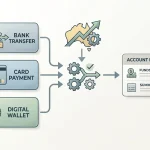
PayID can move released payments in real time, while operator approval, checks and bonus conditions shape when funds become available.

“Instant” describes the movement of money after a payment has been released. It does not mean that a withdrawal request is approved, checked and delivered to your bank account at the same moment. Those are separate stages, handled by different systems.
PayID is Australia’s bank-to-bank payment service, operating on the New Payments Platform (NPP). Transfers made through PayID are processed in real time using the Osko network. In practical terms, PayID lets a payment be directed using an identifier linked to a bank account, rather than requiring the sender to enter the recipient’s full account details. The NPP provides the infrastructure for transferring funds between participating bank accounts; Osko carries the payment through that infrastructure.
For a withdrawal, though, the payment network is not the first actor. The operator must first decide whether to release the requested funds. Until it does, there is no PayID transfer travelling through the NPP for you to receive. The payment rail can move a released payment in real time, but it cannot make the operator approve a request or complete its own checks.
If you’re looking for instant PayID withdrawals with real money in Australia, check whether PayID is actually supported before you deposit: the available details here do not confirm it for any operator. Use the information below as a reference to the specific licensing, deposit or payout facts provided.
Lucky Dreams
Lucky Dreams is listed with a Curacao licence and a minimum deposit of A$20 via POLi. The available details do not confirm PayID support or withdrawal speed.
DragonSlots Casino
DragonSlots Casino is listed under the Curacao Gaming Authority, with Jumpman Gaming Ltd named as the operator. The available details do not specify PayID support or payout speed.
Wild Tokyo
Wild Tokyo lists crypto payouts at 30–60 minutes and fiat payouts at 1–5 days, with a minimum deposit of A$10. These details do not confirm instant PayID withdrawals.
MrPacho
MrPacho lists crypto payouts at 30–120 minutes and fiat payouts at 24–72 hours, with a minimum deposit of A$30. PayID availability is not specified.
LevelUp Casino
LevelUp Casino lists a Curacao eGaming licence, OGL/2023/174/0082, held by Dama N.V., and a minimum deposit of A$15. The available details do not state whether PayID withdrawals are supported.
Playfina Casino
Playfina Casino is listed with a Curacao eGaming licence held by Hollycorn N.V. since 2017; its minimum deposit is A$20–30, depending on the offer. No PayID withdrawal details are provided.
Roby Casino
Roby Casino is listed with a Curacao eGaming licence, with Roby Games Ltd named in connection with it. The available details do not specify deposit methods, payout speed or PayID support.
GoldenCrown
GoldenCrown is listed with a Curacao Gaming Control Board licence, OGL/2023/176/0095, held by Hollycorn N.V. The available details do not specify PayID support or withdrawal speed.
7Bit Casino
7Bit Casino is listed as operating under Curacao and being operated by Dama N.V. No deposit, payout-speed or PayID details are provided.
Kingmaker
Kingmaker lists crypto payouts at about 90 minutes and fiat payouts at 1–5 days, with a minimum deposit of A$30. The available details do not confirm PayID support.
Think of a withdrawal as having two distinct stages:
The word “instant” applies to the second stage, not automatically to the whole sequence. If an operator is still reviewing a request, the NPP has not yet been asked to transfer the money. A label such as “instant withdrawal” therefore does not, on its own, tell you how long it will take from submitting a request to seeing funds in an account.
This distinction also explains why a fast payment rail and a slow overall withdrawal are not contradictory. The transfer can be processed in real time after release, while the release itself remains pending. Conversely, once an operator has sent the payment, a delay in its own earlier processing is no longer the relevant explanation for how the payment rail works.
A PayID is an identifier associated with a bank account. When a payment is addressed to that identifier, the payment system uses the PayID arrangement to direct the transfer to the associated account. The account, rather than the identifier as a separate store of money, is where the funds are received.
For a withdrawal, the operator’s payment system needs a destination PayID and an approved amount. The described request flow is to sign in, open the wallet or withdrawal area, enter a PayID identifier, specify the amount and confirm the request. Submitting those details starts the operator’s process; it does not itself prove that the payment has been released.
 New PayID Pokies in Australia: Payment GuideLearn how PayID deposits move through banks and the New Payments Platform, what to check before paying, and how to assess site…
 Solana Casino Comparison for AustraliaLearn how SOL moves from an Australian exchange to a casino, why blockchain confirmation differs from withdrawal processing, and which platform, bonus…
After release, the transfer moves through the bank-to-bank infrastructure. The NPP enables funds to be transferred in real time between bank accounts, and Osko is the network through which PayID transfers are processed in real time. This is why PayID can support near-instant delivery once the sender has initiated the payment. The speed belongs to the transfer mechanism, not to every action that must happen before it.
The distinction matters when you interpret a status message. A request marked as received, pending or under review is still at the operator stage. A message indicating that a payment has been sent points to the transfer stage. Exact labels differ between services, so the useful question is not just whether a screen says “processed,” but what event that status represents: request submission, operator approval, or payment dispatch.
“Instant” can sound like a promise about the complete journey from clicking a withdrawal button to receiving money. That reading collapses two different processes into one. The operator controls whether and when it releases the payment; PayID and the NPP provide the transfer capability once payment is initiated.
Attention: A label such as “instant withdrawal” only describes the payment phase and does not guarantee that your request will be approved or released immediately.
Accordingly, a claim about instant PayID delivery should be read narrowly. It describes the payment phase, conditional on the payment having been approved and released. It does not establish that every request is approved immediately or that every withdrawal reaches an account without any preceding review. Nor does the payment network determine how an operator handles requests.
This is also why a reported payout time can be difficult to interpret unless its start and end points are clear. A measurement might begin when a request is submitted, or only when an operator releases it. Those measurements describe different intervals. The transfer interval concerns the banking rail; the full withdrawal interval includes the operator’s time before release. A figure for one cannot be assumed to represent the other.
Some specialist reviews have reported withdrawal times measured in seconds for particular PayID services. Such reports describe observed or advertised performance in a particular context, not a universal property of every request. They do not alter the underlying distinction: a payment can move rapidly after release without the request-to-receipt process being instantaneous.
PayID can provide a real-time route for a bank-to-bank payment. It can reduce the time spent moving a released payment compared with a process that relies on a slower transfer route. It cannot decide whether a withdrawal is eligible, perform an operator’s checks, or compel an operator to send funds. Those decisions occur outside the payment network.
This boundary is useful when diagnosing what a status means without assuming that a transfer has begun. If the operator has not released the payment, the relevant process is still on the operator’s side. If it has released it, the payment rail becomes relevant. The two stages should not be described as one undifferentiated “instant” event.
PayID also directs money to a bank account associated with the identifier; it is not a wallet that holds the funds while an operator reviews a request. The payment must be sent to a valid destination. A mismatch between the details entered and the intended account can therefore matter, even though the transfer network itself operates in real time. Use only account details linked to the relevant profile and follow the service’s stated payment instructions.
The terminology should also be understood in the Australian legal context. The Interactive Gambling Act 2001 prohibits operators from providing real-money online casino games to people physically located in Australia. That prohibition concerns the service being offered; it does not change how PayID or the NPP processes an ordinary bank transfer. A payment system’s technical capability should not be taken as evidence that a particular use of it is lawful or that a real-money casino service is available in Australia.
The practical meaning of “instant PayID withdrawal” is therefore precise but limited: once a payment is authorised and released, PayID uses Australia’s real-time bank payment infrastructure to transfer it. The operator’s approval phase comes first and is not made instantaneous by the speed of Osko or the NPP. When those stages are kept separate, the word describes a payment mechanism rather than a guarantee about the entire withdrawal.
For a PayID cashout, the transfer itself is only one part of the timeline. A request must first be checked and released by the operator; only then can the payment phase begin. Consequently, a transfer rail capable of moving funds in real time does not mean that money arrives immediately after you submit a withdrawal request.
There is an important Australian legal boundary: the Interactive Gambling Act 2001 prohibits operators from providing real-money online casino games, including slots and table games, to people physically in Australia. The process described here is a general explanation of what can affect a payment request, not an endorsement or recommendation to use an offshore casino.
After a withdrawal request is submitted, the operator may need to confirm that the account and payment details are consistent with its records. The requested amount, the account’s verification status and any security flags can affect whether the request is released automatically or referred for review.
A specialist review has reported that some services advertised as offering “instant” withdrawals still took as long as a day when internal checks were required. That illustrates the distinction between a fast payment method and the operator’s own processing: until the operator approves and releases the funds, the PayID transfer has not started.
Some specialist reviews also describe automatic approval for withdrawals below a stated threshold at certain operators. That is a service-specific arrangement, not a general feature of PayID, and automatic approval should not be read as a guarantee that a request will be paid immediately. A request can still be checked if account details need confirmation or the operator’s review rules require it.
An operator may ask for identity documents before processing a withdrawal. First withdrawals are a common point at which such requests arise, according to specialist reviews. If verification has not been completed, the request can remain pending while the operator checks the submitted information.
The delay is not caused by PayID. It occurs before the operator releases the payment. Completing identity verification early can make later withdrawals faster because the operator has already reviewed the account information. That does not remove the possibility of further checks: an operator can still review a later request if its details or circumstances require attention.
Make sure the identity information on the account matches the documents supplied. If a document is unclear, incomplete or inconsistent with the account, the operator may need to request clarification before it can proceed. The practical effect is a longer approval stage, even if the subsequent payment transfer is rapid.
The PayID details used for a withdrawal should be the same details used for deposits, and the destination account should be linked to the casino profile. Using different payment details can trigger a security review or prevent the withdrawal from being processed as requested.
This check concerns where funds are being sent, not how quickly PayID can transfer them. If the operator cannot confirm that the destination belongs to or is authorised for the account holder, it may pause the request and seek further information. Check the saved PayID identifier before confirming a request, and do not assume that a different identifier will be accepted simply because it is also yours.
Withdrawal limits are set by the operator, not by PayID. Specialist reviews describe delays for larger requests, including requests above $2,000, and market requirements call for manual review to be disclosed for withdrawals exceeding that amount. The threshold is not a universal PayID rule: it is a point at which the relevant operator’s stated process may require additional scrutiny.
Check the terms for the minimum and maximum per transaction before submitting a request. A separate weekly or monthly cashout cap may also apply, so a request can comply with the per-transaction maximum while still exceeding the amount available for withdrawal during that period. If a large withdrawal is released in instalments under the operator’s policy, receipt of the full sum may take longer than receipt of the first instalment.
A specialist review has reported that some PayID services processed withdrawals in under five minutes, while standard bank transfers in its comparison took one to three business days. Those figures describe the services and comparison covered by that review; they are not a promise about an individual request or a general timing standard. Approval, account checks and operator limits can all affect the result.
A PayID transaction fee may apply. FilmInk has reported this possibility, but a fee is not an inherent feature of every PayID withdrawal. Check the operator’s terms for whether a fee applies, when it is charged and whether the amount is deducted from the withdrawal or charged separately.
The terms should also explain the minimum and maximum withdrawal amounts, any relevant cashout caps, and the processing stages. “Instant” should refer only to the payment phase after operator approval, not to the entire interval from requesting a withdrawal to receiving funds. If a page uses the term without explaining that distinction, it does not tell you how long verification or review may take.
If a request is delayed, identify its current stage rather than treating every delay as a transfer problem. A request awaiting identity documents, a security check or manual approval has not yet reached the PayID payment stage. A request marked as released has passed that operator-controlled stage, although the actual arrival still depends on the payment being completed.
For a real-money casino request involving an Australian resident, the legal context remains decisive: operators are prohibited from providing online casino services to people in Australia. Payment-speed claims do not change that status.
Legal Prohibition
The Interactive Gambling Act 2001 prohibits operators from providing real-money online casino games to people physically located in Australia.
In Australia, the legal setting matters before comparing payment methods: the Interactive Gambling Act 2001 prohibits operators from providing real-money online casino games to people physically located in the country. The comparison below describes how payment types differ in general, not an invitation to use an online casino. It also does not mean that a payment option is lawful or available for casino gambling in Australia.
For the transfer itself, PayID has a specific advantage: it uses Australia’s New Payments Platform, with payments processed in real time through Osko. Once a payment provider releases a withdrawal, the transfer phase can be near-instant. That describes movement of funds between accounts, not the time from submitting a request to receiving money; the operator’s handling of a request is separate.
The key comparison is therefore not simply which method sounds fastest. It is whether the method can receive withdrawals, how long its transfer stage may take, and whether the method is offered at all. A deposit option is not necessarily a cashout option.
PayID is a bank-to-bank payment method that uses an identifier linked to a bank account rather than requiring the sender to enter the recipient’s account details each time. Its real-time payment rail can make the transfer stage shorter than a conventional bank transfer. A report by FilmInk describes PayID withdrawals as almost immediate compared with bank transfers that may take several working days; that is a reported comparison, not a promise for every provider or transaction.
Traditional bank transfers follow a different path and may take longer to reach the receiving account. A specialist review reports that a bank transfer can take as long as five business days to complete. That figure is a reported outer timeframe, not a universal schedule: the relevant bank, processing arrangements and the operator’s payment process can affect the actual experience. Bank transfers may also be described as taking several days, rather than being credited in real time.
PayID is thus distinct from a standard bank transfer even though both involve bank accounts. The name PayID refers to the identifier and payment service used on the NPP; it does not mean every bank transfer is routed through PayID or receives the same timing. When assessing a payment option, check whether the stated withdrawal method is PayID or a conventional bank transfer.
PayPal and Skrill are examples of e-wallets used for online payments, and Neteller is another name that may appear in payment menus. An e-wallet adds an account between the payer and the bank account or card that funds it. That can make the wallet balance available separately from the underlying bank transfer, but it does not guarantee that a withdrawal will be sent to the wallet or that the funds will immediately be available in a bank account.
A specialist review describes e-wallet withdrawals as often being completed within hours rather than days. Separately, payment-method guidance places e-wallet withdrawal processing within a day, while bank transfers and card payments can take several days. These are general reported timeframes, not service guarantees; the receiving wallet, operator and transaction circumstances matter.
Uses the NPP and Osko for near-instant bank-to-bank transfers once released.
Includes PayPal, Skrill, and Neteller; often processed within hours but may require another transfer to a bank.
Conventional transfers that may take several working days or up to five business days to complete.
The useful comparison is that an e-wallet may provide a quicker route to funds held in the wallet than a conventional transfer to a bank account. If you need the money in a bank account, however, there may be another transfer after the wallet receives it. Treat the wallet’s withdrawal availability and the time to move money onward as two separate questions.
Credit and debit cards are not interchangeable for gambling payments. The Australian market rules prohibit accepting credit card payments for online gambling services. A debit card is a different payment instrument, but that distinction does not establish that any particular casino service is lawful or that a card can be used for withdrawals.
Where card payments are part of a payment system, card withdrawals may take several days rather than arriving through a real-time bank payment rail. A card used for a deposit may also not be available as a withdrawal destination. Payment arrangements can depend on the operator’s terms and the card provider’s rules, so the presence of a card logo on a deposit page should not be read as confirmation that withdrawals can be returned to that card.
This differs from PayID’s transfer mechanism: a PayID payment moves between bank accounts through the NPP, while a card transaction is handled through card-payment systems. Consequently, “bank-linked” does not mean “same timing.” A card payment should not be assumed to share PayID’s real-time transfer characteristics.
Some online services offer cryptocurrency, but availability varies. Specialist material describes cryptocurrency transactions as capable of being near-instant; this should be understood as a possibility, not a consistent completion time. The timing can depend on the cryptocurrency network and the service receiving or sending the funds. The value received can also change as the asset’s price changes between sending and conversion.
A cryptocurrency transfer is not a bank-to-bank PayID payment. It does not use the NPP or Osko, and a wallet address is not a PayID identifier. If a service supports cryptocurrency, check whether it accepts that asset for both deposits and withdrawals, and how it handles conversion to Australian dollars. A rapid network transfer does not by itself establish that a recipient can spend the funds immediately in a bank account.
Prepaid products such as Neosurf are primarily associated with adding value to an account. A specialist review describes prepaid cards and vouchers as generally available for deposits but not withdrawals. That difference is fundamental: a voucher can help fund a payment without providing a route for returning a balance to you.
If a prepaid method is used to deposit, the withdrawal may need to use another supported destination. Do not assume that funds can be sent back to a voucher simply because it was accepted at deposit. Before relying on any payment method, distinguish “accepted for payment” from “available for cashout.”
Some specialist reviews report that certain real-money platforms in Australia have offered instant banking services through providers such as POLi. The term refers to a banking payment service and should not be confused with PayID: they are separate methods. Nor does an instant deposit service establish that withdrawals are supported through the same route. A service can accept funds through one channel and return them through another.
Instant banking services, such as those provided by POLi, are separate from PayID and do not automatically guarantee that withdrawals are supported through the same route.
For any comparison, identify the exact method listed for receiving a withdrawal rather than relying on a general label such as “instant banking.” PayID’s defining feature is its use of the NPP for real-time bank transfers. E-wallets, standard bank transfers, card payments, cryptocurrency and prepaid vouchers have different transfer systems and different withdrawal capabilities. And in Australia, the legal prohibition on providing real-money online casino games to people physically in the country remains separate from how any payment technology works.
A balance shown in a casino account is not necessarily a balance you can withdraw. If a promotion attaches wagering conditions to funds, those conditions determine when the related balance becomes eligible for cashout. The key detail is what the wagering requirement applies to: the bonus alone, or the deposit and bonus combined. The same displayed bonus can therefore produce different wagering obligations under different terms.
A specialist review describes both structures and regards a requirement limited to bonus funds as preferable. That distinction matters because a combined-balance condition puts more funds into the calculation. It does not, by itself, tell you how much must be wagered: the promotion’s wording must also explain how the requirement is calculated. Read the complete terms before accepting a bonus, rather than relying on a short promotional label.
With a bonus-funds-only condition, the wagering calculation is based on the bonus amount. Your deposit is not included in that calculation. With a combined condition, the deposit and bonus form the basis of the calculation, so the amount subject to the requirement is larger than the bonus by itself.
You can compare the structures without assuming that two promotions use the same formula. Let the deposit be D, the bonus be B, and the applicable wagering multiplier be R. If the condition applies only to bonus funds, the calculation uses B × R. If it applies to the combined balance, it uses (D + B) × R. These expressions show why scope matters; they do not establish any particular multiplier or promotional rule.
The terms should make clear which balance is covered and what activity counts toward completion. If the wording refers to “bonus funds,” check whether it defines that phrase narrowly or includes other credited amounts. If it refers to the “deposit and bonus,” determine whether both are included in the calculation. A term that names a requirement but leaves its base unclear does not let you work out the wagering obligation.
A bonus-only requirement is generally less demanding in this specific respect because the deposit is outside the calculation. That does not mean every bonus with that structure is automatically favourable. Other conditions can still affect whether the balance can be withdrawn, and the size or appeal of a promotion cannot replace a clear explanation of its rules.
If the requirement applies only to bonus funds, the calculation is B × R. If it applies to the combined balance, it is (D + B) × R, where D is the deposit, B is the bonus, and R is the multiplier.
Where wagering conditions apply, a balance connected with the promotion may remain unavailable for withdrawal until the required wagering is complete. A withdrawal request does not itself satisfy the requirement. Nor does the payment method determine whether the funds are eligible: that is a question of the bonus terms and the account balance, not of how quickly a transfer can move after approval.
This makes it useful to separate two questions. First, are the funds eligible to be withdrawn under the promotion’s rules? Second, once a withdrawal is eligible and released, how does the selected payment method handle the transfer? PayID concerns the payment route; it does not override a wagering condition. An instant payment phase cannot turn restricted bonus funds into withdrawable funds.
Before accepting a promotion, identify what happens if you withdraw before completing its conditions. The terms may specify consequences for a partial or full withdrawal, but those consequences should not be guessed from the word “bonus.” Check whether the promotion is removed, whether associated funds are affected, and whether any remaining balance can still be withdrawn. If the terms do not answer these points clearly, you cannot reliably predict the effect of a cashout.
A no-deposit bonus does not mean that any resulting balance is immediately available as cash. “No deposit” describes how the promotion is received; it does not establish that wagering conditions are absent. If the offer attaches a wagering requirement, the stated rules determine when funds connected with it become eligible for withdrawal.
Check whether the requirement applies to the bonus funds and how completion is measured. Also look for terms governing withdrawal eligibility and any limits on withdrawal amounts. Casino policy may limit the amount that can be withdrawn, so finishing a wagering condition does not, on its own, establish that the entire displayed balance can be cashed out. The applicable terms need to be read together.
Do not infer a cashout right from a balance appearing in the account. A promotional credit, winnings associated with it, and an amount available to withdraw may be treated differently by the promotion’s rules. The terms should explain how those categories relate. If they do not, the balance display alone cannot resolve the uncertainty.
Read the conditions that apply to the specific promotion, not just a general description of bonuses. Confirm whether wagering is calculated on bonus funds alone or on the deposit and bonus together. Then check the definition of eligible wagering, the point at which the requirement is considered complete, and any withdrawal restrictions linked to the offer. These details determine whether a cashout can be requested without affecting the promotional balance.
Keep the deposit route separate from bonus eligibility. Operators generally require funds to be returned to the same method used for a deposit where possible, but that payment rule does not decide whether promotional funds have met their wagering conditions. The two requirements address different issues: one concerns the route for returning funds; the other concerns whether funds may be withdrawn at all.
There is also an important legal context for readers in Australia. The Interactive Gambling Act 2001 makes it illegal for operators to provide real-money online casino games to people physically located in Australia. A discussion of bonus mechanics does not change that legal position or imply that an online casino offer is lawful to use from Australia. It explains only how wagering conditions can affect the withdrawable status of a balance.
The practical distinction remains straightforward: a bonus is not automatically cash, and a completed transfer route does not remove conditions attached to funds. Whether the deposit is included in wagering depends on the promotion’s stated structure. Without that distinction, the displayed balance is not enough to establish what can be withdrawn.
You can use credit or debit cards, PayPal or Skrill e-wallets, and bank transfers; some casinos also accept cryptocurrency. PayID is a bank-to-bank option for near-instant transfers after the casino releases the payment.
They are casinos with straightforward cash-out processes and fast payment handling. PayID options cited for quick payouts include Fastpay Casino, PlayAmo and National Casino, though first-time checks can affect the time you receive funds.
Check that the casino clearly lists withdrawal limits and fees, offers a suitable payment method such as PayID, and explains its processing times. Completing identity verification early and checking whether withdrawals are auto-approved can also help you avoid delays.
PayID transfers can arrive in real time once the casino releases them; reported PayID payouts range from seconds to a few minutes, although internal reviews can take longer. E-wallet withdrawals are typically processed within 24 hours, while traditional bank transfers may take up to five business days.