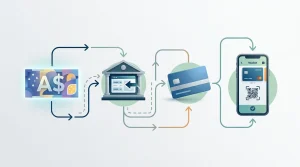
Bitcoin network confirmations and casino processing rules can both affect when a deposit is credited and available for use.

A Bitcoin transfer has two distinct stages: the casino must recognise the incoming transaction, and the Bitcoin network must confirm it. Those stages are related, but they are not the same. A payment can appear as pending before it is confirmed, while the casino may wait for confirmation before making the funds available. The operator’s own processing rules therefore affect when a deposit becomes usable, even after you have sent it.
When you send BTC, your wallet broadcasts a transaction to the network. Miners include eligible transactions in blocks, and each subsequent block adds another confirmation. The time this takes is not fixed. Network activity and the transaction fee can affect how quickly a transaction is included, and a casino may require a particular confirmation status before crediting it. A transfer that is visible on the network is not necessarily a transfer the casino has finished processing.
This distinction matters when a deposit seems delayed. First, check whether the transaction has been broadcast and whether it has confirmations. Then compare its status with the casino’s stated deposit rule. If the network shows the transfer as confirmed but the account balance has not changed, the remaining delay may be on the operator’s side. If it is still unconfirmed, the casino may have nothing further to process yet. Avoid sending the payment again simply because the account has not updated: a second transfer is a separate transaction, not a way to accelerate the first one.
The word “instant” is a poor description of a Bitcoin deposit. A wallet can broadcast a transaction quickly, but broadcast is not the same as final settlement. The network needs to include the transaction in a block, and the receiving service needs to apply its own crediting procedure. The total wait can therefore differ from one payment to another.
The same separation applies to withdrawals. A casino may first review and approve a withdrawal request, then broadcast a Bitcoin transaction. Network confirmation begins only after broadcast. A delay before broadcast points to the operator’s processing stage; a delay after broadcast points to the transaction’s progress on the Bitcoin network. Checking the transaction reference in a block explorer can help distinguish those stages, though it cannot make the operator release a pending withdrawal.
A specialist review characterises Bitcoin as suitable for larger, less frequent cash-outs when a wait of around half an hour is not important. Treat that as a description of a possible use case, not a promised payout time. The actual wait depends on the operator’s handling of the request and the network conditions at the time. If you need to use the funds immediately, a transaction that takes longer than expected can be inconvenient even when nothing has gone wrong.
Bitcoin’s price can move while a deposit or withdrawal is in progress. That creates a separate risk from confirmation time: the number of BTC may remain unchanged while its value in Australian dollars changes. If you convert Australian dollars to BTC before depositing, the amount of BTC available can depend on the conversion price. If you later receive BTC and convert it back, its Australian-dollar value may be different from the value when the withdrawal was initiated.
This exposure can be more noticeable when a transfer and the related decision to convert are separated by time. A withdrawal request may be approved before the transaction is broadcast; after broadcast, the Bitcoin may still need to confirm. Neither stage fixes the Australian-dollar value unless the service explicitly states that it does so. Do not treat a BTC amount as a stable cash equivalent.
Before sending, check the displayed BTC amount, the destination address and any fee shown by your wallet or the receiving service. Before requesting a withdrawal, check whether the casino states the payout amount in BTC or in another currency and when any conversion takes place. If the value matters to your budget, consider the possibility of price movement at both ends rather than relying only on the quoted amount.
Bitcoin can be a practical fit when you value holding or receiving BTC and do not need a rapid cash-out. It is a less comfortable fit when the timing or Australian-dollar value must be predictable. The label “anonymous” does not change either factor, and it does not establish that an account is free from identity checks. Focus on the transaction status, the operator’s stated processing rules and the price exposure; those determine what the payment can actually do.
Australia’s legal framework distinguishes between the conduct of an online casino operator and that of a person who uses an offshore site. The Interactive Gambling Act 2001 prohibits operators from providing online casino games to people in Australia. The restriction applies to services such as online slots, poker and table games; using cryptocurrency does not change the nature of the service or place it outside the Act.
An offshore crypto casino is not licensed in Australia. It operates outside the Australian regulatory framework, so Australian authorities do not supervise its games, payments or handling of customer complaints as they would a locally regulated service. You do not receive Australian consumer protection through the casino’s offshore status. A licence or business address in another country is not an Australian licence and does not give you access to Australian dispute-resolution or compensation arrangements.
That operator restriction does not mean that an individual player commits a criminal offence merely by accessing an offshore casino. The law targets operators, not individual players, and it is not illegal for a person in Australia to gamble on an offshore online casino. This distinction is important: the absence of player liability does not make the operator’s service lawful in Australia, nor does it make the site a protected or locally approved place to gamble.
The Australian Communications and Media Authority (ACMA) regulates online gambling under the Interactive Gambling Act. It monitors online gambling activity and can direct internet service providers to block prohibited offshore gambling sites. A specialist review reported that, by mid-2025, blocking notices had applied to hundreds of domains. That figure describes a dated report, not a guarantee that a particular site is currently reachable or unavailable.
Blocking affects access, not the underlying legal status of a casino. A blocked domain does not become lawful because it moves to another address, and a working address does not mean that ACMA has approved the service. If you encounter an offshore site, its availability should not be treated as evidence of Australian oversight.
The practical risk is that you may be dealing with a business beyond the reach of Australian consumer safeguards. If a dispute arises, the fact that the operator is offshore can make it difficult to pursue a remedy through Australian channels. The site may set its own account and payment rules, while Australian authorities do not provide the protections associated with a locally regulated gambling service. Consider that limitation before relying on the operator to resolve a problem.
Consumer Protection
Offshore crypto casinos operate outside the Australian regulatory framework, meaning you do not receive Australian consumer protection or access to local dispute-resolution arrangements.
Search terms such as “anonymous crypto casino Australia” can suggest that a payment method or site label changes the legal position. It does not. Calling a site anonymous, or using a cryptocurrency, does not establish that it is licensed in Australia, provide Australian consumer protection, or remove the operator’s obligations under the law. Nor should the word “anonymous” be taken as a guarantee that the operator will not request identity information.
Age rules apply regardless of where the operator is based or how a deposit is made: you must be at least 18 to gamble. An offshore site’s own registration process does not replace that requirement. If you are under 18, you must not gamble.
Using cryptocurrency for offshore online casino activity involves several separate steps: choosing an asset the site supports, sending it from a wallet, waiting for the transfer to be recognised, and requesting any withdrawal back to a wallet. Each step depends on both the casino’s payment system and the cryptocurrency network. Crypto does not make an account anonymous, remove identity checks or change the legal status of the service.
Offshore crypto casinos commonly accept Bitcoin, Ethereum, stablecoins and other cryptocurrencies. Bitcoin and Ethereum are supported by almost all such casinos, but a particular site may accept only some assets or may support them on specific networks. The currency shown on a payment page is not enough to identify the correct transfer route: check the asset and network details displayed for that transaction.
The process generally begins with an account on the offshore site. Account creation may involve providing personal details or completing identity verification. A site’s use of crypto does not prevent it from requesting documents or other information, either during registration or later. The term “anonymous” in a site description is not proof that you can use the service without identification.
Once logged in, you would open the deposit page and select an accepted cryptocurrency. The site then displays payment instructions, which may include a wallet address and a network. You use those details to send funds from a personal wallet or another service that holds the asset. The sending service may require you to confirm the transaction before broadcasting it to the network.
The transfer is not the same as an instant update to the casino balance. The cryptocurrency network records and confirms transactions; the casino’s payment system must then detect the transfer and credit the account. Until that happens, the amount may not appear as available funds. If you send a different asset or use a network the deposit instructions do not support, the funds may not be credited and could be difficult or impossible to recover.
After a balance is credited, the site may let you use it for its available gambling services. This describes the payment sequence, not an endorsement or assurance that an offshore service is lawful for operators to provide to people in Australia. Real-money online casino games are prohibited services under Australian law, and offshore crypto casinos are outside Australian regulation. They do not provide Australian consumer protection. You must be at least 18 to gamble.
Deposit Process
Account Creation
Create an account on the offshore site, which may involve providing personal details or completing identity verification.
Selecting Asset
Open the deposit page and select a supported cryptocurrency, noting the specific wallet address and network provided.
Sending Funds
Use your personal wallet to send the asset to the provided address, confirming the transaction before it is broadcast.
Crediting Balance
Wait for the cryptocurrency network to confirm the transaction and for the casino’s system to detect the transfer and credit your account.
A withdrawal normally starts with a request through the account’s cashier or payment area. You select an available cryptocurrency, enter a receiving wallet address and submit the request. The operator may review the account or transaction before sending funds. That review can include identity checks; having deposited with crypto does not remove the possibility of KYC verification.
The withdrawal has two distinct stages. First, the site must approve and send it. Then the relevant network must process the transaction before the receiving wallet reflects it. A displayed status such as “requested” or “processing” may refer to the operator’s review, not confirmation on the blockchain. Conversely, a transaction hash can indicate that a payment was broadcast, but you still need to confirm that the receiving address and network were correct.
Crypto values can move while funds are being sent, held or withdrawn. As a result, the value in Australian dollars when you initiate a transfer may differ from its value when it is credited or later received. That price movement is separate from the amount of cryptocurrency recorded on the network.
Treat each payment screen as a set of instructions for one transaction, not as a generic address to reuse. Confirm the asset, network and destination before sending; transfers may be irreversible. A crypto payment changes how funds move, but it does not guarantee privacy, bypass verification or provide a safeguard if an offshore site refuses or fails to process a payment.
A deposit minimum is an operator’s payment threshold, not a reliable indicator of how much you need to fund an account overall. The figure can differ by casino and by payment method. A specialist review reports that some listed casinos accept crypto deposits starting at $5, while its broader figures put many operators’ minimums at the equivalent of AUD 15 to AUD 30. In that account, Bitcoin minimums are often higher, at AUD 30 to AUD 50. These are reported figures, not a fixed market tariff: the amount shown in an operator’s cashier is the one that applies to that transaction.
Check the minimum for the specific currency and deposit route before sending anything. A site may show a threshold in a currency other than Australian dollars, and the amount required can be affected by the conversion rate used in its cashier. The minimum can also be different for deposits and withdrawals. Do not assume that meeting a displayed threshold means a transfer will be credited immediately or that the same threshold applies to every payment option.
A low minimum may make it possible to open a balance with a small transfer, but it does not establish that the service is suitable or that a withdrawal will be straightforward. Read the deposit instructions and account terms together. If the operator’s displayed threshold, currency conversion, or payment conditions are unclear, pause rather than sending funds to test what happens. A crypto transfer may be difficult or impossible to reverse once broadcast.
Deposit Minimums
Deposit minimums vary by operator and method; for example, some casinos accept crypto from $5, while others set minimums between AUD 15 to AUD 30, with Bitcoin often requiring AUD 30 to AUD 50.
Bonus wording needs the same scrutiny. A headline such as “no deposit” describes an advertised condition, not the full rules for receiving or withdrawing value. It does not by itself tell you whether the offer is available to you, whether registration or identity checks apply, or what restrictions govern any resulting balance. Cryptocurrency does not remove the possibility of KYC checks, and “anonymous” in a promotional label should not be read as a promise of identity-free access.
Before relying on any bonus claim, find the complete terms attached to that specific offer. Check who qualifies, whether a deposit is required at any stage, which games count, and whether play contributes differently across games. Then look for conditions on expiry, maximum cash-out, withdrawal eligibility and verification. These details determine whether an advertised balance can be used as described and whether any resulting funds can be withdrawn. If the terms are missing, contradictory or only available after you register, the headline is not enough to assess the offer.
A bonus can also change the conditions attached to a balance. Compare the offer’s rules with the ordinary account and withdrawal terms, and check whether accepting it is optional. Do not infer a benefit from a large advertised amount or from phrases such as “instant withdrawal”: neither tells you what conditions apply to a particular account. A claim without accessible, specific terms cannot be assessed reliably.
Keep the decision separate from the deposit itself. Do not transfer funds because a promotional message creates urgency, and do not treat a small minimum as a reason to overlook unclear conditions. The balance you send is exposed to cryptocurrency price movement, so its Australian-dollar value can change between purchase, deposit and any later withdrawal. A promotional credit does not remove that market risk.
Offshore crypto casinos are outside Australian regulation and provide no Australian consumer protection. Gambling is restricted to people aged 18 or older. These conditions matter regardless of the deposit size or the wording of a bonus: a low threshold and a prominent promotion do not change the operator’s regulatory position or establish that an offer is safe to rely on.
If you’re looking for an anonymous crypto casino in Australia in 2026, use this list to check the limited operator details available before choosing where to play. Consider the stated licensing, minimum deposits and payout information where provided.
Lucky Dreams
Lucky Dreams lists a Curacao license and a minimum deposit of A$20 via POLi. These details give you a starting point for checking whether its deposit option suits you.
DragonSlots Casino
DragonSlots Casino is listed under the Curacao Gaming Authority, with Jumpman Gaming Ltd named as the operator. You can use those licensing details as a reference when assessing the casino.
Wild Tokyo
Wild Tokyo lists a Curacao license and a minimum deposit of A$10. Its stated payout times are 30–60 minutes for crypto and 1–5 days for fiat.
MrPacho
MrPacho has a stated minimum deposit of A$30. Its listed payout times are 30–120 minutes for crypto and 24–72 hours for fiat.
LevelUp Casino
LevelUp Casino lists Curacao eGaming license OGL/2023/174/0082, with Dama N.V. named. Its minimum deposit is A$15.
Playfina Casino
Playfina Casino lists a Curacao eGaming license and identifies Hollycorn N.V. as the license holder since 2017. Its minimum deposit is A$20–30, depending on the offer.
Roby Casino
Roby Casino lists a Curacao eGaming license, with Roby Games Ltd named. Those are the available details to consider when reviewing this operator.
GoldenCrown
GoldenCrown lists a Curacao Gaming Control Board license, OGL/2023/176/0095, with Hollycorn N.V. named. You can refer to these details when checking its licensing.
7Bit Casino
7Bit Casino is listed as operating under a Curacao license, with Dama N.V. named as its operator. These details offer a limited basis for assessing it.
Kingmaker
Kingmaker lists a minimum deposit of A$30. Its stated payout times are about 90 minutes for crypto and 1–5 days for fiat.
A payment method is useful only if it works at both ends of the transaction. When assessing an offshore casino that describes itself as anonymous, compare the withdrawal route with the deposit route, the blockchain network, the fee and confirmation requirements. A claim of anonymity does not establish that you can use the service without identity checks: an operator may request verification, and cryptocurrency does not remove that possibility.
Start with the exact coin and network the site supports. A token can exist on more than one blockchain, and selecting the wrong network can make a transfer unrecoverable. Check the deposit instructions against the network selected in your wallet, then check that the same asset and network are available for withdrawals. Do not infer support from a logo or a general reference to crypto; the payment page needs to specify the route.
Next, separate network fees from the casino’s own payment conditions. The blockchain fee is paid to process a transfer; an operator may also set its own withdrawal requirements. These are different costs and can affect the amount you receive in different ways. TRC-20 transfers can keep network costs to cents, but that does not establish that every casino supports that network or that its withdrawal conditions are favourable. Confirm the network and any operator-imposed charges before sending funds.
Verify the exact coin and the specific blockchain network supported by the site to avoid unrecoverable transfers.
Distinguish between blockchain network fees and any separate withdrawal requirements set by the operator.
Consider that a fast network cannot guarantee a fast cash-out if the operator has their own review and processing steps.
Confirmation speed is another trade-off, not a promise of an instant payment. A transfer must be included and confirmed on its blockchain, while the operator may apply its own review and processing steps. A fast network cannot guarantee a fast cash-out if the casino has not approved the withdrawal or does not support the relevant route. Look for clear information about what happens after you request payment, and treat vague claims such as “instant” as incomplete unless the site explains which stage they describe.
A specialist review identifies Litecoin and Tether sent over TRC-20 as options associated with quick confirmation, low fees and broad support across anonymous crypto casinos. Treat that as a comparison point, not a universal guarantee. Support can differ between operators, and the word “Tether” alone is not enough to identify a transfer route: check the precise network shown in the casino’s instructions and in your wallet.
Also consider price movement. A crypto balance can change in value between the time you deposit and the time a withdrawal reaches your wallet. The number of coins and their value in Australian dollars are not the same measure. If you are comparing payment options, consider both the network charge and the possibility that the asset’s market price may move during the transaction. A low transfer fee does not remove price volatility.
Use the cashier and terms as evidence, rather than relying on broad labels such as “no-KYC” or “anonymous.” Check whether the site explains its supported withdrawal methods, the conditions for requesting a payout, and when identity documents may be required. If the deposit page gives detailed instructions but the withdrawal information is unclear, you cannot assume that funds can leave by the same route or on the same terms.
These checks assess payment mechanics, not the safety or legality of an operator. Offshore crypto casinos are outside Australian regulation and provide no Australian consumer protection; a polished payment page does not change that. ACMA blocking notices can also make a casino domain unavailable without warning. Gambling is restricted to people aged 18 or older. A careful payment comparison can help you understand the transfer, but it cannot make offshore play anonymous or remove its risks.
An offshore casino domain can stop loading for reasons that do not indicate that the operator has changed its underlying status. In Australia, the Australian Communications and Media Authority (ACMA) can direct internet service providers to block prohibited offshore gambling sites. A block may therefore affect access through a particular internet connection even when the website’s address still exists.
Attention A working website address does not mean that ACMA has approved the service or that the operator is licensed in Australia.
A specialist review reported that blocking notices had covered hundreds of domains by mid-2025. That is a dated report, not a current count of sites or a guarantee that every blocked domain remains inaccessible. Blocking can also vary in what a user sees: a connection may fail, display a warning, or lead to a page provided by the internet service provider.
A domain change can have several explanations. An operator may move its website to a different address, retire an old one, or experience a technical or hosting problem. A new address does not, by itself, show why the previous one disappeared. Nor does it establish that the new address has been reviewed or approved by an Australian regulator. A site’s appearance under a different domain is not evidence that its regulatory position has changed.
The reverse is also true: a site continuing to load does not mean it is authorised in Australia. Offshore crypto casinos are outside Australian regulation and do not provide Australian consumer protection. Access, availability and regulatory status are separate questions. A functioning page only shows that your connection can reach it at that moment.
Treat links and domain announcements cautiously. A message claiming that a site has moved may lead to an unrelated page, so do not assume that a familiar logo or copied design proves the destination is genuine. Avoid entering account details or sending funds until you have independently checked that you are dealing with the intended service. A domain change cannot make a transfer reversible or make an offshore operator subject to Australian consumer safeguards.
If an address disappears, that alone does not tell you whether the cause was an ACMA-directed block, an operator decision or a technical fault. It also does not establish a change in the operator’s legal position. The practical distinction is simple: domain availability describes whether a particular address can be reached; it does not certify the service behind it.
The range of coins varies between offshore casino sites. Bitcoin (BTC) and Ethereum (ETH) are widely supported, while Tether (USDT) and Litecoin (LTC) are also commonly listed. Some sites accept Ripple (XRP), and others may include Solana (SOL), Dogecoin (DOGE) or additional altcoins. A coin appearing on one site’s payment page does not mean it will be available everywhere.
A specialist casino review reports that many online casinos list ten or more cryptocurrencies for deposits and withdrawals. Treat that as a description of the sites reviewed, not a guarantee about any particular operator or a stable count across the market. The available options can differ between sites, and a currency shown for deposits may not necessarily be available for withdrawals. Check the site’s own payment information for the specific coin and transaction direction before relying on it.
Many offshore casinos support Bitcoin (BTC) and Ethereum (ETH), along with Tether (USDT) and Litecoin (LTC). Some may also accept Ripple (XRP), Solana (SOL), or Dogecoin (DOGE).
The names alone do not tell you how a transfer will behave. Tether is a token that can be issued on different blockchain networks; the same ticker does not identify which network a site supports. Likewise, a casino may list a currency but provide limited details about how it handles that asset. Confirm the exact currency and network shown in the payment instructions before sending funds. A transfer to an unsupported address or network may be irreversible.
A broader selection can be useful if you already hold a supported asset, but it does not establish that a site is safer, more private or better suited to you. The phrase “anonymous cryptocurrency casino” should not be read as a promise of anonymity: paying with crypto does not itself remove identity checks or other account requirements. Nor does a long coin list demonstrate that an offshore operator is trustworthy.
For Australian readers, offshore crypto casinos operate outside Australia’s regulatory framework and provide no Australian consumer protection. That remains true regardless of which coin or token a site accepts. Gambling is restricted to people aged 18 or older. Compare the actual payment instructions and available currencies carefully, but do not treat broad support as proof that a site or a particular asset is the best choice.
A casino app is an interface for requesting deposits or withdrawals; it does not determine which blockchain carries a transaction. The coin and network selected in the payment screen must match the network used by the wallet sending or receiving funds. A familiar currency name is not enough: the same token can be available on different blockchains, with different addresses and transfer requirements.
Before sending, compare the app’s selected asset and network with the details shown in your wallet. Check the destination address and any payment instructions character by character. If the casino accepts a token on a particular network but your wallet sends it on another, the funds may not reach the account and may be impossible to recover. Blockchain transfers are generally irreversible once confirmed, so do not rely on customer support to correct a network mismatch.
Network choice also affects cost and timing. A transaction may need confirmation on its blockchain before the casino credits a deposit or processes a withdrawal. A specialist review recommends Litecoin and Tether on the TRC-20 network for faster payouts, citing quick confirmations, low fees and broad support among the casinos it assessed. Treat that as a source-specific recommendation, not a guarantee for every app: the casino must support the exact asset and network, and its own processing step can affect when a payout is released.
Compare the displayed fee and the payout instructions before confirming. A lower network fee does not establish that a withdrawal will be quicker, while a fast blockchain cannot remove any processing time imposed by the operator. The app’s status label can also describe only one stage of the transaction; check whether the transfer is awaiting operator approval, broadcast to the network or confirmed.
Crypto prices can move while you are depositing or withdrawing. The amount shown in your wallet may therefore have a different value by the time it is credited or received, even if the number of coins has not changed. Consider that price exposure alongside the network fee when deciding whether to proceed.
Do not assume an app supports every network associated with a coin. Recheck the selected network each time, especially when switching between deposit and withdrawal screens. A saved address or a previous successful transfer does not prove that the current transaction uses the same network.
Australian tax treatment can differ between a recreational gambling result and the cryptocurrency used to fund it. Recreational gambling winnings are generally not taxed as ordinary income. That does not make the crypto involved tax-free: the Australian Taxation Office treats cryptocurrency as a capital gains tax asset, and disposing of it can have separate tax consequences.
A casino deposit may count as a disposal. If you transfer crypto you already own to pay for gambling, the transfer is technically a CGT event, separate from whether you win or lose. The relevant comparison is between the crypto’s cost base and its value when disposed of. A gain or loss may arise even though you did not convert the crypto into Australian dollars first.
Winning crypto creates another distinction. The gambling win itself is not treated as ordinary income by the ATO, but the value of the crypto when you receive it becomes its cost base for CGT purposes. If you later sell, swap or spend those winnings, that later disposal can trigger CGT rules. Spending crypto to make another casino deposit can therefore be a separate event from the original win.
Keep records that let you establish when crypto was acquired, its cost base, when it was deposited or received, and its value at the relevant time. This helps distinguish the gambling outcome from gains or losses arising as the asset changes hands or value. A deposit made with crypto and a later disposal of gambling winnings should not be treated as one tax event merely because both relate to casino activity.
The practical point is that “gambling winnings are generally not taxed” does not mean every transaction involving crypto is exempt. If the amounts or circumstances are material, get advice from a tax professional familiar with Australian crypto CGT treatment.
A lack of known prosecutions is a narrow observation, not a safety test. No Australian player is known to have been prosecuted for placing a bet at an offshore casino. That does not establish that every site is trustworthy, that an operator is legally entitled to serve Australians, or that a player’s identity and activity are hidden.
“Anonymous” can describe a site’s marketing, not the full payment or account process. A platform may still request identity documents or other checks. Using cryptocurrency does not prove that you can use a service without identification, nor does it remove the risks of sharing personal information with an offshore operator.
Check what the claim of anonymity actually covers: account creation, payment records, identity checks, or visibility to third parties. These are separate questions. A lack of known prosecutions says nothing about how a particular operator stores data, handles disputes or pays withdrawals. It also does not create Australian consumer protection for users of an offshore site.
Treat claims about new no-KYC casinos with the same care. A recent launch, a changing brand or limited public history cannot be used as evidence of safety. Before providing information or funds, read the site’s terms and privacy details and consider whether you can accept the risks if access or support becomes unavailable. If the site does not explain its checks and processes clearly, you cannot infer anonymity from the label alone.
Yes, using an offshore crypto casino is not a criminal offence for an individual player. Using cryptocurrency does not change the rules for operators, and offshore casinos do not provide Australian regulatory protections.
Yes. The number of BTC may stay the same while its value in Australian dollars changes, so the value you receive after converting can differ from its value when you deposited or requested a withdrawal.
Litecoin and TRC-20 Tether are practical choices for faster payouts because they offer quick confirmation, low fees and broad casino support. Bitcoin may suit larger, less frequent cash-outs if you are comfortable with a possible wait.
Yes. ACMA can direct internet service providers to block prohibited offshore gambling sites, and hundreds of domains had been subject to blocking notices by mid-2025.