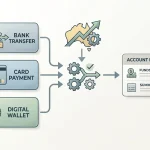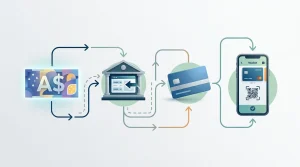
A PayPal label describes a payment option, but it does not establish an operator’s legal status, game availability or withdrawal terms.

A statement that an online gambling service accepts PayPal describes a payment option, not the service’s legal status in Australia. It also does not, by itself, identify which games are offered or establish that the service is available to people in Australia. These are separate questions, and a payment label cannot answer them all.
For someone looking into Australian online pokies that accept PayPal, the key distinction is between a claim about payment and a claim about the operator. “PayPal accepted” may refer to a payment facility shown on a website or mentioned in its material. It does not tell you whether the operator may lawfully provide online casino games to people physically located in Australia. Nor does the wording “Australian casino” prove that the service is Australian, locally regulated or covered by Australian consumer protections.
The Interactive Gambling Act 2001 prohibits operators from providing real-money online casino games to people in Australia. This includes casino-style services such as pokies. The restriction concerns the operator’s provision of the service; it does not make a payment method a route around the law. If an offshore website says it accepts Australian customers and displays PayPal, that combination does not change the legal position of the service.
If you’re looking for casinos that accept PayPal in Australia in 2026, check the available payment methods directly before depositing, as the details provided here do not confirm PayPal availability. These notes highlight the specific licensing, deposit, or payout information available for each operator.
Lucky Dreams
Lucky Dreams lists a minimum deposit of A$20 via POLi and a Curaçao licence. The available details do not confirm PayPal availability.
DragonSlots Casino
DragonSlots Casino is licensed by the Curaçao Gaming Authority and operated by Jumpman Gaming Ltd. The available details do not specify its payment methods.
Wild Tokyo
Wild Tokyo lists a minimum deposit of A$10. Its stated payout times are 30–60 minutes for crypto and 1–5 days for fiat.
MrPacho
MrPacho lists a minimum deposit of A$30. Its stated payout times are 30–120 minutes for crypto and 24–72 hours for fiat.
LevelUp Casino
LevelUp Casino lists a minimum deposit of A$15 and a Curaçao eGaming licence, OGL/2023/174/0082, held by Dama N.V.
Playfina Casino
Playfina Casino lists a Curaçao eGaming licence held by Hollycorn N.V. since 2017. Its minimum deposit is A$20–30, depending on the offer.
Roby Casino
Roby Casino is licensed by Curaçao eGaming, with Roby Games Ltd named as the licensee. No deposit or payout details are provided here.
GoldenCrown
GoldenCrown is licensed by the Curaçao Gaming Control Board under OGL/2023/176/0095, with Hollycorn N.V. named as the operator.
7Bit Casino
7Bit Casino is licensed in Curaçao and operated by Dama N.V. The available details do not specify its payment methods.
Kingmaker
Kingmaker lists a minimum deposit of A$30. Its stated payout times are about 90 minutes for crypto and 1–5 days for fiat.
The distinction matters because payment information is often presented as if it were a complete description of a casino. It is not. PayPal is a way to transfer money through an account linked to the service; it is not an Australian casino licence or a regulator’s approval. A visible logo, a payment-method label or a general statement about PayPal acceptance cannot establish that an operator is authorised to provide online casino games in Australia.
The same care applies to phrases such as “Australian PayPal casino” or “Australian pokies.” They may describe the intended audience, the currency or the wording used in a website’s marketing. They do not necessarily describe where the operator is based or what Australian law permits it to offer. A site can use Australian language and payment references without becoming a lawful Australian online casino.
The Australian Communications and Media Authority, known as ACMA, oversees enforcement of the Interactive Gambling Act. Its role is relevant to the operator’s conduct, not to certifying an individual payment option. Seeing PayPal named on a site does not mean ACMA has approved that site, and it should not be read as a sign that the service is protected under Australian law.
This is also why a list headed “best Australian online casinos that accept PayPal” can create a false impression. A list can make the named services look like locally approved choices, even when the heading only reflects a payment claim or marketing language. Without reliable operator-specific confirmation, naming a service as a PayPal casino would risk turning an unverified label into a recommendation. No operator can be responsibly identified as an Australian online casino accepting PayPal on the basis of a broad payment claim alone.
For people in Australia, the law does not explicitly make players criminally liable simply for using an offshore site. That distinction should not be confused with endorsement, however. The fact that the Act targets operators does not make an offshore casino lawful to provide, or make it a locally regulated service. Australian consumer law does not protect players who use offshore casinos, so a payment option should not be mistaken for a safeguard if a dispute arises.
A useful way to read any PayPal claim is therefore to separate three ideas: the payment method mentioned, the operator making the claim, and the legality of providing the games to people in Australia. Evidence for one does not establish the other two. A PayPal reference may tell you what a site says about payments, but it cannot establish that the site is an Australian casino, that it may offer online pokies to Australian residents, or that a player receives Australian consumer protections.
The phrase “accepts PayPal” is consequently narrower than it may first appear. It is not a legal status, a guarantee of access, or proof of a casino’s catalogue. In Australia, the governing issue for real-money online casino games is the prohibition on operators providing them to people located in the country. Payment wording does not alter that rule.
Legal Warning
The Interactive Gambling Act 2001 prohibits operators from providing real-money online casino games to people in Australia, regardless of the payment methods offered.
A payment logo on a page is not enough to establish that PayPal is available for a particular transaction. The relevant point is what the cashier displays for your account when you reach the deposit stage. Treat the cashier as the place to inspect the available options, not a general payment page or an old description elsewhere.
Before entering anything, check that PayPal appears as a selectable method in the cashier. A logo, a mention in a help page, or a button that leads to a general payment screen does not by itself show that you can complete a deposit with it. If the method is absent, disabled, or produces an unclear instruction, do not assume that another route will work. Availability can depend on the account and the transaction, so the displayed choices matter more than a broad claim.
Once a method is selected, review the information shown before authorising payment. Check that the screen identifies PayPal as the method being used and that the amount and currency match what you intended to enter. If a total, fee, conversion, or other charge is displayed, understand how it affects the amount before proceeding. Do not infer that a fee is absent merely because a general page does not mention one.
Pay attention to where the next button takes you. A payment flow may move from the cashier to a separate authorisation screen. Before approving anything, confirm that the destination and the transaction details still correspond to the payment you meant to make. If the amount, currency, or payment method changes along the way, pause rather than approving the revised transaction without understanding it.
No particular PayPal deposit minimum, maximum, or processing interval can be assumed from the method name alone. If the cashier sets a minimum or maximum, use only the limit shown there, and do not rely on a figure copied from a different account or an unrelated page. If the cashier does not explain a displayed condition, avoid submitting the payment until you can clarify it.
The name and account details involved in a payment should be consistent with the details on the account you are using. Check that you are signed in to the intended PayPal account before approving a transaction, and do not confirm a payment if the authorisation screen shows an account or amount you do not recognise. Never share passwords or one-time security codes with someone claiming to process the deposit for you.
Identity checks can affect access to financial transactions. Online casinos commonly ask customers to complete a Know Your Customer assessment before they can carry out financial activity. That means a deposit screen may not be the only requirement: an account may be asked for identity information or documents before transactions are permitted. Read the instructions in the account area carefully, and do not treat a successful payment authorisation as proof that every account check is complete.
If a verification request appears, make sure it is part of the account’s official process before providing sensitive information. A request received through an unexpected message or an unfamiliar page should not be treated as reliable just because it uses a familiar brand name. Use the account’s own navigation to locate its instructions rather than following a link whose destination you cannot verify.
A deposit is not ready to submit if the cashier does not identify the method clearly, if the final amount differs from the amount you entered, or if you cannot tell what you are approving. Do not repeat a transaction simply because the first screen appears to stall; first check the account and payment records for a pending or completed charge. Submitting again without checking can create a second transaction.
Keep a record of the details displayed at the point of authorisation, such as the stated amount and the method selected. That record can help you describe a problem accurately if the transaction does not appear as expected. It does not guarantee that a payment will be accepted or that an account will be credited.
The practical test is therefore limited and specific: the cashier must offer PayPal for the transaction, the authorisation screen must match the payment you intend to approve, and any account verification requirements must be understood. If one of those checks fails, stop before submitting. A payment option appearing somewhere on a site is not a substitute for checking the live transaction details.
A claim that a casino accepts PayPal is only useful when it identifies what “accepts” means and when that information was checked. A logo, a search result, or a sentence on a comparison page can describe a payment option without showing that it is available to Australian customers. Treat each statement as something to test, not as a recommendation.
Start by separating the claim from the evidence behind it. A page may say PayPal is accepted, while its details refer to another country, a different payment service, or an older version of the operator’s site. The wording should make clear whose account the claim concerns and whether it applies to customers in Australia. If those details are absent, the claim may not answer the question you need answered.
The strongest support is information presented by the operator for the relevant customer group, rather than a third-party page repeating a payment logo or a general description. Even an operator’s statement can be incomplete: payment options may depend on location or account conditions. Read the surrounding wording rather than treating a brand name in a list as proof that every customer can use it.
Check whether the statement is dated or otherwise tied to a current page. Payment information can change, so an undated claim has no clear reference point. A page that uses present-tense wording is not necessarily recent; what matters is whether you can tell when and for whom the information was checked.
Be precise about the action being claimed. “PayPal supported” might refer to deposits, withdrawals, or both, and those are separate claims. A mention of PayPal does not, by itself, establish that it is available for every transaction or that a payment will be approved. Likewise, a claim about an “instant” payment needs evidence about the specific transaction and its stage; the adjective alone does not define what happens.
A screenshot or copied list may help identify a claim, but it has limits. It can be old, cropped, or detached from the terms that explain who can use the option. A customer comment may describe one person’s experience, not a general policy. Several pages repeating the same wording are not necessarily independent confirmation if they all derive from one original claim.
Look for a clear connection between the evidence and the statement. Does it refer to PayPal specifically, to Australian customers, and to the transaction being discussed? If a page merely names a payment provider without those connections, avoid filling in the gaps yourself. Do not infer availability from a familiar logo or from another operator’s policy.
Also distinguish an observed outcome from a guaranteed service. A report that one payment went through does not establish that the same method remains available to other customers. A failed transaction does not, on its own, show why it failed. For instance, a specialist review has reported that an Amex deposit may be declined when Amex blocks payments to a particular website. That is a limited statement about Amex, not a rule about PayPal or proof that a payment claim is reliable.
Labels such as “best” or “top” express a judgement, not evidence that PayPal is available. A ranking may weigh factors unrelated to the payment claim, and its order cannot establish that a method works for a particular customer. Before relying on a recommendation, trace the payment statement back to its underlying support and check that the support matches the claim.
The same discipline applies to phrases such as “PayPal casino” or “PayPal pokies site.” They are shorthand, not a complete description of what is offered. They do not establish the scope of payment access, the conditions attached to it, or the status of any other service. A site’s payment wording should never be used as a substitute for checking each separate claim.
A useful assessment ends with a clear distinction: what the page says, what its evidence demonstrates, and what remains uncertain. If those do not match, do not convert an ambiguous statement into a firm recommendation. This method lets you assess claims without treating promotional language, repeated listings, or a single user report as confirmation.
An “instant withdrawal” label does not tell you when money will be available in your PayPal account. It may describe only one part of the process, such as an operator’s handling of a request, rather than the full interval from submitting a withdrawal to receiving usable funds. Without a clear definition of what the label measures, it is not a dependable estimate.
A withdrawal can involve separate steps: the operator reviews the request, authorises it, and sends the payment; the payment service then processes the transfer and makes the funds available. These steps are not interchangeable. A claim about rapid approval, for instance, does not establish how long the transfer itself takes. Nor does a displayed status necessarily confirm that the funds have reached your account.
For PayPal, do not read “instant” as a promise that a withdrawal will arrive immediately. The timing for a particular transaction depends on the terms and handling that apply to that operator and payment route. A cashier or withdrawal policy should explain what its timing statement covers and when the clock begins. If it gives only a broad label, you cannot turn that label into a reliable arrival time.
Withdrawal Timing
An "instant withdrawal" label may only describe the operator's internal handling of a request, not the full interval until funds are usable in your account.
The distinction matters when you see claims about instant PayPal withdrawals from Australian casino sites. A fast deposit, if offered, would not establish an equally fast withdrawal. The two directions are separate transactions, and evidence about one cannot be used as a timing estimate for the other. Likewise, a general claim about “instant payouts” does not, by itself, identify whether it refers to approval, dispatch, or receipt.
A specialist review reported that Amex casino withdrawals could take up to five days to clear. That statement concerns Amex, not PayPal, and should be understood as a report from that review rather than a universal timetable. It does not show how long a PayPal withdrawal takes, and it cannot support a comparison between the two methods.
When examining a withdrawal-time claim, look for the event being timed, not just the adjective used to describe it. “Processed” may mean that a request has passed an internal review; it need not mean that the recipient has received the money. “Cleared” refers to a later point in the payment path. If a policy does not define these terms, the claim leaves an important part of the timing unclear.
Also distinguish an estimate from a guarantee. A stated range can describe an expected process without ensuring that every transaction will complete within it. An “instant” claim may be even less informative if it omits conditions, the start point, or the stage that is supposedly immediate. Treat those omissions as uncertainty, not as evidence of a particular delay or arrival time.
For a PayPal withdrawal, the useful question is therefore not simply whether a site uses the word “instant.” It is whether the operator explains when processing begins, what it counts as completion, and whether the stated timing refers to approval or receipt. Without those details, you cannot reliably predict when funds will be available.
For anyone considering casinos that accept PayPal in Australia, payment access and legal status are separate questions. A PayPal option does not make an online casino lawful to provide to people in Australia, and it does not give a player the protections that apply when dealing with a locally regulated service.
The Interactive Gambling Act 2001 prohibits operators from supplying real-money online casino games to people who are physically in Australia. The restriction concerns the operator’s provision of the service; it is not a statement that the player commits the same offence simply by accessing an offshore site. The Act does not explicitly criminalise Australian players for using offshore online casinos.
That distinction matters. A person may encounter a site that accepts Australian customers or offers a familiar payment method, but those features do not change the operator’s obligations under Australian law. The legality of providing the gambling service is not decided by whether a transaction can be made, which currency is displayed, or whether a payment account is accepted.
The Australian Communications and Media Authority, usually called ACMA, administers enforcement of the Act. Its role is directed at the law governing interactive gambling services. The fact that enforcement is assigned to a regulator does not turn an offshore casino into a locally authorised service, nor does it establish that an Australian customer has a local remedy if a dispute arises.
There is also an important difference between the position of the operator and the practical position of a player. The law prohibits operators from offering the covered casino services to people in Australia, while it does not explicitly make the player’s use of an offshore site a criminal offence. That distinction should not be mistaken for approval, endorsement, or a guarantee that access will continue. Australian consumer law does not protect players who use offshore casinos, so a customer may lack the protections and avenues of recourse available in a domestic consumer transaction.
A payment method cannot bridge that gap. Whether a site says it takes PayPal, a card, or another service says nothing by itself about the site’s legal status in Australia. Nor does a successful payment establish that the service is locally regulated or that the player is protected under Australian consumer law.
The useful test is therefore not simply whether a cashier displays PayPal. You need to keep the payment question separate from the legal one: payment availability describes how a site claims to process transactions, while the Interactive Gambling Act addresses whether an operator may provide online casino gambling to people located in Australia. A familiar checkout option answers only the first question.
A payment method and a casino’s catalogue are separate parts of an online service. A PayPal symbol or payment reference, if displayed, concerns how a transaction might be handled. It does not show which games the operator offers, whether a particular title is available to a given customer, or whether the catalogue is accessible in Australia.
The distinction matters because a payment page and a catalogue describe different systems. The cashier handles transaction options. The catalogue is determined by the operator’s arrangements and the access conditions applied to its content. Evidence about one cannot establish the other: a PayPal payment claim is not evidence of a PayPal-compatible game, and it cannot confirm that any particular title can be accessed through that payment route.
Searches for casino games associated with PayPal can blur these separate questions. A phrase such as “games with PayPal” may sound as if PayPal is attached to individual games. In practice, payment services relate to an account or transaction process, not to the content selected within a catalogue. A payment method does not identify or unlock a particular game.
Account checks are another independent part of the process. Online casinos commonly require customers to undergo identity and customer checks before they can make financial transactions. That requirement concerns the customer and account; it does not establish what content the operator provides. Passing such a check would not, by itself, prove that a catalogue is available or that its contents can be accessed from Australia.
For a claim about a catalogue to be meaningful, it needs evidence that addresses the catalogue itself, including the relevant access conditions. A payment logo alone cannot supply that evidence. Likewise, a list of titles would not establish that PayPal is accepted. Treating either detail as proof of the other turns an unrelated piece of information into a conclusion it cannot support.
Keep the questions distinct: what payment methods are presented, what content is described, and what access rules apply are not interchangeable facts. A claim about PayPal payments answers only a payment question. It should not be used to infer the presence, availability or accessibility of any casino content.
In Australia, payment habits span physical cards, mobile wallets and services connected with bank accounts. Contactless credit and debit cards are available at nearly all points of sale, while Google Pay and Apple Pay are also accepted in nearly all places where consumers pay. These options give people familiar ways to make everyday purchases without relying on a single payment format.
A mobile wallet changes how you present a payment, rather than replacing the underlying card relationship. You use a phone or other supported device instead of handling the physical card. A bank-linked service such as PayPal is a different kind of option: it sits between the user and a payment transaction, with an account connected to financial services. The categories can overlap in daily life, but they are not interchangeable. A card, a wallet and a bank-linked service each have their own setup and acceptance conditions.
Australian consumers are comfortable moving between these types of payment. That flexibility is a feature of the wider payment environment, not evidence that any particular merchant accepts every method. A payment option being familiar or widely available in shops does not establish that it is available for a particular online transaction. The merchant’s own payment interface determines what can be used there.
This distinction matters when you encounter PayPal described alongside cards or mobile wallets. Its presence in Australian consumers’ broader payment habits says something about familiarity with bank-linked services; it does not, by itself, establish acceptance at an online casino. General payment patterns and a specific operator’s supported methods are separate questions. To understand the first, consider how Australians use different payment formats across everyday commerce. To establish the second, you would need information tied to the individual service rather than an assumption drawn from national habits.
The practical point is that Australians can be accustomed to switching methods while still needing to check acceptance in each setting. Familiarity with a payment type does not make it universally usable, and widespread use of contactless payments or mobile wallets should not be read as a statement about online gambling services.
A payment option can be available for adding funds without being available for receiving winnings. Deposit and withdrawal functions are separate settings: the cashier may show a method for paying in, while the operator’s withdrawal rules determine whether that method can be used to pay out. Seeing a method in the deposit menu therefore does not establish that it can handle withdrawals.
Amex illustrates the distinction. A specialist review reports that not every Australian online casino permits withdrawals to Amex. It also reports that a player must have deposited with Amex before using it for a withdrawal. These are separate conditions: the casino must allow Amex withdrawals, and the player must meet its prior-deposit requirement. The review’s statement should not be treated as a rule for every operator, because payment policies can differ and change.
Limits can differ too. A specialist review reports that individual casinos set their own Amex deposit and withdrawal limits, so the amount allowed for one transaction type does not establish the limit for the other. Check each direction separately in the cashier and the operator’s payment terms.
The same distinction matters when you are considering PayPal. A PayPal option shown for deposits does not by itself prove that PayPal is available for withdrawals. Before relying on it as a payout route, look for PayPal specifically in the withdrawal section and read any conditions attached to that option. If the cashier shows only deposit availability, do not assume the return route will match.
Attention: A payment option available for adding funds does not guarantee that the same method is available for receiving winnings.
This is a question of routing, not just of whether a payment service is recognised. The operator controls which methods it enables for each transaction, and its rules may make the deposit and withdrawal menus differ. Treat the two lists as separate: confirm the method for paying in, then confirm the method for receiving funds. An Amex example shows why that check is necessary, but it does not establish what a casino will allow for PayPal.
A payment method is useful only when the operator makes it available for the transaction you intend to make. A method’s general popularity does not establish that a particular cashier accepts it, and acceptance of one payment type does not imply acceptance of another. This distinction matters when comparing PayPal with card options: each needs to be checked as a separate method rather than inferred from the presence of another.
A specialist review has reported that Visa may be accepted more widely at Australian online casinos than American Express. The same kind of review has noted that some casinos do not accept Amex. These are qualified observations, not a guarantee about any current operator. They also do not establish whether a casino accepts PayPal, or whether PayPal can be used for every transaction offered by that casino.
The practical comparison is therefore about confirmed availability, not which brand sounds more familiar. If a cashier displays PayPal, that indicates the method is offered there for the relevant step; it does not prove that Visa or Amex is also available. Conversely, a card option in the cashier says nothing about PayPal. Payment availability can differ between operators, so a general claim about one method cannot substitute for checking the options presented by the specific service.
For an Australian reader comparing payment methods, keep the claims separate: a report about Visa relative to Amex is not evidence about PayPal, and a mention of PayPal is not evidence that card payments are supported. Treat broad acceptance comparisons as provisional, especially when they come from a specialist review rather than a current statement from the operator. That approach avoids turning a limited comparison into a claim about every cashier or a recommendation to use a particular method.
No payment label establishes the status or protections attached to the service itself. Assessing a payment method and assessing the operator are separate decisions; one cannot verify the other.
A payment method and a promotion are separate parts of an operator’s offer. PayPal describes a way to move money; it does not, by itself, show that a bonus is available, that a payment qualifies for one, or that any promotion is valid for a particular account.
If an operator advertises a PayPal-related bonus, the offer’s own conditions would need to explain what triggers it and which customers may qualify. The presence of PayPal in a cashier cannot substitute for those conditions. Nor does a payment being accepted establish that a bonus has been applied: that is a separate matter from completing a transaction.
Treat claims about a “PayPal casino bonus” as claims about a promotion, not proof of a payment feature or of the operator’s legal status. Avoid relying on a headline alone; the relevant terms should identify the offer and its conditions clearly. Do not assume that using PayPal changes those conditions or provides additional protection.
For Australian readers, there is a more fundamental distinction. The Interactive Gambling Act 2001 prohibits operators from offering online casino games to people in Australia. It does not explicitly criminalise players who use offshore sites, but that does not make those services lawful for operators or make a payment method a safeguard. Australian consumer law does not protect players who use offshore casinos.
A bonus claim therefore cannot establish that an operator may lawfully serve people in Australia, and a PayPal payment cannot turn a promotion into a guarantee. Keep the payment question, the promotion’s terms and the legal position separate when assessing what a claim actually means.
Check the cashier for your account and see whether American Express is available as a selectable deposit method. Some casinos do not accept Amex.
Jackpot City Casino, Spin Palace, Ruby Fortune, Ignition Casino, Joe Fortune and PlayAmo are listed as supporting Amex deposits for Australian players. Check the cashier to confirm it is available for your account.
Yes, some online casinos accept Amex deposits. You select it in the cashier, enter your card details and deposit amount in AUD, then submit the payment.
Amex deposits are typically free, but a casino may charge a 1.5% surcharge, and currency conversion can incur a 3% fee. Withdrawal fees may also apply.
Amex casino deposits are processed instantly.
Deposits typically have no fee, but a casino may apply a 1.5% surcharge and currency conversion can cost 3%. Withdrawal fees may apply as well.
Check with American Express or your card issuer whether it has blocked payments to that website; Australian banks may block gambling-related Amex transactions.