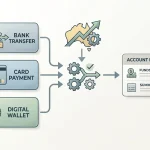
Australian law applies to the casino service itself, while card networks and operators determine whether a deposit is processed.

A card-payment option answers a narrow question: whether a transaction may be accepted by a particular operator. It does not establish that the operator may lawfully provide online casino games to people in Australia. Under the Interactive Gambling Act 2001, offering real-money online casino games to people physically located in Australia is prohibited. The restriction covers casino-style games such as poker, blackjack, roulette and pokies.
The legal focus is on the service being provided, not on the payment method used to fund it. Paying by card does not change the nature of a real-money casino service, and the presence of a card logo or a successful transaction does not make the service lawful in Australia. The same distinction applies if an offshore operator accepts a deposit from an Australian customer: acceptance is a payment outcome, not evidence of permission to offer the underlying gambling service.
This matters because payment availability can be mistaken for regulatory approval. A cashier may display a card option, or a specialist review may report that some Australian-facing casino services have accepted Amex deposits. Such reports describe payment availability as observed or presented by a source; they do not confirm that the service is authorised under Australian law. Payment arrangements can also change, so a past report cannot establish what is currently available.
If you’re looking for casino sites that accept credit cards in Australia in 2026, check the payment options directly before depositing. The details available here do not confirm credit card acceptance, so use each profile as a limited reference rather than a payment guarantee.
Lucky Dreams
Lucky Dreams lists a Curacao licence and a A$20 minimum deposit via POLi. The available details do not confirm credit card acceptance.
DragonSlots Casino
DragonSlots Casino is listed under the Curacao Gaming Authority, with Jumpman Gaming Ltd identified. The available details do not specify payment methods or confirm credit card acceptance.
Wild Tokyo
Wild Tokyo lists a Curacao licence and a A$10 minimum deposit; its stated payout times are 30–60 minutes for crypto and 1–5 days for fiat. The available details do not confirm credit card acceptance.
MrPacho
MrPacho lists a A$30 minimum deposit, with payouts stated as 30–120 minutes for crypto and 24–72 hours for fiat. The available details do not confirm credit card acceptance.
LevelUp Casino
LevelUp Casino lists Curacao eGaming licence OGL/2023/174/0082, held by Dama N.V., and a A$15 minimum deposit. The available details do not confirm credit card acceptance.
Playfina Casino
Playfina Casino lists a Curacao eGaming licence held by Hollycorn N.V. since 2017, and a minimum deposit of A$20–30 depending on the offer. The available details do not confirm credit card acceptance.
Roby Casino
Roby Casino is listed under Curacao eGaming, with Roby Games Ltd identified. The available details do not specify payment methods or confirm credit card acceptance.
GoldenCrown
GoldenCrown lists a Curacao Gaming Control Board licence, OGL/2023/176/0095, held by Hollycorn N.V. The available details do not specify payment methods or confirm credit card acceptance.
7Bit Casino
7Bit Casino is listed as operating under a Curacao licence, with Dama N.V. identified as the operator. The available details do not specify payment methods or confirm credit card acceptance.
Kingmaker
Kingmaker lists a A$30 minimum deposit, with payouts stated as around 90 minutes for crypto and 1–5 days for fiat. The available details do not confirm credit card acceptance.
The Act prohibits operators from providing the specified real-money online casino services to people in Australia. It does not explicitly make an individual player’s use of an offshore casino a criminal offence. Those are separate points: the prohibition on providing the service should not be confused with a claim that the player is criminally liable merely for using an offshore site.
That distinction is not a recommendation to use such a service. It describes where the law places the prohibition; it does not remove the practical and consumer risks of dealing with an offshore operator. In particular, Australian consumer law does not protect players who use offshore casinos. If a dispute concerns an account, a payment, or access to funds, you should not assume that Australian consumer protections will give you a remedy against an overseas gambling business.
A successful card payment does not fill that gap. It cannot show that the operator is subject to Australian consumer law, and it does not provide a guarantee that a dispute will be resolved in your favour. Nor does it turn a prohibited service into a permitted one. Treat payment acceptance and legal status as distinct questions rather than using one as a proxy for the other.
The Australian Communications and Media Authority, commonly called ACMA, oversees enforcement of the Interactive Gambling Act. Enforcement is directed at the prohibition on operators providing online casino services to customers in Australia. Offshore sites may be actively blocked, so an operator’s website or cashier may not remain accessible simply because it once appeared to accept Australian customers or payments.
 EcoPayz Casino Sites in Australia: What to CheckLearn how to assess EcoPayz payment claims, check withdrawal conditions, and understand why Australian-facing access does not establish legal authorisation.
 Casinos That Accept POLi in Australia: What to CheckLearn how to verify whether a casino cashier lists POLi for Australian customers, and why deposit support alone does not confirm withdrawals…
A site’s changing availability does not alter the legal position. If a page loads, a payment option appears, or a transaction is accepted, those events do not amount to approval by ACMA. Conversely, a blocked or inaccessible page is not evidence that the player has committed an offence. The important distinction remains between the operator’s prohibited provision of the service and the absence of an explicit criminal offence for a player using an offshore site.
The phrase “casino sites that accept credit card” therefore describes a payment feature, not a legal category. It can tell you nothing by itself about whether the casino may offer real-money games to people in Australia, whether Australian consumer law applies, or whether the service is likely to remain accessible. A card network’s involvement also does not make the gambling service an Australian-regulated product.
When assessing a payment claim, keep its scope precise. A report that Amex deposits are available at some Australian-facing online casinos is a report about deposits, not a statement of legality or consumer protection. It should not be read as an endorsement, a finding that the operator is permitted to serve Australian residents, or assurance that the same payment option will remain available. The legal question is determined by the service offered to people in Australia, not by whether the cashier accepts a card.
Legal Risk
Offering real-money online casino games to people in Australia is prohibited under the Interactive Gambling Act 2001, and Australian consumer law does not protect players using offshore casinos.
For a reader considering an offshore casino, the key consequence is that card acceptance offers no shortcut around the legal framework. The Act prohibits operators from supplying real-money online casino games to people located in Australia; ACMA is the enforcement authority; and Australian consumer law does not protect players using offshore casinos. Keeping those points separate from the mechanics of a card transaction prevents a payment feature from being mistaken for legal permission or a consumer safeguard.
A deposit flow described for an offshore casino accepting Amex has three visible steps: the payment method is selected in the cashier, the card details and deposit amount in Australian dollars are entered, and the payment is submitted. Those steps describe how the interface is presented; they do not make the service lawful in Australia or provide Australian consumer-law protection. Australian law prohibits operators from providing real-money online casino games to people in Australia.
The distinction matters because a payment screen can make a transaction look routine even when the underlying service is not authorised for Australian residents. A card being listed in a cashier is evidence only of what that operator says its payment interface supports. It is not a statement that an Australian resident is legally protected when using the service.
The cashier is the operator’s payment interface. If it displays Amex as an available option, the stated deposit sequence begins by choosing that option. You then enter the card details and the amount in AUD, and submit the payment. The amount entered is the requested deposit; the amount ultimately debited can also depend on any charges applied to the transaction.
The order of these actions is useful to understand because each serves a different purpose. Selecting Amex tells the interface which payment route you are attempting to use. Entering the card details supplies the information needed to submit that route, while the AUD amount specifies the requested deposit value. Submitting sends the payment request onward for processing. A screen that accepts the details is not, by itself, confirmation that the payment has been completed.
Specialist reviews of casino payment methods describe Amex deposits as being processed instantly. In practical terms, that refers to the reported speed at which the deposit is credited through the casino’s payment flow. It should not be read as a guarantee that every attempted transaction will be accepted, nor as a promise about how quickly a card account will show the final debit. The cashier’s response and the card account’s transaction record are separate things.
Speed and fees answer different questions. Processing time concerns how quickly a deposit is handled; a fee concerns what the transaction costs. An instant deposit can still carry a charge, while a payment with no deposit fee can still take time to appear in an account record.
An instant deposit refers to the reported speed at which the deposit is credited through the casino’s payment flow, not a guarantee of final debit speed or transaction acceptance.
A specialist review reports that Amex deposits generally have no fee, but that the casino’s own terms determine whether a charge applies. Treat that as a condition to verify for the specific operator, rather than a feature guaranteed by the card network. The payment method alone does not settle the question: the casino may set charges for its own payment service, and the applicable terms can change.
The amount shown before submission is therefore not the only detail worth noticing. Read any fee information displayed in the cashier and the operator’s payment terms before deciding whether to proceed. A charge may be presented separately from the deposit amount, so the deposited value and the total cost of the transaction need not be identical. If the terms are unclear, do not assume that a zero-fee deposit is assured.
Deposit timing and deposit charges do not establish whether the same card can receive a withdrawal, how long a withdrawal takes, or whether it carries a separate fee. Those are distinct transaction conditions.
“Instant” is a description of reported processing speed, not a complete account of the payment. It does not tell you whether a particular cashier currently offers Amex, whether the transaction will be approved, or whether a fee applies. Each of those questions concerns a different part of the process: the operator’s available payment options, the outcome of the submitted transaction, and the price attached to it.
There is also an important boundary between describing a payment interface and endorsing its use. Australian residents are not protected by Australian consumer law when using offshore casinos. A familiar card brand, an AUD amount field, or a quick confirmation on screen does not change that position.
A casino’s decision to accept a card depends in part on the payment networks it supports. Seeing a credit-card option in a cashier does not mean every card brand will work there: Amex, Visa and Mastercard are separate networks, and an operator may offer one without offering the others. For Australian readers comparing an online casino credit card option, the network name is therefore a practical detail to check, not a guarantee that a particular card will be available.
Visa may be accepted more broadly than Amex at Australian online casinos, according to a specialist review. That is a reported comparison, not a fixed rule for every operator. Acceptance can change, so a general impression about one network cannot confirm what a particular cashier currently supports. Mastercard is also a distinct option; its availability should be checked separately rather than inferred from the presence of Visa or Amex.
The distinction matters most when you are choosing a payment method before registering or making a payment. If an operator’s payment information names Visa and Mastercard but not Amex, do not assume that an Amex card will be processed through another network. Likewise, an Amex logo or option does not establish that Visa or Mastercard is accepted there. Each network needs to be named in the casino’s own payment information or shown as an available method in its cashier.
Reportedly accepted more broadly than Amex at Australian online casinos, though availability varies by operator.
A distinct payment network whose availability must be checked separately from Visa or Amex.
Often associated with higher transaction limits, although it may be accepted by fewer online casinos than Visa.
A specialist review reports that some online casinos do not accept Amex. Since operator payment options can change, treat this as a reason to verify the current cashier rather than as a universal description of the market. The useful comparison is not simply “credit card accepted” versus “not accepted”; it is which individual networks are listed and whether the stated terms apply to deposits, withdrawals, or both.
A network can be available while its transaction limits differ from those of another card option. A specialist review reports that Amex limits are higher than the limits offered for Visa and Mastercard. This is a reported comparison, not a limit you can assume at every casino. The operator sets the limits, and they can vary between casinos; the cashier or payment terms are the place to confirm the amount that applies to your account.
Keep acceptance and limits as two separate checks. Acceptance tells you whether the cashier offers a network at all. A limit tells you the transaction size the operator permits for that payment route. A higher stated Amex limit does not make Amex more widely accepted, and broader Visa acceptance does not mean Visa has the highest limit. Neither comparison alone establishes which card is suitable for your situation.
The network name also does not tell you the casino’s complete terms. A payment option can have separate rules for deposits and withdrawals, and the presence of a card brand should not be read as confirmation that funds can be returned to it. Check the specific transaction type as well as the network before relying on a card for the full movement of money.
For a clear comparison, look for the card brands listed by the operator and the limits attached to each one. If the casino lists more than one network, compare those terms directly rather than treating all credit cards as interchangeable. If Amex is not listed, its availability cannot be inferred from a Visa or Mastercard option. If the published information is unclear or appears out of date, confirm the current options with the operator before attempting a transaction.
These distinctions help you interpret claims that an online casino accepts credit cards. The phrase may refer to a particular network, not every card brand. Visa may have wider reported acceptance than Amex, while Amex may have higher reported transaction limits than Visa and Mastercard. Both comparisons are conditional: actual availability and limits depend on the individual casino’s current payment terms.
In Australia, payment choice is not limited to carrying a physical card. Contactless credit and debit cards are accepted almost everywhere, and mobile wallets such as Google Pay and Apple Pay are also accepted almost everywhere. Services linked to bank accounts, including PayPal, form another part of the mix. People are comfortable moving between these options, so a payment preference can depend on where they are paying and what they have available at the time.
The methods may look similar at the point of payment, but they are not the same thing. A contactless card is a card used directly; a mobile wallet is an app-based way to make a payment using a supported card; and a bank-linked service provides a separate route associated with a bank account. The distinction matters because accepting one method does not automatically mean that another is accepted too. A payment choice needs to match the options presented by the service receiving the money.
That helps explain why cards remain part of a broader set of everyday payment tools rather than replacing them all. A card can be familiar and direct, while a mobile wallet lets you pay from a phone instead of taking out the physical card. A bank-linked service may suit a transaction where you prefer to use that service rather than enter card details. These are different ways to initiate payment, and people can switch between them without treating one as the only valid option.
For you, the practical point is to identify what is being used at each step. If you tap a phone, the transaction is made through a mobile wallet, even if a credit or debit card is associated with it. If you pay through a bank-linked service, that is not simply another card network. The payment route affects which service handles the transaction and what payment details you need to provide. The appearance of a familiar brand or device does not by itself tell you which route is active.
This wider pattern also puts the phrase “pay by card” in context. It can mean using a physical card directly, or it may refer loosely to paying through a wallet connected to a card. Those options can feel alike to a customer, but they are separate methods from the perspective of the payment interface. When a service offers a choice, check the label for the method you intend to use rather than assuming that a wallet and its associated card will be treated as one option.
The same distinction applies when you compare card payments with bank-linked services. A person may use a card for one purchase, a mobile wallet for another, and PayPal for a separate transaction. This does not imply that every service supports all three. It means consumers are accustomed to choosing among different routes, and the available options can vary with the service and the transaction.
So, when you are deciding how to pay, start with the payment methods actually shown to you. Then distinguish the underlying route: direct card use, a mobile wallet, or a bank-linked service. That makes it easier to understand what you are selecting without assuming that widespread acceptance of one method guarantees acceptance of another.
An Amex option being listed for a particular online service does not mean every attempted payment will be accepted. The payment can be limited by the casino’s own settings, or by whether Amex permits transactions to that website. These are separate conditions: a casino may offer Amex, yet a payment can still fail if the card network blocks that destination.
A specialist review reports that Amex may block payments to particular websites. That restriction is destination-specific, so an Amex card working for other purchases does not establish that it will work for a payment to that site. If the transaction is blocked on that basis, changing the amount would not remove the underlying restriction.
The casino’s deposit limit is another variable. A specialist review notes that online casinos set their own Amex deposit and withdrawal limits, and those limits can differ between operators. The permitted amount is therefore not a fixed property of Amex itself. A payment that falls outside a casino’s stated deposit range may not be accepted even when Amex is shown as an available method.
Keep the two checks distinct: whether Amex is available for the destination, and whether the intended deposit fits the casino’s current limits. The first concerns permission to make that type of transaction; the second concerns the amount the casino allows through its own payment settings. Passing one check does not guarantee that the other will pass.
Payment information can also change. An operator’s cashier and payment terms are the relevant places to confirm its current Amex availability and deposit limits before attempting a transaction. A description on another site may not reflect a later change, and a method shown in general payment information may not be available for every account or transaction.
If a payment is not accepted, avoid treating repeated attempts as proof that the card or account is faulty. First identify whether Amex is currently offered for that destination and whether the intended amount fits the stated deposit range. If those conditions appear to be met, the reason may require clarification from the relevant payment provider or operator. A listed payment method describes an option, not a guarantee that each transaction will be authorised.
An Amex gift card has a limited role in a casino account: it may be used to make a deposit where the casino accepts American Express. That does not mean it can be used for every account transaction. In particular, the gift card is for money going into the account; it cannot be used to receive a withdrawal.
The distinction matters because “accepts Amex” can describe a deposit option without saying anything about how winnings can be paid out. A gift card that works for a deposit is therefore not a route for moving money in both directions. Treat its use as deposit-only, rather than assuming that acceptance for one transaction makes it suitable for withdrawals too.
Acceptance is the condition to check before relying on the card. A casino that does not accept American Express does not meet the stated condition for using an Amex gift card. Even where Amex is accepted, the relevant point is limited: the card may be used for deposits, not withdrawals. The gift-card format does not change that boundary.
Attention Amex gift cards may be used for deposits at casinos that accept American Express, but they cannot be used to receive withdrawals.
This also means the card should not be treated as a substitute for a general-purpose payment method. If your aim is to fund an account, its possible use depends on Amex acceptance. If your aim is to receive money from an account, the gift card is not an option. Keep those two directions separate when assessing what a payment method can do.
Do not infer more from the word “gift card” than the stated use supports. It does not establish that every Amex-accepting casino will take the card, nor does acceptance for deposits imply that withdrawals can be sent to it. The practical limit is clear: Amex gift cards may be used for deposits at casinos that accept American Express, but not for withdrawals.
A payment method shown for deposits does not necessarily provide a route for taking money out. Before relying on a card for a cash-out, check the operator’s withdrawal terms and cashier: Amex withdrawals are not guaranteed, and availability can depend on the payment history on your account.
A stated condition is that you must have deposited with Amex before requesting a withdrawal to it. That does not mean every account that meets the condition can use the card for payouts. An operator may not support Amex withdrawals, or may apply separate rules to winnings. A specialist review has reported both restrictions on withdrawals to Amex and additional withdrawal fees at some casinos; these details can vary, so the terms for the specific service matter.
Fees and processing time are separate issues. A fee affects how much reaches you; clearing time is how long it takes for an approved payout to arrive. A specialist review has reported that an Amex casino withdrawal can take as long as five days to clear. Treat that as a reported maximum, not a guaranteed timetable for every request. The operator’s processing stage and the time for funds to clear are not necessarily the same thing.
Before requesting a payout, confirm that Amex is listed as an available withdrawal method for your account, that you have previously deposited with it, and whether a fee applies. If the cashier does not show the option, or the terms do not confirm eligibility, do not assume that a card used to fund an account can also receive winnings. Keep in mind that Australian consumer law does not protect players using offshore casinos.
A casino’s decision to list Amex as a payment option is separate from the decision made when a transaction is authorised. Listing the card means the cashier can offer that route; it does not mean every payment request will be approved.
The issuer sits between the card account and the payment request. Australian banks may block gambling-related transactions on Amex cards at this stage. If the issuer refuses authorisation, the payment will not complete, even if the casino accepts Amex and the card details are valid. The refusal is therefore different from an operator not supporting the network at all.
There can also be a restriction associated with a particular website. A specialist payment review has reported that Amex may block payments to specific websites, which could result in a deposit being declined. That is a site-specific restriction, not proof that Amex payments to all casinos accepting credit cards are unavailable. Such conditions can change, so a past report should not be treated as a guarantee of present acceptance.
A decline alone may not tell you which party refused the request. The issuer may have applied a gambling-transaction block, or Amex may have restricted payments to that website. The cashier’s display can show that a transaction failed without identifying the underlying rule. Check any message shown and contact the card issuer if you need to understand an issuer-level decision; do not assume that changing card details will remove a restriction.
There is a separate legal consideration. The Interactive Gambling Act 2001 prohibits operators from providing real-money online casino games to people in Australia. Australian consumer law does not protect players who use offshore casinos. A payment appearing as accepted, or being declined, does not change either point.
For a person considering an online casino payment without a credit card, the alternatives described here are cryptocurrency and bank transfer. Their trade-offs concern both the time it takes for money to move and any fees attached to the transaction.
Bitcoin and Ethereum are cryptocurrencies that can support deposits and withdrawals almost instantly, with limited or no fees. That can reduce the wait associated with moving funds, but the payment still depends on the service accepting that cryptocurrency and on the transfer being made correctly. Speed and low fees do not, by themselves, establish that a service is lawful or suitable for Australian residents.
A bank transfer follows a different path: funds move through banking services rather than a card network or cryptocurrency system. A specialist review describes bank transfers as potentially taking longer and costing more. Those are possible disadvantages, not fixed terms; the actual timing and charge can depend on the services involved. Check the payment conditions before initiating a transfer, since a fee or delay can affect the amount available and when it becomes accessible.
The comparison is therefore not simply between a card and a substitute. Cryptocurrency may mean quicker movement and fewer fees, while a bank transfer may involve more waiting and expense. If you are assessing an online casino that does not offer card payments, consider those differences without treating payment availability as evidence that the operator may lawfully provide online casino games to people in Australia.
Before attempting a card payment, check whether your account has passed identity verification. Online casinos can require a Know Your Customer review before processing financial transactions. This may involve submitting documents to confirm who you are; until the operator accepts them, a payment or other account activity may be unavailable. The precise documents and review process depend on the operator.
Separate any fee into two categories. A casino surcharge is added by the operator to the card transaction. A currency-conversion fee arises when the payment is processed in a currency other than Australian dollars. They are different charges, so one does not explain or replace the other.
A specialist review has reported that a casino may add a 1.5% surcharge to an Amex transfer. Treat that as a possible operator charge, not a standard rate: check the cashier and the payment terms before submitting. A specialist review has also reported a 3% currency-conversion fee on Amex cards. Whether that applies to your transaction depends on how it is billed and converted, so check your card terms as well as the casino’s fee information.
These checks do not establish that a site is lawful or provide consumer protection. Australian consumer law does not protect players using offshore casinos. Consider the legal position separately from the mechanics and cost of a card transaction.
Yes, at casinos that accept American Express, but only to make deposits; gift cards cannot be used to withdraw winnings.
Check the casino’s cashier for American Express as a deposit option. Some casinos do not accept Amex, and a payment may also be blocked by Amex or your bank.
Look for American Express in the casino’s cashier before attempting a deposit. Its availability can vary, and Amex or your bank may still block a transaction.
A successful Amex payment does not guarantee that your money is protected or that a dispute will be resolved in your favour. Australian consumer law does not protect players using offshore casinos.
Using Amex does not make an offshore casino transaction legally authorised or guarantee a remedy if there is a dispute. Australian consumer law does not protect players using offshore casinos.
Yes. Each casino sets its own Amex deposit and withdrawal limits, so the limits vary between operators.
Some casinos do not allow withdrawals to Amex, and a withdrawal generally requires you to have deposited with Amex first. Where available, it can take up to five days to clear, and a fee may apply.