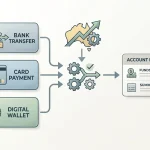
Withdrawal timing spans the operator’s review and the onward payment, so an instant transfer may not mean instant receipt.

A withdrawal is not a single action. It is a sequence: you submit a request, the operator records and assesses it, the funds are authorised for release, and a payment provider or bank moves them to the destination account. The time you experience runs across all of those stages. A payment described as “instant” may refer only to the final transfer, not the interval from clicking the withdrawal button to seeing cleared funds.
There is an important legal context in Australia: the Interactive Gambling Act 2001 prohibits operators from providing real-money online casino games, including slots, to people physically located in the country. The process below explains the mechanics of a withdrawal claim in general; it is not an endorsement of, or recommendation to use, such a service.
When you submit a request, the platform first needs to receive and record it. The request normally identifies the amount and the destination payment details. A confirmation message may show that the request has entered the operator’s system, but that does not by itself establish that the money has been sent. “Requested,” “pending,” “approved” and “paid” can describe different points in the process.
If you’re choosing a casino with quick withdrawals in mind, check the payout details that are actually available before you decide. This list highlights the stated payment speeds and other known details without assuming that missing information guarantees fast cashouts.
Lucky Dreams
Lucky Dreams is listed with a Curaçao license and a minimum deposit of A$20 via POLi. No payout speed is provided here.
DragonSlots Casino
DragonSlots Casino is listed as licensed by the Curaçao Gaming Authority under Jumpman Gaming Ltd. No payout speed is provided here.
Wild Tokyo
Wild Tokyo lists crypto payouts at 30–60 minutes and fiat payouts at 1–5 days. Its minimum deposit is A$10.
MrPacho
MrPacho lists crypto payouts at 30–120 minutes and fiat payouts at 24–72 hours. Its minimum deposit is A$30.
LevelUp Casino
LevelUp Casino is listed with Curaçao eGaming license OGL/2023/174/0082, issued to Dama N.V. Its minimum deposit is A$15; no payout speed is provided here.
Playfina Casino
Playfina Casino is listed as licensed by Curaçao eGaming under Hollycorn N.V. since 2017. Its minimum deposit is A$20–30, depending on the offer.
Roby Casino
Roby Casino is listed with a Curaçao eGaming license under Roby Games Ltd. No payout speed or deposit minimum is provided here.
GoldenCrown
GoldenCrown is listed with Curaçao Gaming Control Board license OGL/2023/176/0095 under Hollycorn N.V. No payout speed or deposit minimum is provided here.
7Bit Casino
7Bit Casino is listed as operating under Curaçao licensing and as operated by Dama N.V. No payout speed or deposit minimum is provided here.
Kingmaker
Kingmaker lists crypto payouts at approximately 90 minutes and fiat payouts at 1–5 days. Its minimum deposit is A$30.
The operator then decides whether it can release the funds. That decision may involve checking the account and transaction against its rules and internal procedures. Until approval is complete, the funds remain under the operator’s control. The transfer system used later cannot make this part happen faster: a fast payment network does not bypass an operator’s pending review.
The timing therefore depends on more than the payment method. A specialist review has noted that withdrawal speed can be affected by several factors, but the useful distinction is between the operator’s work and the transfer itself. The first determines when funds are released; the second determines how quickly released funds reach the destination.
Once a request is approved, the operator must issue the payment instruction. A status that says “approved” may mean the request has passed the operator’s decision stage, while a later status may indicate that the payment has actually been sent. The precise labels vary, so read them as process updates rather than as interchangeable promises.
After dispatch, the transfer travels through the relevant payment system and is credited by the receiving institution or provider. That final stage can be quick or take longer, depending on the route and its processing conditions. A casino cannot make a recipient’s account display the funds merely by marking a request as paid. The payment may still be moving, awaiting settlement, or subject to the receiving provider’s handling.
This explains why an “instant withdrawal” label needs careful interpretation. It may describe the payment phase after approval, while the request is still waiting in an operator queue beforehand. A specialist review reported cases where services promoted instant withdrawals but internal review meant the overall wait could extend to 24 hours. That is a reported example, not a dependable timetable for every operator or request.
A useful way to interpret a withdrawal is to separate its milestones:
These labels are not universal. If a status is unclear, the operator’s terms or support channel should define what it means. In particular, check whether “processing time” starts when you submit the request, when it is approved, or when the payment is dispatched. Without that starting point, two stated timeframes may describe different parts of the same journey.
The amount requested can also intersect with rules that operate beyond a single transaction. A specialist review has noted that weekly or monthly cashout limits may be separate from a per-transaction maximum. Such limits affect what can be released and when, rather than how quickly a transfer network moves funds. Large withdrawals may also be released in instalments under an operator’s policy, so a single request need not correspond to one payment arriving at one moment.
For a quick withdrawal online casino claim, the meaningful question is therefore not simply whether the payment method is labelled instant. You need to know where the clock starts, what must happen before release, what “paid” means, and whether account or cashout rules divide the request into separate payments. The full time from request to receipt is the combined duration of those stages; speed at the final stage cannot erase time spent earlier in the process.
A withdrawal time depends partly on the route used to send the money. E-wallets, bank transfers and card payments do not follow the same payment path, so their completion times can differ even after a withdrawal has been approved. A displayed estimate is therefore best read as a method-specific timeframe, not as a guarantee that the full period from request to receipt will fit within it.
Real-money online casino games, including slots, are prohibited interactive gambling services when provided to people in Australia. The Interactive Gambling Act 2001 makes it illegal for operators to provide those services to people physically located in the country. The timing distinctions below describe how payment routes work; they do not change that legal position.
PayPal and Skrill are examples of e-wallets used for online payments. Their account-to-account payment route can make a withdrawal arrive sooner than one sent through a traditional bank transfer. E-wallet withdrawals are described as being processed within 24 hours, while a specialist review reports that transactions can be completed within hours rather than days. That reported timing is not a fixed promise: the time taken can depend on the service and on when the payment is released.
It is useful to separate processing from receipt. “Processed” may refer to the point at which a payment is handled or sent, while “completed” can refer to the funds appearing in your e-wallet. Those events may be close together, but they are not interchangeable descriptions. When a service gives a timeframe, check whether it refers to its own handling of the withdrawal or to the time for the money to reach the receiving account.
An e-wallet can reduce the time spent in the payment stage, but it cannot make an earlier approval stage disappear. If an operator has not released a withdrawal, the e-wallet provider has no payment to deliver. This is why a route described as quick does not, by itself, establish the time from submitting a request to receiving funds.
A bank transfer sends the funds to a bank account rather than to an e-wallet balance. The route can involve the operator sending the payment and the receiving bank processing it before the balance is updated. Bank transfers and card payments may take several days; one specialist review reports that a traditional bank transfer can take as long as five business days to complete. That is a reported upper timeframe, not a universal schedule for every transfer.
The distinction between business days and calendar days matters. A timeframe expressed in business days does not count weekends in the same way as a calendar-day estimate. Bank processing windows can also affect when a transfer appears, so the elapsed time may not match the number of days you count from the request date.
Reported as a shorter route where transactions can be completed within hours rather than days.
Traditional routes that may take several days, with some reported cases taking up to five business days.
Timing varies by route and the parties processing the payment; depends on the specific terms of the service.
A transfer estimate should also be read alongside the operator’s processing estimate. If the operator’s stated handling period and the bank’s transfer period are separate, the total can include both. A quoted bank-transfer time does not necessarily include time spent waiting for the withdrawal to be approved and sent.
Credit and debit cards are among the payment types that specialist reviews report as available to Australian players, alongside e-wallets and bank transfers. There is no single card timeframe that can be applied to every service: the handling and receipt of a payment depend on the route used and the parties processing it.
A card may also be associated with a payment account rather than functioning as a separate destination in the same way as an e-wallet. The label “card withdrawal” therefore does not explain, on its own, exactly how a particular payment will be returned or when it will appear. The relevant terms should state the available withdrawal route and its estimated processing time.
Prepaid cards and vouchers work differently from debit or credit cards used as payment instruments. A specialist review describes vouchers such as Neosurf as generally available for deposits but not withdrawals. If a voucher is accepted to add funds, do not assume that it can also receive a cashout; the withdrawal method may need to be a different supported route.
The broad comparison is that e-wallets are reported as the quicker route, while bank transfers and card payments may take several days. For traditional bank transfers, a specialist review reports a completion period of as long as five business days. These figures describe reported timings, not guaranteed results for every operator or payment.
The stages represented by those estimates are important. A payment method’s transfer speed applies only once the withdrawal has been sent through that method. If the payment is still awaiting release, choosing a route with a short transfer time cannot shorten the waiting that comes before it. Likewise, an estimate for processing does not necessarily tell you when the funds will be visible in your account.
When comparing payment terms, look for the exact method name and the point at which its stated timeframe begins. Check whether the estimate is expressed in hours, days or business days, and whether it describes approval, dispatch or receipt. Those distinctions make a larger practical difference than a broad label such as “instant” or “quick.”
Some specialist reviews report that Australian-facing services offer cards, PayPal, Skrill and bank transfers, with cryptocurrency available at some services. Availability is not uniform, and a method listed for deposits is not necessarily available for withdrawals. The route offered for receiving funds is the one that matters when comparing cashout timing. A service’s terms should clarify which payment options can be used to withdraw and the applicable processing times.
For a useful comparison, treat the timeframe as one part of the payment route rather than as a standalone speed claim. An e-wallet may have a shorter reported payment period than a bank transfer, but the total wait still depends on when the payment is released and how the receiving service handles it. A card estimate may cover several days without specifying exactly when the funds will appear. Reading the method, timing unit and stated start point together gives you a clearer picture of what each estimate actually describes.
PayID is Australia’s bank-to-bank payment system, operating through the New Payments Platform (NPP). Transfers can move in real time through the Osko network, but that describes the bank payment stage—not the full time between requesting a withdrawal and receiving money.
There is an important legal distinction in Australia: providing real-money online casino games, including slots, to people in the country is prohibited under the Interactive Gambling Act 2001. The explanation below describes how PayID transfers work; it is not a recommendation to use an online casino.
A withdrawal has two separate stages. First, the operator must receive and assess the request, then release the funds. Only after release does the PayID transfer stage begin. If the operator has not approved or sent the payment, the NPP cannot make it arrive sooner. This is why “instant” can describe the transfer from the operator’s payment account to your bank account without meaning that the request-to-receipt process is instant.
If an operator’s withdrawal form supports PayID, the described request process is to sign in, open the Wallet or Withdrawal area, enter your PayID identifier, specify the amount and confirm. The submitted request is not the same as a completed transfer: it still has to be handled by the operator before the payment can be sent. Once released, the transfer can use the real-time infrastructure associated with PayID and Osko.
That division also explains why published timing claims can differ. A specialist review has reported PayID withdrawals taking under five minutes at the operators it assessed. Treat that as a report about particular services, not a guaranteed timing for every request. The operator’s approval process, the payment details entered and the receiving bank’s handling can all affect what you experience. PayID’s real-time capability applies to the payment rail; it does not control the operator’s internal decision or prove that a particular request has been approved.
Before confirming a request, check that the PayID identifier is correct and that the receiving account is the one linked to your profile. An incorrect or mismatched detail can prevent a successful transfer or require the payment to be reviewed. Keep the confirmation screen or transaction reference so you can identify the request if you need to ask about its status.
When checking a payment status, distinguish between “requested,” “approved” or “released,” and “received.” A request awaiting operator action has not entered the bank-transfer phase. A released payment that has not appeared in the account is a different issue from a request still being reviewed. That distinction helps you describe the point where the process has stopped without assuming that the word “instant” applies to every stage.
PayID’s central advantage is therefore specific: once a payment has been released, the transfer can move in real time between bank accounts through the NPP and Osko. It cannot remove the time or checks that occur before release, and no label should be read as a promise of immediate receipt from the moment you submit a withdrawal request.
A withdrawal can remain pending even when the payment service itself supports rapid transfers. The delay may occur before the operator releases the funds, or after release while the receiving bank processes them. For people in Australia, this concerns withdrawals from offshore services: the Interactive Gambling Act 2001 prohibits operators from providing real-money online casino games to customers physically located in Australia.
Legal Prohibition
The Interactive Gambling Act 2001 prohibits operators from providing real-money online casino games to people physically located in Australia.
A specialist review identifies first-time identity checks, requests above $2,000, and bank processing windows as possible causes of delay. These are triggers to investigate, not a universal timetable: an operator’s procedures and the circumstances of a request determine what happens next. A request may also need manual attention if its details do not match the account information or if the operator applies an additional review.
A pending status can mean that the operator has not yet authorised the payment. A review may pause release while staff assess the request or seek information. Once the operator sends the funds, the receiving institution’s processing schedule can still affect when they appear in your account. A transfer that reaches a bank outside its processing window may not be reflected immediately, even if the payment network can move funds quickly.
This distinction matters when interpreting claims about an instant withdrawal. “Instant” can describe only the payment phase after operator approval; it does not mean the complete request-to-receipt process is immediate. If the request is waiting for review, faster transfer infrastructure cannot remove that wait. If the operator has released it, the remaining timing depends on the route and the receiving bank’s handling.
Bank processing windows are also different from a review hold. The first concerns when a financial institution handles a payment; the second concerns whether the operator has authorised it. Checking the withdrawal status and any message attached to the request can help identify which stage is still active, without assuming that every delay has the same cause.
Operators may apply withdrawal limits under their own policies, and the amount requested can affect how a cashout is handled. A report by filmink.com.au notes that limits and possible transaction fees can be relevant to PayID withdrawals. Separately, a specialist review flags requests above $2,000 as a possible review trigger. That figure should not be read as a standard threshold used by every operator: the applicable rules depend on the service’s terms and review process.
A request above a stated threshold may be routed for manual assessment rather than cleared automatically. Large withdrawals may also be released in instalments under an operator’s policy, so the full balance may not arrive as one payment. These conditions affect the path and timing of a request; they do not establish when any particular operator will complete it.
Before submitting a cashout, check the operator’s published terms for applicable limits, review conditions, and processing windows. If a request is delayed, distinguish between a pending operator decision and a payment already sent but not yet shown by the bank. That distinction gives you a more useful basis for understanding the delay than the word “instant” alone.
A withdrawal limit determines how much you can request in one transaction and whether a cashout can be completed in a single request. Before relying on any payment option, read the applicable terms and check both the minimum and maximum amounts. A specialist review reports that reputable PayID casino services publish these limits clearly, but a published figure is useful only if you know which rule it describes.
Withdrawal Limits
Per-transaction maximums may be separate from overall weekly or monthly cashout caps, and large withdrawals may be released in instalments.
A per-transaction maximum is not necessarily the only restriction. The terms may also set an overall cashout limit across a period, so check whether separate weekly or monthly caps apply. If a request exceeds an operator’s policy, it may not be handled as one payment; large withdrawals may be released in instalments under the operator’s rules. That can change how much you receive in each payment and when the remaining balance is released. Do not assume that a maximum shown beside PayID covers every limit on your account.
Fees need the same attention. A report by Filmink notes that a transaction fee may apply when PayID is used for a withdrawal. The relevant terms should clarify whether a charge applies, how it is calculated and whether it is deducted from the requested amount or handled separately. If the fee is not clear, ask the service to explain it before confirming the transaction. A small-looking charge can affect the amount that reaches your account, so compare the net amount rather than the requested amount alone.
Read the withdrawal conditions as a set: minimum, maximum, any broader cashout cap, possible instalments and fees. Then check that the rules apply specifically to withdrawals through your selected route. Deposit limits and withdrawal limits are not interchangeable. A service’s headline payment information may not show every condition that affects a cashout, so rely on the detailed terms rather than assuming that one figure or a “no fee” label tells the whole story.
A withdrawal route is shaped partly by how the deposit entered the account. Operators generally require funds to be returned to the original deposit method where that is possible. This can limit the routes shown when you request a cashout: a payment method available for depositing is not necessarily available for receiving withdrawals.
The reason is that deposits and withdrawals are separate payment flows. A provider may support a casino deposit without supporting a return payment, or the operator may need to use another route under its payment rules. If the original method cannot receive funds, the withdrawal options and any alternative instructions depend on the operator’s terms. Check those terms before depositing, rather than assuming that the same button will be available in reverse.
Some specialist reviews have reported that real-money casino services have offered instant banking through providers such as POLi. That describes a deposit service, not a promise that a withdrawal will use the same channel or arrive immediately. The provider’s role in moving money into an account does not determine how the operator sends money out. A listed banking option therefore tells you little about withdrawal eligibility unless the cashout terms explicitly confirm it.
Before making a payment, check which methods are accepted for deposits and withdrawals, whether returns to the original method are supported, and what alternatives apply if they are not. Use payment details linked to your casino profile, and make sure the account receiving a withdrawal belongs to you. These checks help you identify routing constraints before funds are in the account; they do not remove any review or processing steps that may apply.
There is also an important Australian legal context: the Interactive Gambling Act 2001 prohibits operators from providing real-money online casino games, including slots, to people physically in Australia. This explanation is not an endorsement or offer of such a service. If you are examining payment terms, distinguish a provider’s ability to process a transaction from the legality of the underlying gambling service.
Verification Tip
Complete all identity verification steps before requesting your first cashout to reduce avoidable back-and-forth and friction.
A first cashout can be the point at which an operator asks you to confirm who you are. Specialist reviews report that initial withdrawal requests may prompt identity checks. This is separate from the transfer itself: the operator needs to establish that the account and the person requesting payment match before processing a withdrawal.
The review may involve checking information already supplied during registration against documents or other details you provide. If the information is incomplete, inconsistent or difficult to verify, the request may remain pending while the operator seeks clarification. That does not mean the payment route has failed; the operator may not yet have released the funds for transfer.
For real-money platforms, identity verification is required before a withdrawal is processed. Treat a “no verification” claim with care: it does not remove that requirement. A quick payment method cannot make funds available while an account check is still unresolved, because the transfer phase begins only after the operator approves and releases the withdrawal.
You can reduce avoidable back-and-forth by completing the account’s verification steps before requesting a cashout. Use accurate, consistent account details, follow the operator’s document instructions, and check messages or account notifications for requests for further information. If the operator asks for clarification, respond through the account’s stated support channel and ensure your reply addresses the specific point raised.
Completing verification early can significantly reduce friction on later withdrawals. Once the account has been checked, a subsequent request may not need the same initial review, although that does not guarantee approval without further checks. An operator may still need to confirm details if the account information changes or a later request cannot be matched confidently to the verified profile.
The practical distinction is simple: verification establishes whether the account is cleared for withdrawal processing; payment timing concerns how long the funds take to arrive after release. Preparing the account in advance addresses the first stage, not every factor that can affect the eventual receipt of funds.
A balance shown after slot play is not necessarily available to withdraw. If it includes promotional funds, the terms attached to those funds may require wagering to be completed before a cashout can be requested. The relevant question is therefore not only how much the account displays, but which parts of that balance are withdrawable under the promotion’s rules.
In Australia, the Interactive Gambling Act 2001 prohibits operators from providing real-money online casino games, including slots, to people physically located in the country. The following explains how bonus conditions affect withdrawal eligibility as a general feature of online casino terms; it is not an offer of those services to Australian players.
A wagering requirement sets a condition that must be met before bonus-related funds can be withdrawn. Until it is complete, the operator may treat some or all of the balance as restricted. A withdrawal request made before meeting the condition may therefore be declined, or the bonus and associated winnings may be removed under the stated terms.
A specialist review describes two bases for wagering: the requirement can apply to bonus funds alone, or to the combined value of the deposit and bonus.
The exact rule depends on how the promotion defines the amount that must be wagered. A specialist review describes two possible bases: the requirement can apply to bonus funds alone, or to the combined value of the deposit and bonus. Bonus-only wagering is preferable because the required activity is calculated against a smaller base than when the deposit is included as well. The terms should identify which calculation applies; the word “bonus” by itself does not tell you.
For instance, if a promotion says wagering applies to the combined deposit and bonus, depositing money does not make that deposit automatically withdrawable while the condition remains unmet. If the rule applies only to the bonus, the deposit and bonus are treated differently under the promotion. The precise balance available at any point still depends on the operator’s written terms and how they account for play.
Before attempting to withdraw, confirm that all bonus wagering requirements have been met. Look for the calculation basis, what activity counts towards completion, and any restrictions that define when the promotion ends or its funds are forfeited. If the terms are unclear about whether the deposit is included, ask the operator to explain the rule before accepting or using the offer.
This matters because a displayed balance can combine money with different conditions. The account may show a total without making the withdrawal status of each component obvious. Check the promotion details and account information rather than assuming that a balance available for play is also available for withdrawal.
A quick withdrawal from slot winnings is not possible while the funds remain ineligible under an active bonus condition. That is an eligibility issue, not a transfer-speed issue: choosing a payment route cannot make an unmet wagering condition complete. Review the promotion first, then request a withdrawal only when the applicable requirements have been satisfied.
Bonus terms can also differ between offers, so do not carry a rule from one promotion over to another. Read the terms tied to the specific offer you accepted. Where wagering applies to both deposit and bonus, assess that combined basis before treating any resulting balance as cashable. Where wagering applies only to bonus funds, keep that distinction clear when checking whether the deposit itself is subject to the condition.
When a payment route is used to fund an account, the operator may require a withdrawal to return through that route where possible. This links the outgoing payment to the method already associated with the account. If you used PayID to deposit, for instance, the withdrawal request may need to use the same PayID details rather than a different identifier.
The account details matter as much as the payment method. A request sent to another person’s account, or to details that are not linked to your profile, may not match the operator’s records. That mismatch can prevent the requested route from being used and may lead to the operator asking for another eligible method. Only use payment details that belong to you and are connected to the account.
Before making a deposit, check the payment and withdrawal terms together. A method shown as available for deposits is not necessarily available for cashouts. Prepaid cards and vouchers, for example, may be deposit-only; if a route cannot receive withdrawals, the operator may specify an alternative. Confirming this beforehand helps you understand how funds could be returned without assuming that the original payment method will always be supported.
If you have already deposited, keep the same payment details available when requesting a withdrawal. For PayID, that means entering the identifier associated with the deposit, not substituting another PayID because it is easier to access. Where the original route is unavailable, follow the operator’s stated procedure and use only an account linked to your profile.
These routing rules do not make a cashout instant: they concern where a payment may be sent, not how quickly it is released or received. Also, Australian law prohibits operators from providing real-money online casino games, including slots, to people physically located in Australia. This explanation describes payment-routing mechanics and is not an offer of access to those services.
Compare how long approval takes with the transfer time after funds are released, and check what each withdrawal status means. Also look for clearly published withdrawal limits, identity-verification requirements and payment-method rules; a fast transfer method cannot skip an operator’s review.
E-wallet withdrawals are often completed within hours and are typically processed within 24 hours, while bank transfers and card payments can take several days; traditional bank transfers may take up to five business days. PayID transfers can arrive almost instantly once the operator releases them, but reviews, verification and limits can add time.
Available methods can include credit and debit cards, PayPal, Skrill, bank transfers and, at some sites, cryptocurrency. PayID is another near-instant bank-to-bank transfer option; prepaid vouchers such as Neosurf are generally for deposits, not withdrawals.
They are online casino sites that promote a straightforward or fast cashout process. The actual wait includes the operator’s review and release of funds as well as the time taken by the payment method to deliver them.