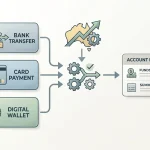
E-wallets move funds between a supported funding source and casino account, while operator rules determine available deposit and withdrawal options.

An e-wallet is a payment account that sits between your bank or other funding source and a casino’s payment system. It is separate from the casino account you use to access games. The casino account records your login and the balance available for play; the e-wallet holds funds outside that account and moves money between it and the casino, where the operator permits the transaction.
The payment chain has two distinct transfers. First, you add funds to the e-wallet from a supported source. Then you instruct the casino to take a deposit from that wallet. The casino credits its own account balance after it receives and records the payment. The wallet is not where your casino balance is stored, and having money in the wallet does not by itself make it available to play.
Names you may encounter include MiFinity, Skrill and Neteller. These e-wallets are used for both deposits and withdrawals, though a particular operator may not support every wallet or every transaction direction. The available method depends on the operator’s payment rules, so the name of a wallet alone does not establish that it can be used to fund or cash out from a particular casino.
Choosing an online pokies site with e-wallet payments means checking the details that matter to you before you deposit. Use these brief operator notes as a starting point for your comparison.
Lucky Dreams
Lucky Dreams lists a minimum deposit of A$20 via POLi and a Curacao licence. You can use these details to assess whether its deposit option and licensing information suit your needs.
DragonSlots Casino
DragonSlots Casino is listed with a Curacao Gaming Authority licence under Jumpman Gaming Ltd. This gives you the stated licensing and operator information to consider.
Wild Tokyo
Wild Tokyo lists a minimum deposit of A$10 and payouts of 30–60 minutes for crypto or 1–5 days for fiat. You can weigh those stated deposit and payout details against your preferences.
MrPacho
MrPacho lists a minimum deposit of A$30, with crypto payouts in 30–120 minutes and fiat payouts in 24–72 hours. These details give you a clear snapshot of its stated deposit and payout terms.
LevelUp Casino
LevelUp Casino lists a minimum deposit of A$15 and a Curacao eGaming licence, OGL/2023/174/0082, under Dama N.V. You can review these stated details when considering the operator.
Playfina Casino
Playfina Casino lists a Curacao eGaming licence held by Hollycorn N.V. since 2017. Its stated minimum deposit is A$20–30, depending on the offer.
Roby Casino
Roby Casino is listed with a Curacao eGaming licence under Roby Games Ltd. That licensing information is the stated detail available for you to consider.
GoldenCrown
GoldenCrown is listed with a Curacao Gaming Control Board licence, OGL/2023/176/0095, under Hollycorn N.V. You can use this licensing detail as a starting point for further checks.
7Bit Casino
7Bit Casino is listed as operating under a Curacao licence, with Dama N.V. as its operator. This is the available licensing information for you to take into account.
Kingmaker
Kingmaker lists a minimum deposit of A$30, with crypto payouts at about 90 minutes and fiat payouts in 1–5 days. You can compare those stated terms with your own deposit and payout preferences.
A deposit can therefore be understood as a sequence of records: a debit from the wallet, a payment instruction to the casino, and a credit to the casino balance. If the casino does not register the credit, the wallet balance and casino balance may temporarily show different states. That difference does not necessarily mean the money has disappeared; it means the payment has not yet been reflected in both systems. Check the transaction status in the wallet and the casino account rather than treating either balance as a complete view of the transfer.
A withdrawal reverses the direction of the payment, but it is not simply a button that moves money instantly from a game to a wallet. The casino first records a withdrawal request against the casino balance. After the operator’s pending period, it sends the approved amount through a payment route, and the wallet then records the incoming funds. The casino’s release of a withdrawal and the wallet’s receipt of it are separate steps, so a request marked as submitted may not yet appear as a completed wallet transaction.
A specialist review reports that e-wallet withdrawals can arrive within 24 hours after the casino’s pending period. Treat that as a reported processing pattern, not a promise for every operator or transaction: the casino’s own handling happens first, and the timing can depend on its procedures and the payment route. The key distinction is that the pending period belongs to the casino’s processing stage; the wallet transfer begins after that stage ends.
 Casinos by Feature for Australian PlayersBrowse casino listings by deposit minimums, mobile access, withdrawal speed, payment options and other features relevant to Australian players.
 $5 Minimum Deposit Casinos in Australia: What to KnowLearn why a $5 advertised deposit may not be usable across games, payments or bonuses, and how the Interactive Gambling Act 2001…
This separation also explains why a casino balance and an e-wallet balance should not be confused when checking a payment. Money shown in the casino account is controlled by the casino’s balance system. Money shown in the wallet is controlled by the wallet provider. A deposit moves value from the second system into the first; a withdrawal, once released, moves it back. Each system can display its own status, and those statuses may not update at the same moment.
For an Australian reader, the term “e-wallet pokies” describes a payment arrangement, not a separate kind of casino account. It does not mean the wallet supplies the games, holds the casino login, or guarantees that a payment route is available. Nor does naming a payment provider establish that an offshore operator is authorised to provide online casino-style games in Australia. The Interactive Gambling Act 2001 prohibits operators from offering those services to people located in Australia. This explanation describes how a payment chain works; it is not a recommendation to use an offshore casino.
The practical way to read the chain is to identify where the money is at each stage: in the funding source, in the e-wallet, in the casino account, or on its way back to the wallet. If a transfer appears incomplete, first identify which stage has not updated. A wallet debit without a casino credit points to the deposit transfer or casino recording stage; a casino withdrawal request without a wallet receipt means the payout has not yet completed its return path. Keeping the wallet and casino account conceptually separate makes those states easier to interpret without assuming that one balance automatically controls the other.
A casino account and an e-wallet account are separate accounts, even when the same e-wallet is used to move money between them. Your casino login identifies you to the operator and gives access to your balance, games and transaction history. Your e-wallet login gives you access to the payment service and its balance. Signing in to one does not sign you in to the other, and a successful casino login does not by itself confirm that a withdrawal can be released.
This distinction matters when you use an e-wallet for real-money play. A deposit involves an instruction from the casino account to send funds through the selected payment method. A withdrawal is a separate transaction that the casino must approve before money can be sent out. The e-wallet is the destination or route for that payment; it does not decide whether the casino has approved it.
When registering, enter information that matches the identity and payment details you may later need to verify. If the name or other identifying details on a casino account differ from those on the e-wallet, the mismatch can prompt questions or prevent a transaction from being processed. The exact checks and acceptable documents depend on the operator’s rules, so read those before depositing rather than assuming that access to the account is all that will be needed.
 $5 Minimum Deposit Pokies in Australia: What to KnowLearn why a stated $5 floor may not work across payment methods, and how Australia’s reported $10–$20 AUD usable-deposit estimate affects real-money…
 A $10 Minimum Deposit Casino in AustraliaThe operator sets no deposit minimum, but payment routes may impose their own. See how transaction limits, bonuses and withdrawals affect a…
Also make sure you can still access the e-wallet used for a deposit. Losing access to it, closing it, or using a different wallet for a later payment can complicate the withdrawal route if the casino expects money to be returned through the original method. Keep your casino and e-wallet credentials private, and use each service’s own sign-in process. A payment confirmation from the wallet is not the same as confirmation that the casino has credited the funds or approved a cashout.
A first withdrawal commonly triggers identity verification, often called KYC. The casino may ask for identification, a selfie, and proof of address. These checks are intended to establish that the account belongs to the person requesting payment. They are distinct from the e-wallet’s own login or any verification that the wallet provider may conduct.
Prepare to submit clear, current documents through the casino’s stated verification process. Check that the information is legible and that the details match the casino account. If a document is unclear, incomplete or inconsistent, the operator may request another submission before reviewing the withdrawal. Do not send identity documents through an unverified message or link; use the account area or contact route provided by the service and confirm that it is genuine.
Verification can affect when a withdrawal is released because the operator may review the account before approving the transaction. A withdrawal request showing as submitted is not necessarily a completed payment. Check its status in the casino account, and distinguish a request awaiting review from one that has been approved and sent. If the status is unclear, ask support what remains outstanding and whether any document or account detail needs attention.
Identity Verification
Submit Documents
Provide clear and current identification, a selfie, and proof of address through the casino's official verification process.
Match Details
Ensure that the provided documents are legible and that the information matches the details on your casino account.
Monitor Status
Distinguish between a withdrawal request that is merely submitted and one that has been approved and sent.
Some casinos require a withdrawal to go back through the method used for the deposit. Others treat particular payment methods as deposit-only, meaning they can accept funds but cannot receive a cashout. A specialist review describes these as operator-dependent conditions, not a single rule that applies to every casino. Read the payment and withdrawal terms for the specific account before making a deposit.
This is why the presence of an e-wallet option on a deposit page does not prove that it is available for withdrawals. Check whether the same wallet can be selected for both directions, whether the wallet account must be in your own name, and what alternative route applies if the original method cannot receive funds. If the terms require the original method, using another e-wallet later may not change that requirement.
For a withdrawal request, compare the casino’s selected destination with the payment method you used and the method shown in the account’s transaction records. If the casino asks for additional information, resolve that request through its official account or support channel rather than submitting a second, conflicting withdrawal request. Keep confirmations and messages so you can describe the transaction accurately if you need help.
Before entering personal or payment details, establish whether the service accepts your location and understand the limits of using an offshore operator. The Interactive Gambling Act 2001 prohibits operators from offering online casino-style games to people in Australia. An e-wallet login does not change that legal context or make an operator’s withdrawal obligations easier to enforce. Do not treat a successful deposit, a verified wallet or an open casino account as assurance that a withdrawal will be approved.
 $10 Minimum Deposit Pokies in AustraliaLearn how operator and payment-method thresholds affect whether a $10 deposit can be completed, and why the amount shown in the cashier…
 $20 Minimum Deposit Casinos in Australia: How Limits WorkLearn why a casino’s stated minimum may differ from the amount accepted at checkout, where payment providers and processors can set their…
A payment-method list for Australian punters is a snapshot of what a particular operator says it accepts, not a standard that applies across every site. Availability can depend on the operator’s payment arrangements, the punter’s location, the currency selected and whether a method supports deposits, withdrawals or both. A method appearing in a general guide does not establish that it will be offered at the cashier you see.
That distinction matters with e-wallets. MiFinity, Skrill and Neteller are used for deposits and withdrawals at some casinos, but their presence on one site does not guarantee availability on another. The cashier is the practical check: it shows the options the operator currently makes available to your account. Read the payment terms as well, because a method displayed for deposits may not be available for cashouts.
Lists can also become outdated. POLi is an important example: it stopped operating in Australia in September 2023 and no longer processes local transactions. A page that still presents POLi as a working Australian option may be reusing old information. This does not mean every list is unreliable; it means you should check its date and confirm the method directly with the operator before relying on it.
A specialist review describes PayID, POLi, BPAY, cards and cryptocurrency among deposit methods found at mobile casinos, but that should be read as a report of options across sites, not a universal cashier menu. The distinction is especially useful when a list groups payment methods together. It may describe what one or more operators have offered, without showing which options remain active, which are limited to deposits, or which are available to customers in Australia now.
E-wallets used for deposits and withdrawals at some casinos, though availability depends on the operator's rules.
A near-instant deposit option that is typically free, provided the receiving service supports it.
A previously important Australian option that stopped operating in September 2023 and no longer processes local transactions.
When comparing options, look for the precise method name in the cashier and then check its terms. A brand name alone may not answer whether the method is supported for your location, whether it can receive withdrawals, or whether the displayed option is subject to additional conditions. If the cashier does not show the method, treat it as unavailable to your account unless the operator confirms otherwise.
It also helps to separate a payment brand from the payment route. A site may accept a bank-related method, a card or an e-wallet, but the route and conditions can differ between operators. The broad category does not tell you what the cashier will actually process. Nor should a payment option shown in a mobile interface be assumed to be available in the desktop cashier, or vice versa; check the account interface you intend to use.
For a useful comparison, record each method under two headings: deposits and withdrawals. This prevents a common misunderstanding in which a method appears in a deposit list and is assumed to work in both directions. Some casinos restrict particular options to deposits, while others set rules about which route can be used for a withdrawal. Check the cashier and the payment terms before depositing, rather than treating a general list as confirmation.
A method being available does not establish how quickly a withdrawal will reach you. The casino may first keep a withdrawal request pending before releasing it for payment. Only after that stage does the payment provider’s part of the process begin. A specialist review reports that e-wallet withdrawals arrive within 24 hours after the casino’s pending period, but this is a reported timeframe, not a promise that every operator or transaction will follow it. The pending period itself can add time before the transfer is sent.
This is why a displayed payout estimate needs context. Check whether the stated time starts when you submit the withdrawal, when the casino approves it, or when the payment provider receives it. Those are different points in the chain. For exact comparisons between AUD payment routes, the relevant details are the operator’s current terms and the status shown for your transaction.
A list can still help you identify methods to investigate, but it cannot replace those checks. Confirm that the option appears in the cashier for your location, establish whether it is deposit-only or supports withdrawals, and read the conditions attached to it. That gives you a more reliable picture than assuming an Australian payment list applies uniformly across every casino.
An AUD transaction has more than one clock. A deposit can be delayed before it reaches an account, while a withdrawal can involve a casino’s release process followed by the payment provider’s transfer time. These stages should not be treated as one guaranteed completion window. The method, the operator’s handling of the transaction and the banks involved can all affect when the money appears.
An AUD transaction involves multiple stages, including the casino's release process and the payment provider's transfer time, meaning there is no single guaranteed completion window.
PayID is described in a specialist review as a near-instant deposit option that is typically free. That is a report about the method, not a promise that every transaction will arrive immediately or that every service will offer it. The receiving service must support PayID, and the payment details have to match the instructions provided. If a transfer is delayed, check its status with the relevant provider rather than sending another payment: a duplicate can create a separate transaction to trace.
Bank transfers behave differently, particularly for withdrawals. A specialist review reports that a bank transfer can take up to five business days to arrive. This is a possible transfer window, not a countdown that begins when you request a payout: the receiving bank cannot process funds it has not yet been sent. Weekends and public holidays can also mean that a business-day estimate does not map neatly to calendar days. Check whether a displayed status refers to a request awaiting release or a transfer already sent.
The distinction matters because a payment marked as pending has not necessarily entered the banking system. Once the sender has released it, the remaining delay may be outside the sender’s direct control. If the expected period has passed, a useful first step is to establish whether the transfer was actually initiated and obtain its transaction reference. Then ask the bank or provider whether it can locate the payment. Repeating the request before the first transfer is traced can make the situation harder to resolve.
Card payments have a different failure point: the issuing bank may stop the charge before it is completed. A specialist review notes that some Australian banks flag or block gambling-related card transactions, which can lead to a declined deposit. A failed card charge does not by itself show whether the problem is the card, the merchant processing route or the bank’s decision. Check the transaction status with the bank and do not assume that changing the amount or retrying repeatedly will resolve a block. Do not attempt to bypass a bank restriction.
An e-wallet introduces another step between a bank account or card and the casino balance. The wallet may show a separate balance and its own transaction status, so a delay can occur at the funding stage or at the transfer from the wallet to the recipient. A displayed AUD amount also does not, on its own, establish that every part of the route settles in Australian dollars. Check the currency and any conversion information shown before confirming a transaction. Timing estimates for one payment route should not be applied automatically to another.
When comparing payment timing, identify which event an estimate describes: payment approval, the operator’s release of a withdrawal, or arrival in a bank account. Those are different events. A “processed” status may mean the sender has completed its step, not that the receiving account has been credited. Conversely, a deposit that appears to have failed may still be awaiting a decision from the bank. A transaction record can help you distinguish a completed payment from one that is pending or declined.
Keep the amount, date, payment method and reference associated with each transaction. If the status is unclear, use the provider’s official support channel and give them the reference rather than sharing sensitive account details in a public forum. Avoid sending another payment while the first one remains unresolved. That precaution is especially relevant where a bank has flagged a card charge: repeated attempts may be declined again and may not clarify the original transaction.
Legal Restriction
Online casino-style games offered to people in Australia are prohibited under the Interactive Gambling Act 2001.
These timing details describe payment behaviour, not a guarantee that an offshore casino will accept an Australian punter, release a withdrawal or provide a lawful service. Online casino-style games offered to people in Australia are prohibited under the Interactive Gambling Act 2001. A quick deposit method does not remove that restriction, and no payment estimate should be read as assurance that funds will be available by a particular time.
On a phone, access to an offshore crypto-friendly casino that accepts Australian punters is generally through its website rather than a separate app. The site opens in your mobile browser, and you use the same account you would use on a desktop computer. The phone changes how the pages are displayed and controlled; it does not create a separate casino account.
The word “e-wallet” describes a payment method, not a type of mobile app. You can visit a casino website in a browser whether or not you have an e-wallet app installed. The two apps, if you use both, perform different jobs: the browser displays the casino site, while the e-wallet app manages access to the wallet service. A payment step might send you from one to the other, but that does not make the casino itself an e-wallet app.
Browser play is the usual access route because casino apps are seldom available through the Australian Google Play Store or Apple App Store. A casino website may be designed to fit a phone screen, with menus and controls arranged for touch input. Opening it in the browser also means you can return to the same account from another device, subject to the site’s own access rules.
Some websites offer a Progressive Web App, or PWA. This is still the casino website, presented through a home-screen shortcut that can behave more like a native app. If the site provides an installation prompt, you can tap it, choose the option to add or install the shortcut, and confirm. The exact wording and placement of the prompt can differ between browsers and devices.
A PWA does not mean that a separate casino program has been downloaded from an app store. It gives you a direct way to open the website, often without first typing its address into the browser. The content still comes from the site, so a shortcut cannot fix a website that is unavailable or a connection that is failing. If you remove the shortcut, that does not by itself delete your casino account.
For a mobile session, check that the address bar shows the intended website before entering account details. A shortcut can make a site easier to reopen, but it does not verify that the page is genuine. Do not assume that a search result or an installation prompt proves the operator is suitable for your location. Confirm that the site accepts Australian users before depositing.
A specialist review identifies weak connectivity, limited available memory, an outdated browser and too many apps running at once as possible causes of mobile problems. These conditions affect different parts of the session. A poor connection can interrupt the exchange of data between the phone and the website. Low memory can make a browser tab reload or close. An old browser may fail to display newer site features correctly, while background apps can compete for memory and processing capacity.
A useful way to diagnose a fault is to change one condition at a time. If a page stalls, check whether other websites load on the same connection. If they do not, the connection is a more likely cause than the casino page. If other sites work, close unused apps and reopen the casino page. If the problem continues, update the browser where an update is available, then try loading the page again.
A page that reloads when you switch away from it may have been closed to free memory. Keep the casino tab in the foreground while checking whether it remains stable. If only one feature fails, reload the page before changing several phone settings; a temporary loading problem can look like a device fault. If the same issue persists in the updated browser, record what you were doing when it occurred and contact the operator through its stated support channel.
Avoid installing a casino file from outside an app store merely because the site suggests it as an alternative. Sideloaded apps carry security risks, and their safety depends on the operator. A browser or PWA avoids that particular installation route, but neither guarantees that the operator is trustworthy. VPN access also carries a separate risk: using a VPN to reach a blocked casino may lead to winnings being voided or the account being closed. If an offshore casino refuses to pay, there is no Australian government body to which you can complain for payment recovery.
Australian law draws a distinction between the conduct of an operator and that of an individual punter. Under the Interactive Gambling Act 2001, operators must not provide real-money online casino-style games to people in Australia. That includes pokies and other casino games offered over the internet. The law does not make it an offence for an individual in Australia to play at an offshore mobile casino, but that does not make the service locally regulated or remove the risks of using it.
Access can also be unreliable. The Australian Communications and Media Authority (ACMA) works to restrict access to illegal gambling services, so a site that opens today may later be blocked by an internet provider. A blocked page is not evidence that an operator has changed its terms or resolved a payment dispute; it may reflect enforcement action. Do not try to bypass a block with a VPN. A casino may treat VPN use as a breach of its rules, which can lead to account closure or forfeiture of winnings.
An offshore crypto-friendly casino operates outside Australia’s local online-casino framework. Curaçao, the Malta Gaming Authority and Gibraltar are among the jurisdictions associated with licences used by casinos that accept Australian players. A licence from a foreign jurisdiction is not an Australian licence and does not give you access to Australian consumer or gambling protections.
Attention A foreign licence does not provide you with Australian consumer or gambling protections, and there is no local body to compel an offshore casino to pay winnings.
Before entering personal details or depositing, confirm directly in the casino’s terms that it accepts customers located in your state or territory. Acceptance can depend on where you are physically located, and a site appearing in a search or loading on your device does not confirm that you are eligible. You must be at least 18 to register and gamble in Australia; an offshore operator’s registration screen does not replace that requirement.
There is no Australian government body that you can approach to compel an offshore casino to pay winnings if it refuses. A foreign licensing authority may have a complaint process, but its powers and procedures are not the same as those of an Australian regulator. Consider this limitation before sharing documents, sending funds or relying on a casino’s description of its dispute process.
Casinos that accept Australian players commonly rely on a mobile website or a Progressive Web App rather than an app-store listing. If a casino asks you to download an app file directly and install it outside the official store, that is sideloading. The security of that file depends on the operator: the installation route itself does not establish that the software is safe. It may also ask for device permissions that are not necessary for ordinary browser access. Avoid installing an app unless you can verify the operator and understand what access the app requests.
These checks do not make an offshore service risk-free. They help distinguish the legal position of the operator from the position of the individual punter, and expose practical issues that a working payment option or accessible website cannot answer. Do not treat a foreign licence, a successful login or an available e-wallet as proof that an operator is authorised in Australia, will accept your location, or will resolve a dispute in your favour.
A bonus is not the same as withdrawable cash. Its practical value depends on the conditions attached to it: how much wagering is required, which games count, how long you have to meet the requirement, and whether a cap limits what can be cashed out. Read those terms before claiming, including for a no-deposit offer associated with an e-wallet. The payment method does not remove the bonus conditions.
Wagering requirements state how much qualifying play must take place before bonus-linked funds or winnings become eligible for withdrawal. A specialist review describes welcome-bonus requirements in the 30x–50x range and treats requirements above 40x as steep. The multiplier alone does not tell you the full cost: check whether it applies to the bonus, the deposit, or both, and how the operator counts each wager. If the terms are unclear about the calculation, you cannot reliably estimate the work required to clear the bonus.
A minimum-deposit condition can also change the offer’s value. A bonus may be available only after a qualifying deposit, so compare that threshold with what you intended to deposit rather than increasing your deposit just to unlock the promotion. For a no-deposit bonus, check what the operator requires before any winnings can be withdrawn; the label does not establish that the resulting balance is immediately cashable.
Game restrictions affect progress. The terms may exclude particular games or count wagers on different games at different rates. If a game contributes little or nothing toward wagering, playing it may use your balance without bringing you closer to completion. Check the eligible-game list and contribution rules before you start.
Expiry dates set the period in which you must satisfy the conditions. A specialist review reports that some bonuses have a 7–10-day clearance window; treat that as an offer-specific term, not a universal deadline. If you cannot meet the stated requirement before expiry, the bonus may be lost.
Finally, check the cashout cap: it can limit the amount withdrawable from bonus play even after wagering is complete. Review that cap alongside the wagering calculation, deposit threshold, game restrictions and expiry date. These terms determine the bonus mechanics; they are separate from whether a payment method is available or how a casino account is accessed. If any condition is missing or ambiguous, do not claim until you understand how it applies.
Yes. Social and free-play casino apps using virtual credits are available in Australia through the Google Play Store and Apple App Store.
Yes, PayID is available as a mobile casino deposit method and is near-instant and typically free. Casino-style games offered by offshore operators are prohibited in Australia, and many operators are accessed through a mobile browser or PWA rather than a native app.
Yes. Responsible gambling controls can include deposit limits, loss limits, wager limits, session time limits and self-exclusion.
You must meet the stated wagering requirement before a bonus is cleared. Welcome bonuses commonly require wagering the bonus amount 30 to 50 times; many must be cleared within 7–10 days, and missing the deadline means losing the bonus.