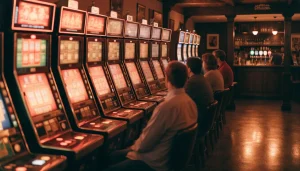
Explore free-play limits, return settings, Australian rules for real-money play, access options and what searches can verify.

Trying a pokie without staking money can help you become familiar with its presentation and the way you interact with it. If you are looking for a free way to explore Big Red, treat that activity as an introduction to a game, not as a preview of what will happen when money is involved. A run of free results is a run of results from those particular spins; it is not a forecast.
The key is how the outcome is generated. A Random Number Generator (RNG) determines each spin separately. The result of one spin does not set up, improve or weaken the chance of a particular result on the next. A sequence that looks favourable does not mean a win is due to continue, and a sequence that looks poor does not mean a win is due to arrive. The appearance of a pattern does not change the independence of the events.
That distinction matters because people naturally look for patterns in short sequences. Several similar results can feel as though they form a trend. A different result after a long run can feel overdue. But those interpretations come from observing the sequence, not from the sequence changing the RNG’s next decision. The next spin is not informed by what you have just seen.
If you’re looking for big red pokies online in Australia in 2026, operator details can help you check the basics before choosing where to play. Use this list as a reference for the licensing and payment information provided.
Lucky Dreams
Lucky Dreams lists a Curacao license and a A$20 minimum deposit via POLi. These details give you a couple of practical points to check before signing up.
DragonSlots Casino
DragonSlots Casino is listed under the Curacao Gaming Authority, with Jumpman Gaming Ltd named as the operator. You can use that licensing information as a starting point for your checks.
Wild Tokyo
Wild Tokyo lists a Curacao license and a A$10 minimum deposit. Its stated payout times are 30–60 minutes for crypto and 1–5 days for fiat.
MrPacho
MrPacho lists a A$30 minimum deposit. Its stated payout times are 30–120 minutes for crypto and 24–72 hours for fiat.
LevelUp Casino
LevelUp Casino lists a Curacao eGaming license, OGL/2023/174/0082, under Dama N.V. Its stated minimum deposit is A$15.
Playfina Casino
Playfina Casino lists a Curacao eGaming license and says Hollycorn N.V. has held it since 2017. The stated minimum deposit is A$20–30, depending on the offer.
Roby Casino
Roby Casino is listed under Curacao eGaming, with Roby Games Ltd named in connection with the license. That is the available operator detail to consider when making your checks.
GoldenCrown
GoldenCrown lists a Curacao Gaming Control Board license, OGL/2023/176/0095, under Hollycorn N.V. You can use those details as a starting point for reviewing the operator.
7Bit Casino
7Bit Casino is listed as operating under a Curacao license, with Dama N.V. named as its operator. No deposit or payout details are provided here.
Kingmaker
Kingmaker lists a A$30 minimum deposit. Its stated payout times are about 90 minutes for crypto and 1–5 days for fiat.
Free play can still be useful for limited, practical reasons. It may let you see the game’s visual layout, identify controls and get used to the pace of interacting with it. You can notice whether the information on screen is easy for you to follow and whether you understand what an action does before taking it. These are observations about your experience of the interface. They do not establish how likely a future result is to be a win.
Keep the scope of what you learn clear. Becoming comfortable with the controls does not give you an advantage over the RNG. Seeing a result occur during free play does not make that result more likely to recur, or less likely to recur, when you continue. Likewise, a long stretch without a particular result cannot be used to calculate that it must appear soon. Each spin remains a separate random event.
This also means that a short session cannot provide a dependable measure of how the game will behave over time. A cluster of wins or losses can occur in a limited run, but it cannot tell you that the same pattern will carry on. Nor can an especially memorable result explain what the next spin will produce. Individual outcomes are observations of what happened, not instructions to the RNG about what should happen next.
 Pokies by Region: Australian Casino and Pokies GuideExplore casino and pokies topics grouped by Australian cities and regions, with related searches for online casinos, live dealers, keno and payouts.
 Best pokies in Geelong: how to check venuesLearn how to verify a Geelong venue’s current hours, location and facility details, and why search labels or 24-hour claims need checking.
If you are exploring free Big Red play, separate two questions. The first is whether you can understand and operate the game as presented. Free play may help you answer that by letting you interact with the interface. The second is what a later spin will produce. Past results cannot answer that question, because the next outcome is determined independently rather than being predicted by the preceding run.
Be especially cautious about turning a session into a personal system. Stopping after a win, continuing after a loss, or waiting for a particular symbol does not make the RNG respond differently. Those choices may change how long you keep interacting with the game, but they do not make earlier results predictive. A session log can record what occurred; it cannot reveal a reliable sequence for future spins.
The useful takeaway is modest: free play can support familiarisation, while its results remain random outcomes rather than evidence about what comes next. If you enjoy exploring a pokie without a stake, assess what you can actually observe—the controls and presentation—and leave predictions out of it. Neither a promising run nor a frustrating one changes the independent nature of the next spin.
A pokie’s advertised return to player (RTP) is not necessarily a single setting shared by every casino carrying that game. A specialist review reports that some providers give casinos a choice of RTP configurations for a particular pokie. Where that option exists, two casinos can offer the same game with different return percentages.
The distinction is between the game itself and the configuration selected for it. Its title, artwork and general play may appear the same, while the casino’s version uses a different available return setting. That does not mean every pokie has configurable RTP, or that every casino chooses a different setting. The variation applies only where the provider makes multiple settings available and the casino selects among them.
For someone comparing big red pokies games, the name alone cannot establish which RTP configuration a casino uses. Nor does seeing the same title at two casinos show that their settings match. A return figure is useful only if it is tied to the specific version offered at that casino. If the figure is not stated for that version, you cannot determine its setting from the game’s appearance or title.
RTP describes a theoretical return across a very large number of plays; it is not a forecast of what you will receive during a particular session. A higher stated setting does not promise a win, and a lower one does not determine the result of an individual play. Treat RTP as a property of the configured game over the long run, not as a prediction for your next outcome.
When a casino publishes an RTP, check that the information refers to the exact game version it offers. If it gives no version-specific figure, avoid assuming that a percentage mentioned elsewhere applies to its copy. The same title can have different settings where the provider supports that choice, so a general figure for a game may not settle the question for every casino.
This is why comparing titles alone can leave out an important detail. The return setting belongs to the casino’s particular configuration when the provider offers alternatives. It is separate from the game’s name and presentation, and should not be inferred from either.
The key legal distinction is between the person placing a bet and the company providing the service. Under the Interactive Gambling Act 2001, a company must not offer real-money online pokies to people in Australia unless it holds the relevant Australian licence. No domestic licences for online casinos have been issued, so there is no Australian-licensed online casino where you can play pokies for real money.
That rule concerns the operator’s conduct; it does not make an individual player liable simply for playing on an offshore site that accepts Australian customers. Australians may legally play with such a site, but that permission should not be confused with local regulation or legal protection. The service is still being offered from outside the Australian licensing system, and the operator is not made Australian-licensed by accepting a player from Australia.
Legal Warning
No domestic licences for online casinos have been issued, meaning there is no Australian-licensed online casino where you can play pokies for real money.
This distinction matters if you are considering real-money play after looking for Big Red pokies online in Australia. A site’s willingness to accept a registration or deposit does not establish that it is authorised under Australian law, nor does it give you the protections you would expect from a locally regulated service. There is no domestic online casino regulator overseeing an Australian-licensed casino, because no such casino exists.
The Interactive Gambling Act sets the relevant restriction on companies providing online casino-style games to people located in Australia. Pokies offered for real money fall within that category. The legal issue is not whether a website uses Australian wording, displays prices in Australian dollars, or can be opened from an Australian connection. It is whether an operator is providing a prohibited service to people in Australia without the required domestic authority.
The absence of Australian-licensed online casinos is therefore not a minor detail about a particular website. It means there is no local online casino licence that a real-money pokies site can show as proof of Australian authorisation. An offshore company may hold a licence from another jurisdiction, but that does not turn it into an Australian-licensed operator or remove the Australian prohibition on offering the service to local residents.
 Pokies in Perth: Hours, Access and What to CheckLearn why venue hours may not confirm gaming-area access, what to verify before travelling, and how to assess Perth pokies and online…
 Pokies Open Near Me in Australia: Casino HoursLearn how “open now” listings differ from access to gaming floors and individual services, and what to check for early, late, and…
For players, the practical consequence is that the operator’s position and the player’s position are not identical. The Act targets companies that provide the service. An Australian player is not committing an offence merely by playing on an offshore casino that accepts them. But being outside the law’s target does not give the player a local enforcement route against the offshore business. If a dispute arises, the fact that the site accepted Australian customers does not create Australian licensing oversight.
Some offshore gambling websites may be reachable, while others may be blocked. The Australian Communications and Media Authority (ACMA) enforces the Interactive Gambling Act and can block access to illegal offshore gambling sites. Internet service providers must follow ACMA’s blocklist. As a result, being able to reach a site at a particular time is not evidence that the site is permitted to serve Australian customers or that it will remain accessible.
A block also does not serve as a customer-protection process. It restricts access to a listed site; it does not resolve a player’s account dispute, verify a casino’s claims, or compel an offshore operator to pay a balance. Conversely, a site that is not currently blocked has not thereby received Australian approval. Accessibility and authorisation are separate questions.
This is why the phrase “Big Red pokies real money” can lead to a more complicated decision than simply finding a game page. The relevant legal question is not just whether a game appears on a screen. It is whether an offshore operator is offering real-money online pokies to Australian residents, and what protections exist if something goes wrong. Under the Australian framework, there is no domestic online casino licence behind such a service.
Australian Law
The Interactive Gambling Act 2001 prohibits companies from offering real-money online pokies to people in Australia without the relevant Australian licence.
If an offshore casino refuses to pay winnings, an Australian player cannot rely on Australian legal remedies to compel payment through the local system. The operator is outside the domestic online-casino licensing framework, and no Australian casino regulator supervises it as a licensed local provider. A player may be left dealing with the operator’s own complaint process or whatever processes exist in the operator’s jurisdiction; those possibilities do not amount to a right of recourse in Australia.
That is a material difference from the operator’s obligation under Australian law. The law restricts companies from supplying the service without a domestic licence, but it does not create a local guarantee that an offshore site will honour a claim. Nor does the fact that a site accepts Australian customers establish that an Australian authority can recover disputed funds on the player’s behalf.
Do not treat access, a successful account opening, or a displayed game as evidence of a local safety net. Those are observations about the website’s operation, not proof of Australian oversight. The same applies if a site describes itself as licensed overseas: a foreign licence is not an Australian online-casino licence, and it does not provide Australian legal recourse if the operator withholds winnings.
BetStop is Australia’s national self-exclusion register, but its reach is limited to Australian-licensed operators. Since offshore online casinos are not bound by that domestic licensing system, registering with BetStop does not prevent an offshore site from accepting you or require it to block your account. Treat the distinction seriously: BetStop is not a universal block across every gambling website that can be reached from Australia.
If you use BetStop, do not assume that it will control access to offshore pokies. Its effect depends on the operator being within the Australian licensing system, and offshore casinos sit outside that system. This limitation does not make BetStop ineffective where it applies; it means you should not rely on it as a restriction on services that it does not govern.
The legal age for gambling in Australia, including online pokies, is 18. That age rule does not change the licensing position: an adult player may not be individually liable merely for playing offshore, while the company providing real-money online pokies to Australians remains subject to the operator prohibition. Age eligibility, operator authorisation, site accessibility, and the availability of legal recourse are separate questions.
When you assess a real-money offer connected with Big Red pokies, keep those questions separate rather than treating a single sign—such as a site being open, accepting an account, or naming an overseas licence—as a complete answer. The Australian framework has no locally licensed online casino, allows ACMA to block illegal offshore services, and does not give Australian players a local remedy if an offshore casino refuses to pay. That is the practical boundary between what the law says about operators and what protection an individual player can expect.
No Local Recourse
If an offshore casino refuses to pay winnings, you cannot rely on Australian legal remedies or a local regulator to compel payment.
A pokie spin is an individual random event determined by a Random Number Generator (RNG). The RNG determines the outcome; the result of an earlier spin does not determine the result of the next one. That independence is the key to understanding what happens when you play: a sequence may look patterned, but its previous outcomes do not give you a way to predict the next.
It is tempting to read a run of results as a signal. Several wins in succession can seem to suggest that another is more likely, while a long run without a win can feel as though a result is overdue. Neither conclusion follows from independent spins. The RNG does not need to balance the sequence by producing a particular outcome next. Each new spin is determined separately, rather than being adjusted to compensate for what came before.
This also means that a player’s choice of timing cannot be inferred to change the outcome. Waiting after a loss, spinning immediately after a win or varying the rhythm of play does not make earlier results predictive. A different routine may change how long you spend playing, but it does not alter the stated relationship between spins: each is a separate random event determined by the RNG.
The distinction between a sequence and a prediction matters. Looking back, you can describe what happened: a particular sequence contained wins, losses or other outcomes. Looking forward, that history does not reveal what the next spin will produce. Even a sequence that appears unusually consistent is still a record of past events, not information that determines the next one.
When you play a Big Red pokie, the same principle applies at the level of the spin. The name or theme does not make the result of one spin depend on the previous result. It is easy to assign meaning to familiar features on a screen or to remember a striking run, but those observations do not change the independence of the events. The useful question is not whether the last spin seems to hint at what comes next; it is whether you are treating separate outcomes as though they were linked.
A practical way to keep the mechanism clear is to separate what you control from what you do not. You can decide whether to start another spin or stop playing. You cannot use the previous result to know what the RNG will determine for a new spin. Choosing to continue after a loss does not make a win more likely because of that loss, and stopping after a win does not preserve a favourable pattern for later.
This is why a spin should be understood as one event, not as a step in a sequence that must reach a particular result. The outcome can be observed once it occurs, but it cannot be worked out from the outcomes that came before it. Treating the next spin as unknown is more accurate than reading streaks as clues.
Looking for a way to try Big Red pokies without staking money is different from looking to play for cash. Free play can let you explore an experience presented as a game, but the label alone does not tell you how that version is configured or how closely it corresponds to any real-money version. Treat it as a way to become familiar with what is on screen, not as evidence about what would happen in another setting.
The distinction matters because a demo is not a forecast. A sequence of wins, losses or other results in free play cannot show you what your next real-money spin will produce. Each spin is determined by a Random Number Generator (RNG), and one result does not influence the next. A run of favourable results does not make an unfavourable result due, and a run of unfavourable results does not make a win more likely.
A free-play version may give you a chance to see how the game is presented and to become familiar with its visible elements. You can observe what appears on the screen and how the experience responds as you use it. Those observations are about the version in front of you. They do not establish the chance of a particular outcome, the expected result of future spins or the behaviour of a real-money version.
This is a useful boundary to keep in mind when trying a Big Red demo pokie. The word “demo” describes an intended mode of use, but it does not, by itself, specify the details of that mode. It does not tell you whether the demo uses the same settings as a real-money game, whether the two versions are otherwise identical, or whether a particular run of results can be reproduced. Without reliable information about those details, it is better not to assume them.
Free play can still serve a limited purpose. It can help you decide whether you understand the visible sequence of actions and whether you want to spend more time examining the game. It cannot test a theory about when a win will occur. Nor can a long session turn random outcomes into a dependable guide to future ones. More observations give you more examples of what happened in that session; they do not make those examples predictive.
People naturally look for patterns in a run of results. A few similar outcomes may feel like a trend, while a change after a quiet spell may feel significant. But the RNG-based mechanism provides no basis for treating one spin as a message about another. The result already produced is part of the past; it does not set the result of the next spin.
The RNG-based mechanism ensures that the result already produced is part of the past and does not set the result of the next spin. Whether outcomes alternate, cluster, or repeat, a pattern noticed after the fact cannot be used to anticipate what comes next.
That remains true whether the outcomes seem to alternate, cluster or repeat. A pattern noticed after the fact does not establish a rule that can be used to anticipate what comes next. The same applies to a stretch of free play that seems unusually successful or unsuccessful. It describes that stretch only. It does not demonstrate that the game has entered a state that will continue.
This point is easy to lose when free play involves no cash stake. A player may repeat spins to see whether a perceived pattern continues, then begin to treat the apparent pattern as a strategy. But repetition does not change the independence of the spins. If you use a demo to explore, separate what you can directly observe from what you might be tempted to infer. “This happened in the session” is an observation. “Therefore it is likely to happen next” is a prediction that the observed sequence does not support.
A free version and a real-money version should not be assumed to share every setting or operating detail simply because they appear similar. A familiar screen or repeated sequence of actions does not prove that the underlying conditions are the same. In particular, results from free play do not establish the return configuration or outcome probabilities of a separate version.
That limit cuts both ways. A disappointing free session does not prove that a real-money session would be disappointing, and a favourable free session does not provide evidence that real-money play would be favourable. Neither comparison is valid as a prediction when the versions’ relationship has not been established and each spin is independently determined.
So, if your aim is simply to try the experience without staking money, keep the purpose narrow: observe the presentation and learn what you can from what is visible. If your aim is to judge the likelihood of winning with money, a demo sequence cannot answer that question. It supplies no dependable signal about future outcomes.
The practical distinction is between familiarisation and forecasting. Free play may help with the first; it does not provide a sound basis for the second. Treat each result as an outcome that has already occurred, rather than as a clue about what the next spin must do.
A phone can display a game through a browser, through an app, or not at all; those are separate ways of delivering software. The name of a pokie does not tell you which applies. A search for a mobile version of Big Red therefore cannot, by itself, establish that the game opens in a phone browser, that an app exists, or that either option is supported.
The distinction matters because “mobile access” is not a single technical feature. A browser-based game would need to load and operate in the browser on your device. An app-based version would require a compatible app and its own installation process. A game might also be unavailable on a particular device. You cannot infer any of these conditions merely from seeing a title or an image of a game on a screen.
If you encounter a page that presents the game as playable on a phone, treat that statement as a claim to check, not proof of compatibility. Look for clear information about the device and access method, and confirm that it refers to the specific game rather than to a general mobile service. A page that says a site is mobile-friendly does not necessarily show that every game on it works in a phone browser.
The same caution applies to buttons or prompts labelled “play.” A label alone does not show whether selecting it opens a browser game, requests an app, or leads somewhere else. Avoid entering personal or payment information just to test an uncertain link. In particular, do not treat a mobile layout, an app listing, or a working page as evidence that a service is authorised or suitable for Australian players.
This leaves a simple way to assess the mobile-access question: separate the claims. Is the specific game identified? Is the access method stated? Does the information apply to your device? If any point is unclear, you do not have enough to conclude that the game can be played on your phone. A desktop page resizing to fit a small screen is not, on its own, confirmation that the game functions there.
The practical answer is therefore conditional. Phone access depends on the particular game and the way it is delivered; the title alone cannot settle it. Keep browser compatibility, app availability and permission to use a service as distinct questions.
A request for a red kangaroo-themed pokie can mean either a game with that subject or a particular title someone remembers. Those are different things: an animal in a picture, a phrase in a description and a game’s official name are not interchangeable. Treating them as the same can lead you to mistake a general reference for an identifiable title.
“Big Red” may look like part of a name, while “kangaroo” may describe the theme being sought. But wording alone does not establish that a specific pokie exists under that name, who made it or what appears on its screen. A confident-sounding label is not evidence of a title or provider. Avoid attaching details such as symbols, bonus features or game rules to the phrase unless they are shown for the particular game being described.
If you encounter a game presented as a match, read its displayed title and provider information as separate details. The title tells you what the game is called; the provider identifies the company associated with it. A page that uses kangaroo imagery or mentions a red kangaroo does not, by that fact alone, establish that “Big Red Kangaroo” is the official title. Likewise, a title that sounds similar does not prove the game has the theme you want.
Keep the description narrow. This distinction prevents a loose match from becoming a false claim about a particular pokie.
For anyone looking specifically for a big red kangaroo pokie, the useful standard is therefore exact identification, not resemblance. A named game, its provider and its theme are separate claims; each needs to be supported by the information presented about that game. Until those details are clear, the phrase is best understood as a description of what you are looking for, not as proof of a particular title.
Yes, free play can let you get familiar with Big Red’s controls and presentation. Its results do not predict what will happen on later spins.
Yes, Australian players can legally play on offshore sites that accept them, but it is illegal for companies to offer real-money online pokies to Australians without a domestic licence, and none have been issued. If an offshore casino refuses to pay, you have no legal recourse in Australia.
You must be 18 or older to gamble online in Australia.