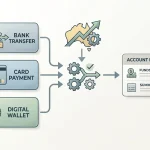
See how deposits move through phone wallets, cards, bank options and payment portals, including the checks, fees and cashout limits that can apply.

A phone-based payment and a bank-card payment can look similar at checkout: you select an option, confirm an amount and approve a transaction. The difference is the entry point. With a phone wallet, the phone presents a payment credential and may ask you to authenticate locally. With a card, the card details or a saved card credential are submitted for authorisation. Neither route changes what the underlying transaction is; it changes how the payment instruction is presented and approved.
A phone wallet can keep the full card number out of the checkout flow. Instead, the wallet can provide a substitute credential associated with the card, then use a device-level confirmation such as a passcode or biometric check. That means approving a wallet payment is not the same as typing the card number into a form. The wallet handles the interaction with the device, while the card account remains the source of funds.
A direct card payment starts with the card details, or with a stored credential linked to them. The payment request is sent for authorisation against the card account. The card issuer and other institutions involved can approve or decline it. Correct details do not guarantee approval: the transaction can also be affected by the issuer’s controls, merchant classification, payment routing or restrictions applied to the destination.
Choosing a casino payment method means weighing the deposit minimum against how quickly withdrawals are processed. This list highlights the payment-related details available for Australian players so you can focus on what matters to you.
Lucky Dreams
Lucky Dreams lists a A$20 minimum deposit when you use POLi. Its listed licence is Curacao.
DragonSlots Casino
DragonSlots Casino is listed with a licence from the Curacao Gaming Authority, under Jumpman Gaming Ltd. That licensing detail is the available point of reference for you when considering this casino.
Wild Tokyo
Wild Tokyo lists a A$10 minimum deposit, with crypto payouts taking 30–60 minutes and fiat payouts 1–5 days. Its listed licence is Curacao.
MrPacho
MrPacho lists a A$30 minimum deposit. Its stated payout times are 30–120 minutes for crypto and 24–72 hours for fiat.
LevelUp Casino
LevelUp Casino lists a A$15 minimum deposit and a Curacao eGaming OGL/2023/174/0082 licence held by Dama N.V.
Playfina Casino
Playfina Casino lists a minimum deposit of A$20–30, depending on the offer. Its listed Curacao eGaming licence is held by Hollycorn N.V., since 2017.
Roby Casino
Roby Casino is listed with a Curacao eGaming licence held by Roby Games Ltd. This licensing information is the available detail for you to consider.
GoldenCrown
GoldenCrown is listed with a Curacao Gaming Control Board OGL/2023/176/0095 licence held by Hollycorn N.V.
7Bit Casino
7Bit Casino is listed as operating under a Curacao licence, with Dama N.V. as its operator.
Kingmaker
Kingmaker lists a A$30 minimum deposit. Its stated payout times are around 90 minutes for crypto and 1–5 days for fiat.
This distinction matters when comparing online payment options. A phone wallet is an authentication layer, not necessarily a separate bank account or an independent way around card restrictions. If a wallet uses a card underneath, a refusal connected to that card or its issuer may still prevent the payment. Conversely, a successful device authentication only confirms that you approved the wallet request; it does not mean the transaction has been authorised or completed.
Card acceptance is not uniform across merchants or destinations. A specialist review reports that Australian financial institutions block many standard Visa and Mastercard transactions directed to offshore casinos. This is a time-sensitive observation, not a guarantee that every card payment will be blocked or that a particular card will work. The result can depend on the financial institution and the route used for the transaction. A card logo displayed at checkout therefore does not establish that the payment can be processed from Australia.
There is also a legal limit that changes how this topic should be understood. Under the Interactive Gambling Act 2001, operators cannot legally provide real-money online casino games, including pokies, to people physically located in Australia. Payment explanations are not an endorsement or a suggestion to use an offshore casino. A payment button or card option appearing on a site does not make the underlying service lawful.
For a clear comparison, separate three questions: how you authenticate, which account or credential funds the transaction, and whether the institutions involved will authorise it. A phone wallet mainly changes the first question and may alter how payment credentials are exposed. A bank card identifies the funding instrument more directly. Neither interface guarantees acceptance, and a phone does not turn a declined card into a different payment method.
A payment has two directions. A deposit moves value from a payment account or service into an account balance; a withdrawal moves value out of that balance to a destination you control. The two legs are related, but they are not necessarily mirror images. A casino payment method shown for adding funds does not, by itself, establish that the same route can return funds to you.
For a deposit, the payment instruction begins with the method you select and the details you enter or approve. The payment provider or bank then handles the request, and the receiving service records the result against your account. If the transfer is accepted, the account balance can be updated. If it is declined, interrupted or not matched to your account, the displayed balance may not change even though you have started the process. The precise handling depends on the payment route and the operator’s procedures.
Attention: A payment method available for adding funds does not guarantee that the same route can be used to return funds to you.
A withdrawal begins from the balance held by the operator, not directly from the original payment account. The operator must submit a payout instruction to an eligible destination. That means the destination needs to be supported for withdrawals, and the details must identify an account or service that can receive the funds. A route that accepts money in one direction may not provide a corresponding way to send it back.
A specialist review reports that casino payment methods can differ between deposits and withdrawals. Treat that as a point to verify for the particular service, rather than as a fixed rule across the market. The payment screen, terms or operator support should make clear which methods apply to each direction. Before any deposit, confirm the withdrawal route as well; otherwise, you may discover only later that the method used to fund the account is not available for cashout.
There can also be an operator-controlled step between requesting a withdrawal and the money being sent. For example, a specialist review describes bank-transfer withdrawals that are processed manually on set days rather than continuously. In that account, a request made on Friday could arrive by Wednesday. This is a reported process, not a timetable that should be assumed for every operator or bank. It illustrates why the time shown for a payment method may not include the time an operator takes to review and release a request.
The amount being returned can affect which route is practical. A specialist review describes bank transfer as slow but suitable for withdrawals above $10,000. That does not make it the right route in every case: eligibility, any applicable conditions and the operator’s own payout process still matter. The useful distinction is between a method’s ability to receive a transfer and the service’s decision to offer that method for a particular withdrawal.
For casino payment risk management, think of the deposit and withdrawal as separate transactions connected by an account balance. Check where each one starts, where it is meant to end, and which party handles each stage. Keep a record of the method and destination selected, and do not assume that a successful deposit proves that a later payout will follow the same path.
In Australia, the legal context is material: the Interactive Gambling Act 2001 prohibits operators from providing real-money online casino games to people physically located in the country. This explanation describes payment mechanics; it is not an invitation to use a service that cannot lawfully provide those games in Australia.
PayID is an identifier linked to an Australian bank account through the New Payments Platform (NPP). Instead of relying on account details alone, a payment can be addressed using a mobile number, email address or Australian Business Number (ABN) that has been registered with a participating bank. The identifier points to the linked account; it is not a separate bank account or a payment balance held by PayID. Every major Australian bank supports PayID, although that does not mean every business accepts payments through it.
PayID is an identifier (such as a mobile number, email, or ABN) linked to an Australian bank account via the New Payments Platform (NPP).
For any online service, PayID’s presence in the Australian banking system is only one part of the route. The business receiving a payment must also offer a PayID option and arrange for payments to be accepted through its own payment setup. In a casino context, availability therefore depends on the operator, not just on whether your bank supports PayID. A specialist review reports that most offshore operators now use PayID as their main way to accept Australian-dollar deposits. Treat that as a time-sensitive report about operators, not a guarantee that a particular site offers it or that the option will remain available.
There is an important legal distinction behind that availability. Under the Interactive Gambling Act 2001, providing real-money online casino games, including pokies, poker and table games, to people physically in Australia is illegal for operators. Payment support does not make such a service lawful or establish that it is authorised in Australia. A payment method describes how money may be routed; it does not determine whether the underlying gambling service can legally be provided.
The link between PayID and an account also explains why the identifier needs to be treated carefully. A mobile number, email address or ABN is useful as a payment address only when it has been connected to the intended bank account. The identifier itself does not tell you whether a receiving business is lawful, nor does its appearance on a payment screen provide that assurance. PayID support by a bank should not be confused with endorsement of a casino or its services.
BPAY is another bank-payment option, but its timing differs from a route described as immediate. A specialist review gives a BPAY payment timeframe of one to two business days. That timing matters when considering when funds may be available to the receiving service: a payment initiated through BPAY should not be assumed to arrive in time for real-time activity. The review describes BPAY as a possible fallback when PayID is unavailable, rather than a real-time payment route. These are reported details, not a promise about every receiving service or transaction.
The distinction is between a bank’s ability to support a payment network and an individual operator’s decision to offer a particular route. PayID can be widely supported by banks while remaining absent from a specific payment page; BPAY can be available while taking longer to complete. Neither fact establishes that an online casino is legally permitted to serve people in Australia.
A payment gateway is the technical layer that carries a payment request from a checkout to the systems that assess and handle it. It is not the same thing as the bank or payment service holding the account. Its role is to pass the relevant transaction details through the route configured for that checkout and return a response, such as acceptance or rejection. A gateway can therefore affect whether a payment request is handled, but it does not by itself establish that a particular payment method is available or that a transaction will be approved.
The checks around a request can involve more than the payment details entered at checkout. The operator may need to confirm that the account holder’s identity matches the account and that the payment method is being used by its owner. A specialist review describes operators requesting government-issued identification, an address document dated within the preceding three months, and evidence connecting the customer to the payment method. The exact documents and when they are requested depend on the operator’s process.
These checks serve different purposes. Identification can help confirm who is using the account. An address document can support the recorded contact details. Payment evidence can help establish that the source of funds belongs to the account holder. If the submitted information does not match, or a document is unclear, the review may require further evidence before the payment request can proceed. Entering payment details successfully is therefore not the same as completing every check associated with an account.
The gateway’s response should also be read narrowly. An approved request means that the transaction passed the checks applied at that stage; it does not necessarily resolve any separate account or identity review. A rejected request likewise does not identify a single cause by itself. The issue could be with the supplied details, the route used, or a decision made elsewhere in the payment chain. The operator or payment service has to clarify the reason.
Payment labels at checkout can be misleading if treated as proof of a working route. Seeing Apple Pay, Google Pay or Klarna named in a general description of casino payment technology does not establish that an Australian customer can use it for a particular service. Availability depends on the actual checkout and the relevant rules, not just on what a gateway is technically capable of routing.
There is also an important Australian context: the Interactive Gambling Act 2001 prohibits operators from providing real-money online casino games to people physically in Australia. A description of gateway mechanics is not an endorsement or a route for accessing such services. If you are reviewing a payment request in another lawful context, rely on the specific provider’s explanation of its checks rather than assuming that gateway approval alone verifies everything.
A prepaid voucher separates spending from a bank account or card: you pay for a voucher in advance, then enter its details where that payment option is accepted. The amount available for a transaction is bounded by the value loaded onto it. Once that balance has been used, the voucher cannot fund further spending unless it is topped up or replaced, if the issuer and service allow that.
That cap can make the spending boundary easier to see. A payment cannot draw more than the voucher’s remaining stored value, so the voucher does not provide an open-ended source of funds. It does not, however, set a limit on activity elsewhere or determine what a service will accept. Acceptance, transaction rules and any account conditions are separate matters controlled by the service and the voucher provider.
The important constraint appears when money needs to come back out. A voucher used to pay is generally not a destination for a withdrawal: the service may not be able to credit funds back to the voucher. That means a voucher can serve as an incoming payment route without also serving as an outgoing one. If a service permits withdrawals, you may need to nominate a different method that it supports for cashouts.
Prepaid vouchers often serve as an incoming payment route but may not be a valid destination for withdrawals.
Treat those two functions separately before relying on a voucher. Confirm whether it is accepted for payment, and whether the service requires a different withdrawal route. Do not assume that a payment method shown at checkout will also appear as a cashout option. If no suitable withdrawal method is available, the voucher’s spending cap does not solve that problem; it only limits the value that can be spent through the voucher.
Keep track of the voucher balance as well. If the amount due exceeds the remaining stored value, the payment may not complete unless the service allows another way to cover the difference. Whether split payments are possible is specific to the service, so do not assume that they are. A voucher with too little value is not equivalent to a general-purpose account balance that can be drawn from another source.
For any payment service, check the terms that apply to both payment and withdrawal before committing funds. In Australia, real-money online casino services are prohibited for operators under the Interactive Gambling Act 2001. This explanation describes how prepaid vouchers work as a payment mechanism; it is not a recommendation to use one for online gambling.
The practical distinction is simple: the voucher’s loaded value defines the maximum available to spend through it, while the cashout route is a separate arrangement. A voucher balance should not be treated as withdrawable money, and using a voucher does not guarantee that a service will accept it or provide a compatible route for returning funds.
A payment option displayed in a casino payment portal does not, by itself, tell you how money can leave an account. Deposit and withdrawal functions are separate settings. An operator may list a method for adding funds without offering it for cashouts, and a method available for withdrawals may not appear as a deposit option. A specialist review reports that casino payment methods can differ by direction; treat that as a reason to verify the operator’s current rules, not as a universal arrangement.
Before taking any payment action, inspect the portal’s deposit and withdrawal information separately. For each method, establish whether it is shown for deposits, withdrawals, or both. If the portal is unclear, ask the operator directly and keep the reply. A method’s name appearing in a general list, promotional message or account page is not confirmation that it can be used for the transaction you intend.
PayID is a useful example of why the two checks matter. A specialist review reports that its deposit availability depends on the operator and that withdrawal support needs separate confirmation. Do not infer cashout support from a PayID deposit option, or infer that a deposit is accepted because withdrawal instructions mention PayID. Confirm each direction on the operator’s own payment information before relying on it.
Read the conditions attached to the route as well as its label. Check whether the operator requires you to use the same method for both directions, whether a separate withdrawal route is specified, and whether the account must meet verification requirements before a request can be made. Do not assume that a rule stated for one method applies to another. If the available wording does not answer a question, ask for a clear response rather than treating silence as approval.
This check is not a recommendation to use an offshore casino. Under Australia’s Interactive Gambling Act 2001, operators may not provide real-money online casino services to people physically located in Australia. A payment portal’s availability, or an operator’s statement about its payment options, does not change that legal position. Do not treat a foreign authorisation or a working payment button as evidence that the service is lawful to provide in Australia.
For a practical record, note the exact method and direction described, then retain the relevant terms or operator response. Recheck them if the portal’s options change; availability is an operator-specific setting, not a guarantee attached to a payment brand. This prevents a common error: assuming that being able to send funds establishes a usable way to receive them. If a withdrawal route is not explicitly confirmed, do not count it as available.
A payment route can have more than one cost: a fee charged by the payment service, a fee set by the casino, and a currency-conversion charge if the account and transaction use different currencies. Compare the amount that would leave your account with the amount credited, then check what the withdrawal route would cost. A low-cost deposit does not establish that cashing out through the same route is free.
A specialist review reports that some casinos apply a transaction fee of 1–3% to Skrill withdrawals to a bank account. It gives a transfer time of 1–2 days for that route. Treat both details as specific to the arrangement described, not as a fixed Skrill tariff or a promise about every operator. Before using it, check whether the fee is deducted from the withdrawal, added separately, or charged by the service rather than the casino.
For Neteller, a specialist review quotes a 1.45% charge when the wallet is funded by credit card. That figure concerns the cost of funding the wallet, not the cost of sending a casino withdrawal to a bank. It also does not make card funding an acceptable way to pay for online gambling in Australia; do not use a credit card for that purpose. Check the terms for any other funding route separately, because this stated charge does not describe them.
The currency used for the casino balance can create another deduction. A specialist review puts conversion from Australian dollars to euros at 2–4%. If your payment enters in Australian dollars but the balance is held in euros, the conversion can reduce the credited value; converting back when withdrawing may create a further cost. Confirm the account currency and the conversion terms before moving money, rather than judging the route by its headline fee alone.
Some casinos apply a 1–3% transaction fee for withdrawals to a bank account, taking 1–2 days.
Funding the wallet via credit card may incur a 1.45% charge.
Converting Australian dollars to euros can result in a 2–4% deduction.
Timing also affects how long funds remain unavailable, though it is separate from the fee. One specialist review describes MuchBetter withdrawals as faster than traditional bank-transfer cashouts and says the latter can take as long as five days. This is a reported comparison, not a guaranteed processing schedule: the operator’s handling and the bank’s processing are distinct parts of the route.
When comparing casino payment providers, write down the fee, currency, and stated timing for each direction. Check the operator’s own terms for the specific payment route and confirm that the withdrawal method is available before depositing. If a fee is described only as a percentage, calculate it against the amount you intend to move; if the balance currency differs from yours, account for conversion as well. These checks reveal the likely cost of moving money without assuming that one provider’s terms apply across casinos.
“Instant” can describe one stage of a payment, not the entire movement of money. A payment system may approve an instruction quickly, while later processing takes longer. The label alone does not tell you when funds are finally settled or available to withdraw.
A specialist review describes Visa and Mastercard deposits as instant. Read that as a claim about the deposit step, not a promise that every transaction will be approved or that money can be returned just as quickly. An authorisation is a decision to accept a payment instruction; it does not establish the timing of later settlement or a withdrawal. The review’s description also does not make card deposits an appropriate option: Australian law prohibits operators from providing real-money online casino services to people in Australia.
BPAY illustrates the difference between a quick instruction and a completed payment. A specialist review gives a BPAY processing time of one to two business days. That is a stated timeframe for the payment process, not an instant result. Business-day timing also differs from a clock-time promise: the phrase does not mean the same number of elapsed hours in every case.
When comparing an instant payment casino claim with a slower route, identify which event the claim measures. Is it approval, the operator receiving funds, settlement, or a completed withdrawal? If the wording does not specify, it cannot tell you how long the whole process takes. The same distinction applies to casino payment integration: connecting a payment option to an account does not by itself establish the time taken at every processing stage.
Names such as Interac, Neteller or MiFinity do not answer that timing question on their own. A method’s label is not a processing guarantee, and a deposit-time claim cannot be carried over to cashouts. Keep authorisation, settlement and withdrawal as separate stages when interpreting “instant”; otherwise, a fast first step can be mistaken for a fast end-to-end payment.
A digital wallet on your phone can act as the payment interface for a deposit: instead of entering payment details directly on a site, you approve the payment through the wallet. A specialist review describes Apple Pay deposits as using the phone’s digital wallet with biometric authentication. In that flow, the biometric check confirms your authorisation on the device; it does not, by itself, establish that a payment has been accepted by the recipient.
Legal Prohibition
Under the Interactive Gambling Act 2001, it is illegal for operators to provide real-money online casino games to people physically located in Australia.
That distinction matters. Wallet authentication is one step in a transaction, not a guarantee that funds will move or that an account will be credited. Whether a payment option appears, and whether a transaction proceeds, depends on the parties and systems involved. Do not treat a wallet button as proof that a service is lawful or that the payment route is available for a particular purpose.
An account-based payment app works differently in concept: it links activity to an account held with the payment provider, while a phone wallet provides an interface for authorising a payment. The labels can overlap in everyday use, but they do not make different payment routes interchangeable. A payment option’s name alone does not tell you how it is funded, whether it is accepted for a particular transaction, or what rules govern its use.
PayPal is a separate case in Australia. It has expressly prohibited gambling transactions in the country since 2021, so it should not be treated as an available route for gambling payments. This is a provider restriction, not a signal that another app-based method is permitted.
The legal setting is broader than payment-provider rules. Under the Interactive Gambling Act 2001, operators are prohibited from providing real-money online casino games, including pokies, to people physically in Australia. A payment method does not change that status. A wallet’s authentication step, or an app’s account structure, cannot make a prohibited service lawful.
For any financial transaction, distinguish the device action from the payment decision: biometric approval records your instruction, while acceptance and processing depend on the relevant payment arrangements. Avoid sharing security credentials or approving a transaction you did not initiate.
PayID uses a linked identifier to direct a payment to an Australian bank account. That identifier can be a mobile number, an email address or an ABN. The New Payments Platform connects it to the account, so the identifier acts as a reference for routing a bank payment; it is not itself a separate account or a mobile-billing charge.
This distinction matters when you see a phone number offered as a payment detail. Entering a PayID-linked number does not mean the money is billed to your phone plan. The number points to a bank account registered to receive payments through the platform. An email address or ABN can serve the same role if it has been linked to an account.
A phone can therefore be the device used to make a payment while the bank account remains the source of funds. The payment mechanism depends on the linked identifier and the bank account behind it, not simply on whether you are using a mobile site or app. This is different from a digital wallet, where the phone can authenticate a card payment; PayID identifies the destination bank account.
For any service displaying PayID details, the identifier should match the payment instructions provided for that transaction. A familiar-looking phone number is not enough to establish that it is the intended recipient: the relevant detail is the account linked to it. Do not assume that an identifier available for one payment direction can also be used for another.
These mechanics do not establish that a particular gambling service accepts PayID. Availability is determined by the service, and payment options should not be treated as evidence that the service is lawful. Under Australia’s Interactive Gambling Act 2001, it is illegal for operators to provide real-money online casino games, including pokies, to people in Australia. This explanation describes how PayID links identifiers to bank accounts; it is not a recommendation to use it for online gambling.
Yes. Some casinos charge a 1–3% fee for Skrill withdrawals, and Neteller charges 1.45% for credit-card funding.
Yes. Casino bank transfers may carry a flat $5–$15 fee, and currency conversion from AUD to EUR can cost 2–4%. Check the fees for both deposits and withdrawals before using a method.
A card option at checkout does not guarantee the payment will be authorised; Australian financial institutions block many standard Visa and Mastercard transactions to offshore casinos. Also, real-money online casino games cannot legally be provided to people physically in Australia.
No. PayPal has banned gambling transactions in Australia since 2021, and real-money online casino games cannot legally be provided to people physically in Australia.
Visa and Mastercard deposits are instant, while BPAY payments take one to two business days. The time depends on the payment method you choose.
MuchBetter withdrawals are faster than traditional bank-transfer cashouts, which may take up to five days. Check that MuchBetter is supported for withdrawals, not just deposits.